We expect that the Hong Kong dollar peg will hold. The Hong Kong Monetary Authority (HKMA) has large reserves to intervene, and the peg is a cornerstone of Hong Kong’s success as a global financial center.
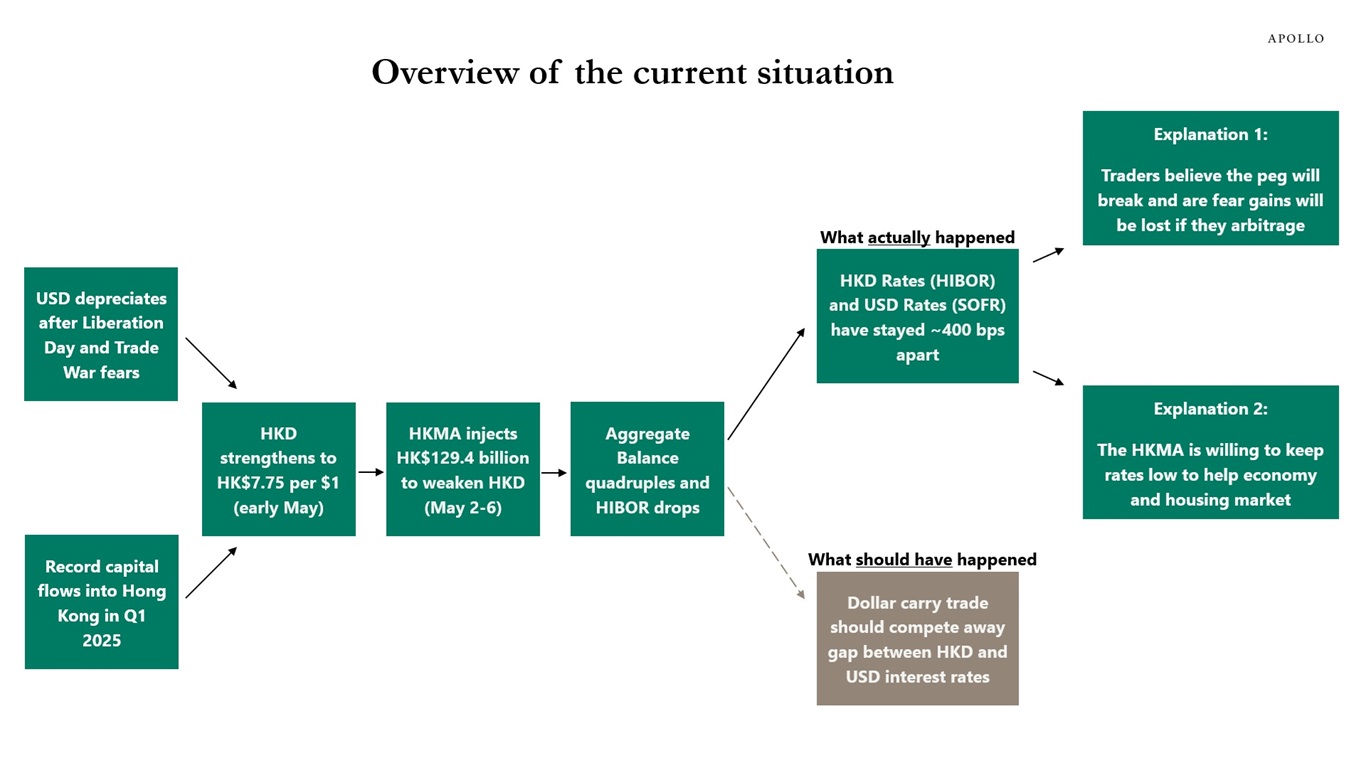
But there are pressures on the Hong Kong dollar peg. After Liberation Day, the US dollar depreciated significantly. As a result, capital started flowing into Hong Kong, and the Hong Kong dollar appreciated so much that it reached the strong limit of the trading band relative to the US dollar.
In response, a few weeks after Liberation Day, the HKMA lowered Hong Kong interest rates to zero. As a result, there is now a significant gap between interest rates in the US and in Hong Kong, which is putting pressure on the peg because investors can now borrow in Hong Kong dollars and invest in US dollars, earning a significant return as long as the peg holds.
This has increased discussion among macro investors about the Fleming-Mundell policy trilemma, which says that a country cannot simultaneously have 1) a fixed exchange rate, 2) free capital movement and 3) an independent monetary policy.
The bottom line is that we expect the Hong Kong dollar peg to hold. But investors should be aware of the mounting pressures, as abandoning the peg would have significant implications for global markets.
We put together a chart book to understand this topic better, and it is available here.
Note: All references to Hong Kong refer to the Hong Kong SAR, China. Source: Apollo Chief Economist
This presentation may not be distributed, transmitted or otherwise communicated to others in whole or in part without the express consent of Apollo Global Management, Inc. (together with its subsidiaries, “Apollo”).
Apollo makes no representation or warranty, expressed or implied, with respect to the accuracy, reasonableness, or completeness of any of the statements made during this presentation, including, but not limited to, statements obtained from third parties. Opinions, estimates and projections constitute the current judgment of the speaker as of the date indicated. They do not necessarily reflect the views and opinions of Apollo and are subject to change at any time without notice. Apollo does not have any responsibility to update this presentation to account for such changes. There can be no assurance that any trends discussed during this presentation will continue.
Statements made throughout this presentation are not intended to provide, and should not be relied upon for, accounting, legal or tax advice and do not constitute an investment recommendation or investment advice. Investors should make an independent investigation of the information discussed during this presentation, including consulting their tax, legal, accounting or other advisors about such information. Apollo does not act for you and is not responsible for providing you with the protections afforded to its clients. This presentation does not constitute an offer to sell, or the solicitation of an offer to buy, any security, product or service, including interest in any investment product or fund or account managed or advised by Apollo.
Certain statements made throughout this presentation may be “forward-looking” in nature. Due to various risks and uncertainties, actual events or results may differ materially from those reflected or contemplated in such forward-looking information. As such, undue reliance should not be placed on such statements. Forward-looking statements may be identified by the use of terminology including, but not limited to, “may”, “will”, “should”, “expect”, “anticipate”, “target”, “project”, “estimate”, “intend”, “continue” or “believe” or the negatives thereof or other variations thereon or comparable terminology.