Training and running frontier AI models requires capital on a scale rarely seen in the private sector. Hyperscaler capex has already tripled since 2023, and forecasts now point to more than $2.7 trillion of cumulative AI-related spending from 2025 to 2029.
What began as a largely self-funded capex cycle is quickly becoming a financing event. In the final three months of 2025 alone, Oracle, Meta, Google and Amazon issued roughly $90 billion in bonds. As AI investment increasingly turns to debt markets, we expect this shift to meaningfully reorder the top ranks of the investment grade credit universe.
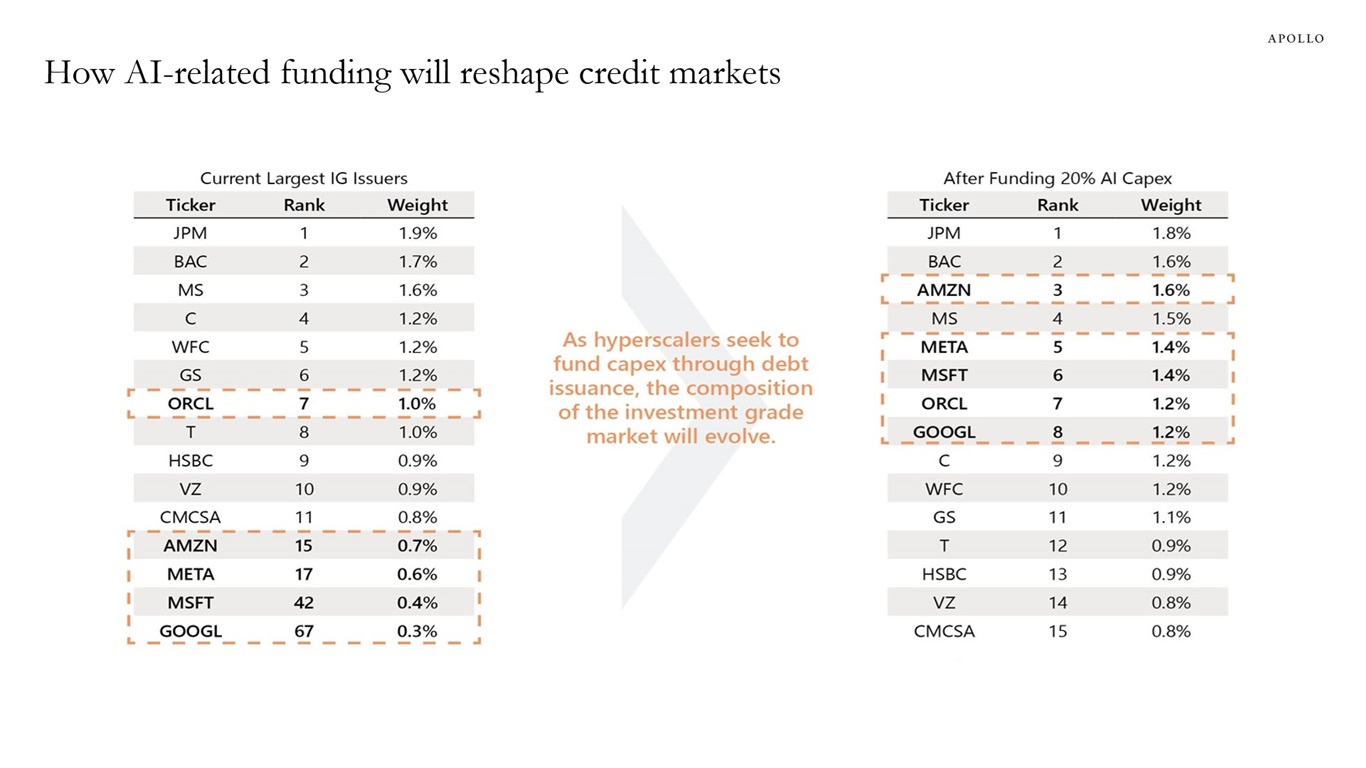
As the chart below illustrates, financing just 20% of AI capex through IG markets would materially reshape index composition — propelling Amazon into the top 3 issuers and pushing Meta, Microsoft, Oracle and Google into the top 10, with Google jumping from 67th to 8th.
This is one of the core themes explored in our 2026 Credit Outlook. In addition, we also highlight several forces reshaping credit markets:
Credit has shifted back into a buyer’s market. Economic growth in the US is expected to support corporate and consumer fundamentals in 2026. But the technical backdrop has flipped. After years of scarcity, credit markets are entering a higher supply regime driven by AI-related hyperscaler issuance and a reacceleration in M&A.
AI issuance is increasing concentration and correlation risk. AI-related exposure is becoming pervasive across portfolios, with apparent diversification across issuers and sectors increasingly masking a single macro bet on AI — raising correlation risk and increasing the value of diversification into areas structurally insulated from the AI arms race, including European private credit and sports financing.
M&A is returning at scale, reinforcing supply dynamics. Lower financing costs, workable valuations, abundant private equity dry powder, and a more supportive policy backdrop are driving a resurgence in deal activity, with large transactions tapping multiple segments of the credit markets simultaneously.
The cycle is defined by dispersion, not distress. Economic growth is narrowing rather than weakening, concentrating among higher-income consumers and large, AI-exposed corporates. This K-shaped environment is driving widening dispersion across credit markets, making selectivity paramount as dispersion — not defaults — creates opportunity.
Note: Assumes hyperscalers issue IG debt to fund 20% of BBG consensus capex 2026-2029, while rest of IG index grows at 5% / year. Data as of December 2025. Sources: Bloomberg, BofA
This presentation may not be distributed, transmitted or otherwise communicated to others in whole or in part without the express consent of Apollo Global Management, Inc. (together with its subsidiaries, “Apollo”).
Apollo makes no representation or warranty, expressed or implied, with respect to the accuracy, reasonableness, or completeness of any of the statements made during this presentation, including, but not limited to, statements obtained from third parties. Opinions, estimates and projections constitute the current judgment of the speaker as of the date indicated. They do not necessarily reflect the views and opinions of Apollo and are subject to change at any time without notice. Apollo does not have any responsibility to update this presentation to account for such changes. There can be no assurance that any trends discussed during this presentation will continue.
Statements made throughout this presentation are not intended to provide, and should not be relied upon for, accounting, legal or tax advice and do not constitute an investment recommendation or investment advice. Investors should make an independent investigation of the information discussed during this presentation, including consulting their tax, legal, accounting or other advisors about such information. Apollo does not act for you and is not responsible for providing you with the protections afforded to its clients. This presentation does not constitute an offer to sell, or the solicitation of an offer to buy, any security, product or service, including interest in any investment product or fund or account managed or advised by Apollo.
Certain statements made throughout this presentation may be “forward-looking” in nature. Due to various risks and uncertainties, actual events or results may differ materially from those reflected or contemplated in such forward-looking information. As such, undue reliance should not be placed on such statements. Forward-looking statements may be identified by the use of terminology including, but not limited to, “may”, “will”, “should”, “expect”, “anticipate”, “target”, “project”, “estimate”, “intend”, “continue” or “believe” or the negatives thereof or other variations thereon or comparable terminology.