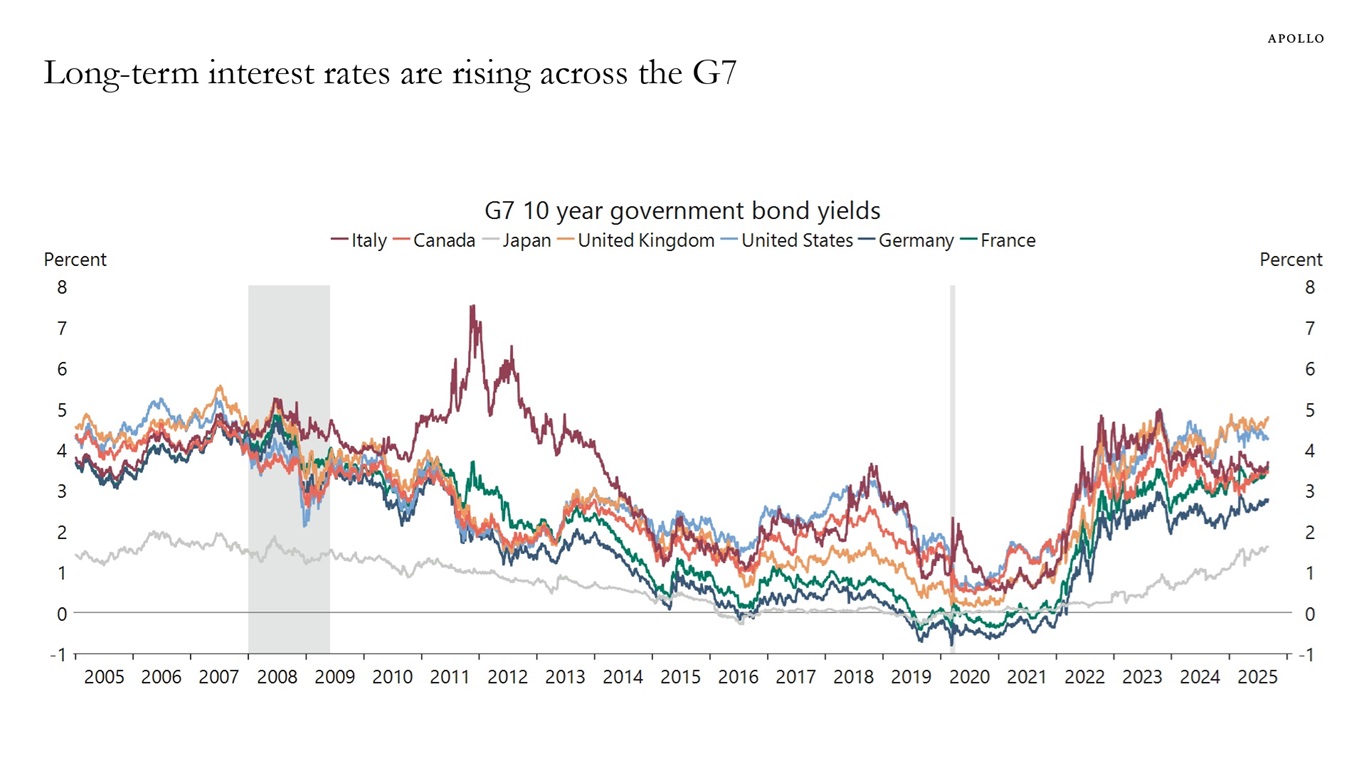
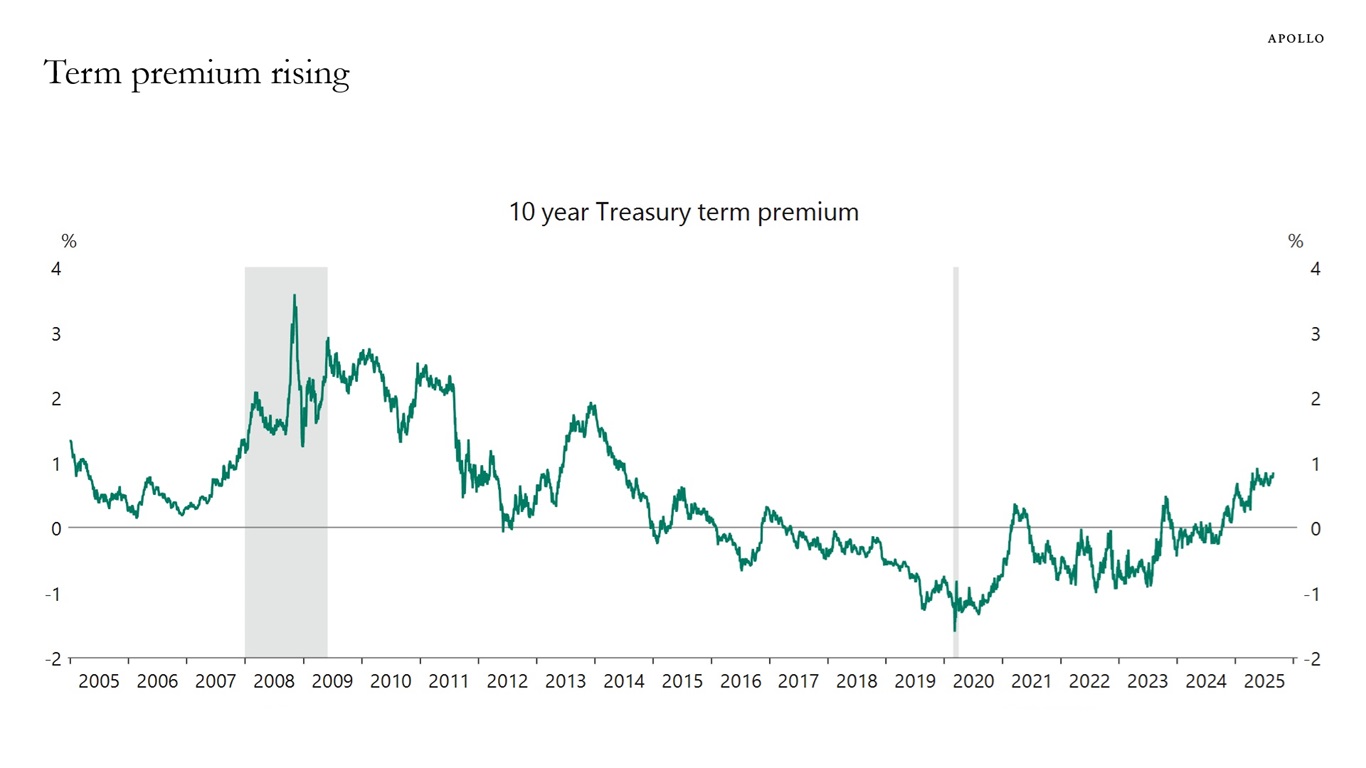
There are fiscal challenges in most countries, and government debt levels, yield levels and the term premium are rising across the G7, see charts below.
This raises questions about debt sustainability and the ability of governments to repay their debt, particularly in Europe and Japan, where growth is structurally weak due to demographics and years of policy choices that have dampened growth.
What are the consequences if the risk-free asset is no longer risk-free?
1) Higher government borrowing costs and, as a result, higher borrowing costs for consumers and firms.
2) Loss of monetary policy effectiveness, as cuts by the central bank don’t lower long-term interest rates.
3) Financial instability, because the risk-free rate is used for valuing assets and pricing risk.
In extreme cases, the central bank may decide to do YCC or QE to lower long-term interest rates. But this comes at the risk of a dramatic depreciation of the currency, as the central bank essentially intervenes to support fiscal policy and, as a result, the central bank loses credibility among investors.
Sources: US Department of Treasury, Macrobond, Apollo Chief EconomistNote: The NY Fed measure for the term premium is based on a five-factor, no-arbitrage model. Sources: Federal Reserve Bank of New York, Macrobond, Apollo Chief Economist
This presentation may not be distributed, transmitted or otherwise communicated to others in whole or in part without the express consent of Apollo Global Management, Inc. (together with its subsidiaries, “Apollo”).
Apollo makes no representation or warranty, expressed or implied, with respect to the accuracy, reasonableness, or completeness of any of the statements made during this presentation, including, but not limited to, statements obtained from third parties. Opinions, estimates and projections constitute the current judgment of the speaker as of the date indicated. They do not necessarily reflect the views and opinions of Apollo and are subject to change at any time without notice. Apollo does not have any responsibility to update this presentation to account for such changes. There can be no assurance that any trends discussed during this presentation will continue.
Statements made throughout this presentation are not intended to provide, and should not be relied upon for, accounting, legal or tax advice and do not constitute an investment recommendation or investment advice. Investors should make an independent investigation of the information discussed during this presentation, including consulting their tax, legal, accounting or other advisors about such information. Apollo does not act for you and is not responsible for providing you with the protections afforded to its clients. This presentation does not constitute an offer to sell, or the solicitation of an offer to buy, any security, product or service, including interest in any investment product or fund or account managed or advised by Apollo.
Certain statements made throughout this presentation may be “forward-looking” in nature. Due to various risks and uncertainties, actual events or results may differ materially from those reflected or contemplated in such forward-looking information. As such, undue reliance should not be placed on such statements. Forward-looking statements may be identified by the use of terminology including, but not limited to, “may”, “will”, “should”, “expect”, “anticipate”, “target”, “project”, “estimate”, “intend”, “continue” or “believe” or the negatives thereof or other variations thereon or comparable terminology.