




The Daily Spark has moved to Apollo.com— read the latest from Torsten Slok here.
Want it delivered daily to your inbox?
-
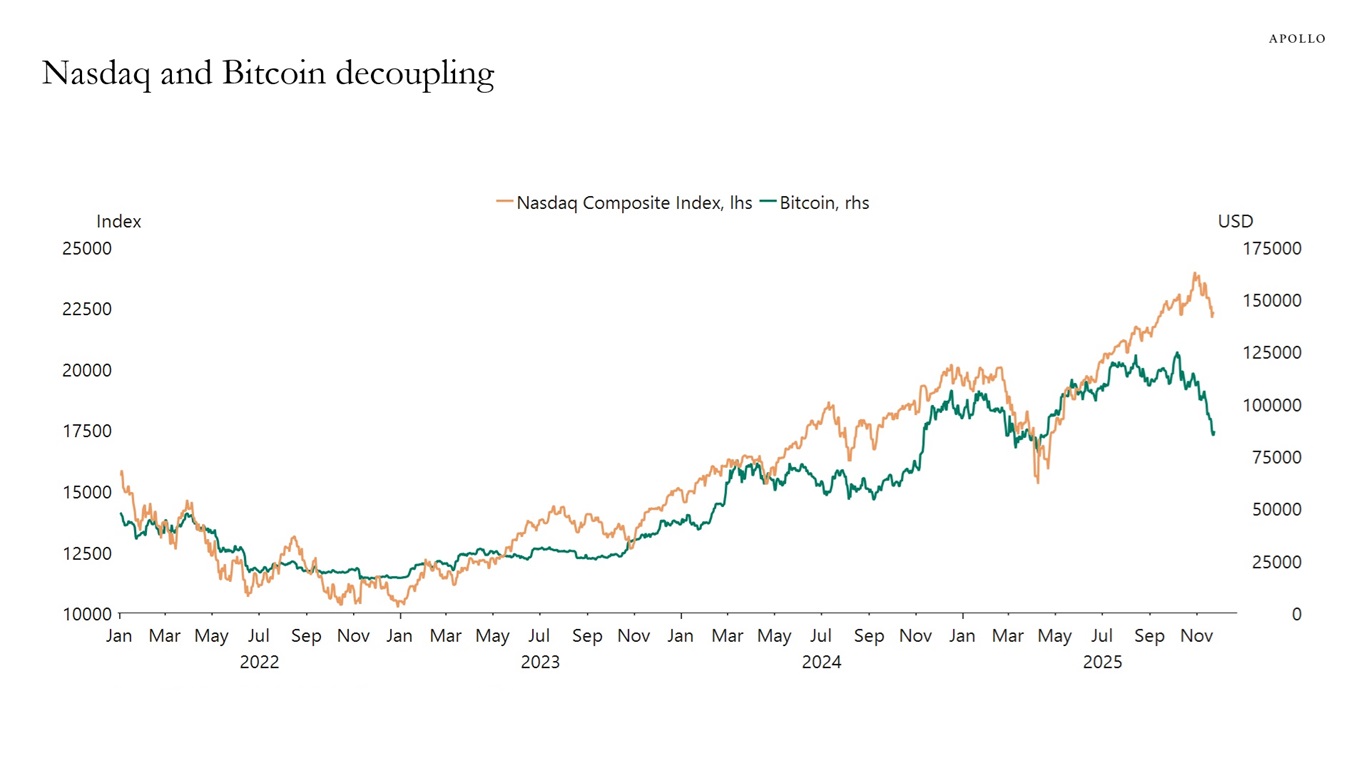
Bitcoin and the Nasdaq Composite are normally highly correlated, but that correlation has broken down in recent weeks with a much sharper drop in the price of Bitcoin, see chart below.

Sources: Nasdaq, Macrobond, Apollo Chief Economist See important disclaimers at the bottom of the page.
-
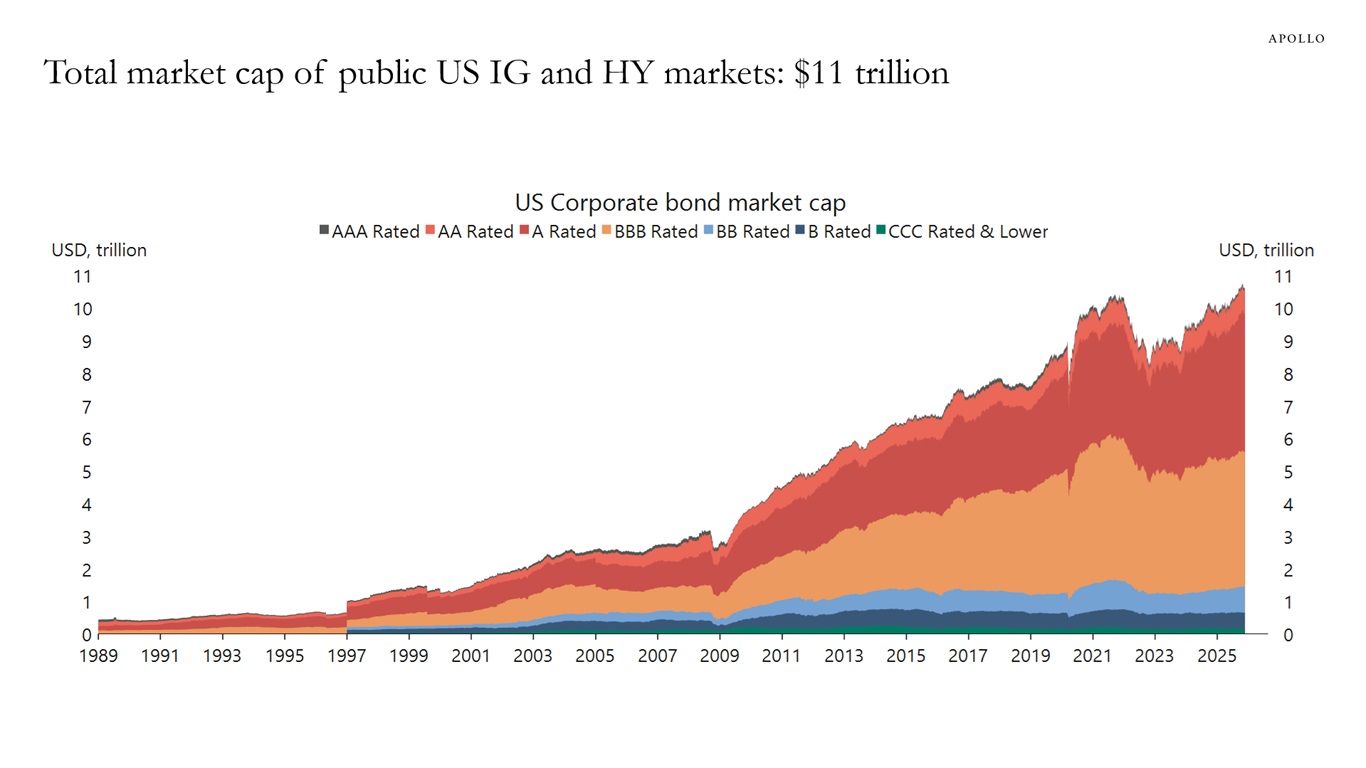
Since 2009, the total amount of public IG and HY bonds outstanding has grown from $3 trillion to $11 trillion, see chart below. Most of the growth has been in BBB and A-rated corporate bonds, and those two ratings combined now account for 79% of all corporate bonds outstanding by market value.
These numbers have to be compared with the roughly $2 trillion outstanding in private credit, up from $1.2 trillion in 2009.
The bottom line is that public credit markets have grown much faster than private credit markets both in percent and in dollars.
Sources: ICE BofAML, Macrobond, Apollo Chief Economist See important disclaimers at the bottom of the page.
-
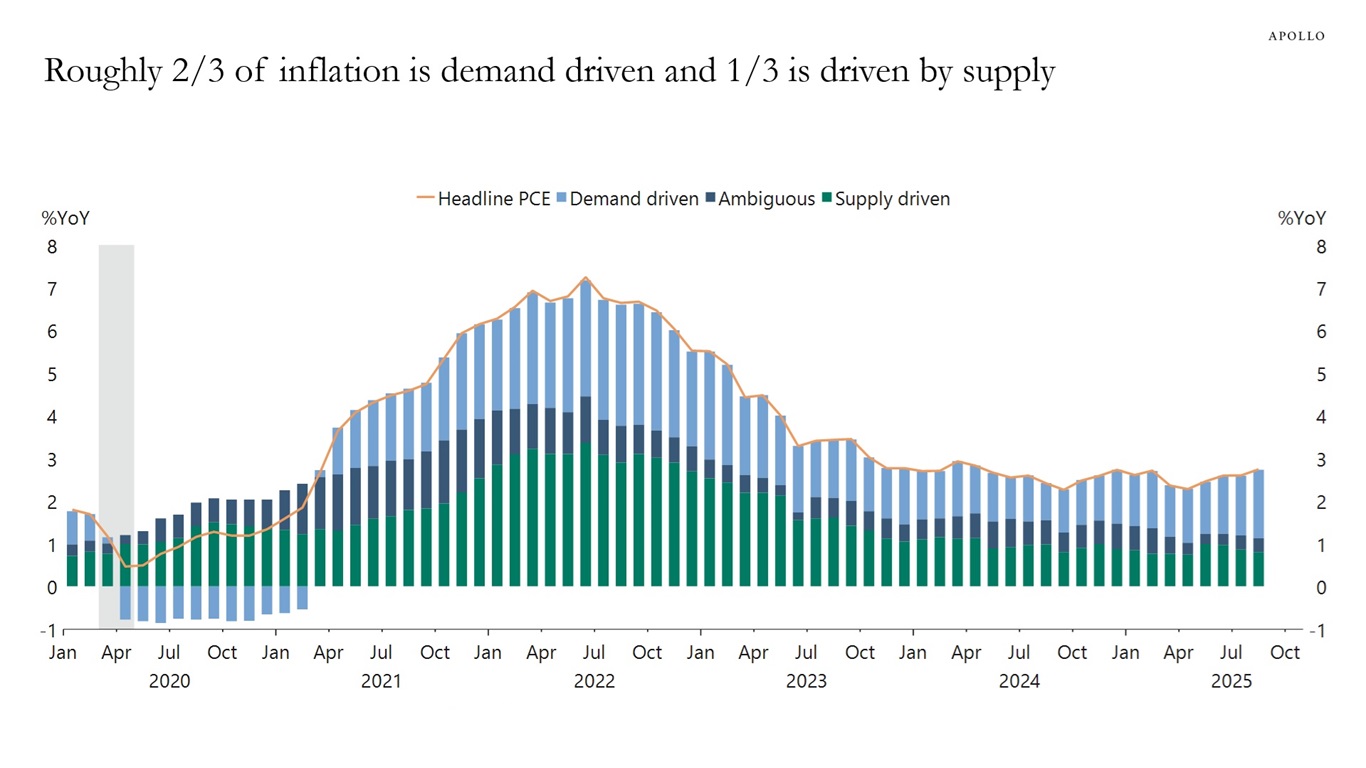
The debate over the Federal Reserve’s policy trajectory hinges on the underlying drivers of inflation. A decomposition by the San Francisco Fed reveals that the current inflationary environment is largely a demand-side story, with strong economic activity accounting for the majority of price growth. This has direct implications for monetary policy: as long as demand-pull inflation keeps the headline rate above the 2% target, a higher-for-longer interest rate stance is required to bring the economy back into balance.
Conversely, if inflation were primarily a function of supply shocks, the case for demand destruction via high rates would be moot, likely creating space for policy easing. Ultimately, the source of inflation is the critical variable determining the need for further Fed action.
Sources: Federal Reserve Bank of San Francisco, US Bureau of Economic Analysis (BEA), Macrobond, Apollo Chief Economist See important disclaimers at the bottom of the page.
-
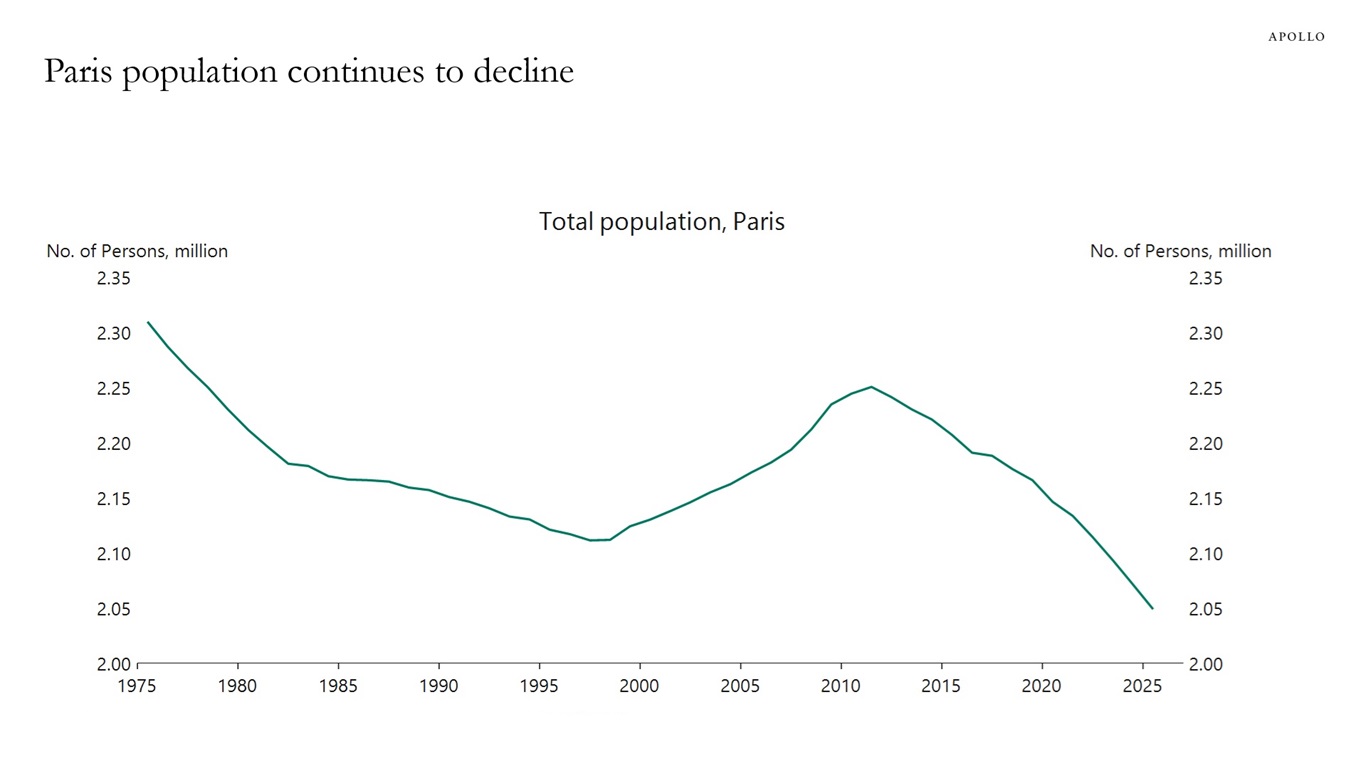
The number of people living in Paris continues to decline. This trend is driven by several factors, including affordability, limited new construction, the proliferation of short-term rentals, the conversion of residential units into office space, and the rise of second homes often owned by international buyers, see chart below.
Sources: French National Institute of Statistics & Economic Studies (INSEE), Macrobond, Apollo Chief Economist See important disclaimers at the bottom of the page.
-
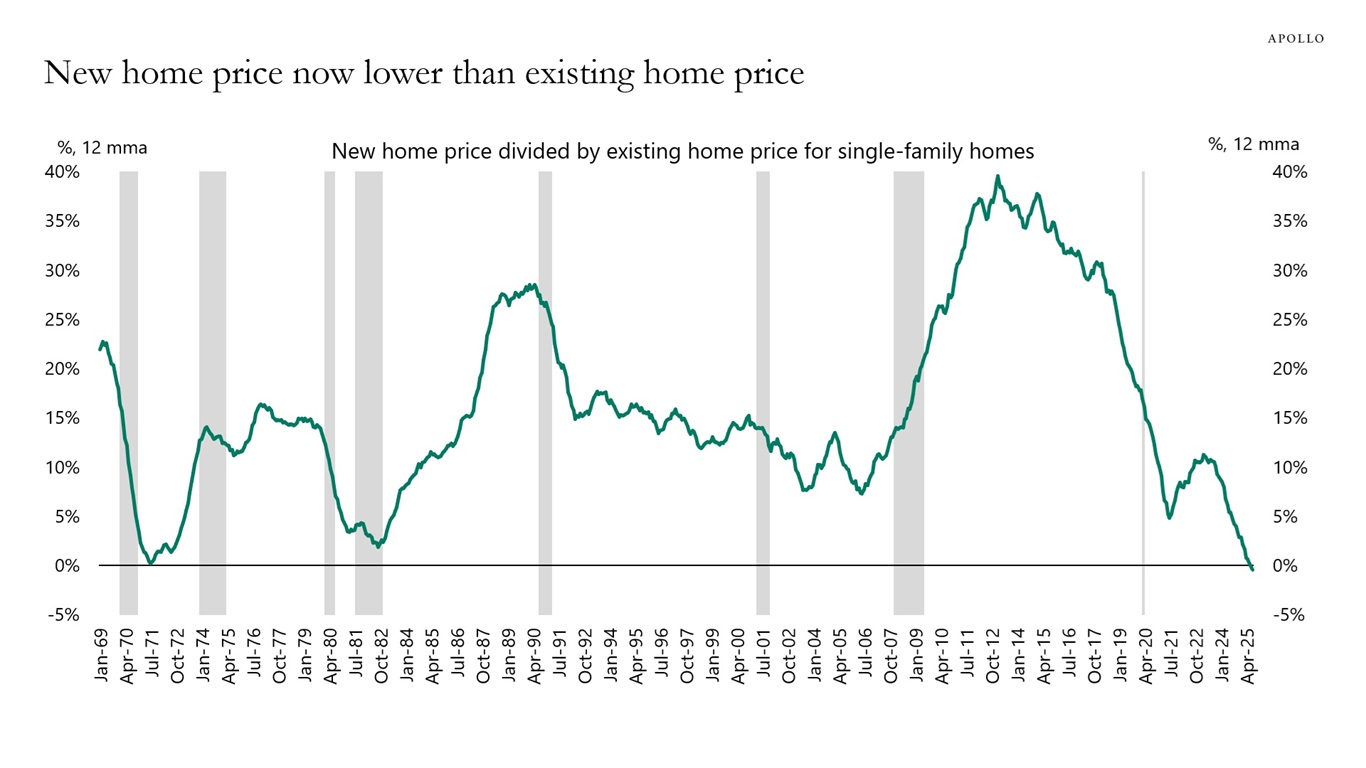
For the first time in more than 50 years, the price of a new single-family home is lower than the average price of an existing single-family home, see chart below.
The downward pressure on new home prices is driven by homebuilders producing smaller homes and providing incentives to homebuyers in a market where affordability is a challenge.
The upward pressure on existing home prices is driven by low inventory as many current homeowners are reluctant to sell because they have locked in low mortgage rates from previous years.
Sources: National Association of Realtors, US Census Bureau, Apollo Chief Economist See important disclaimers at the bottom of the page.
-
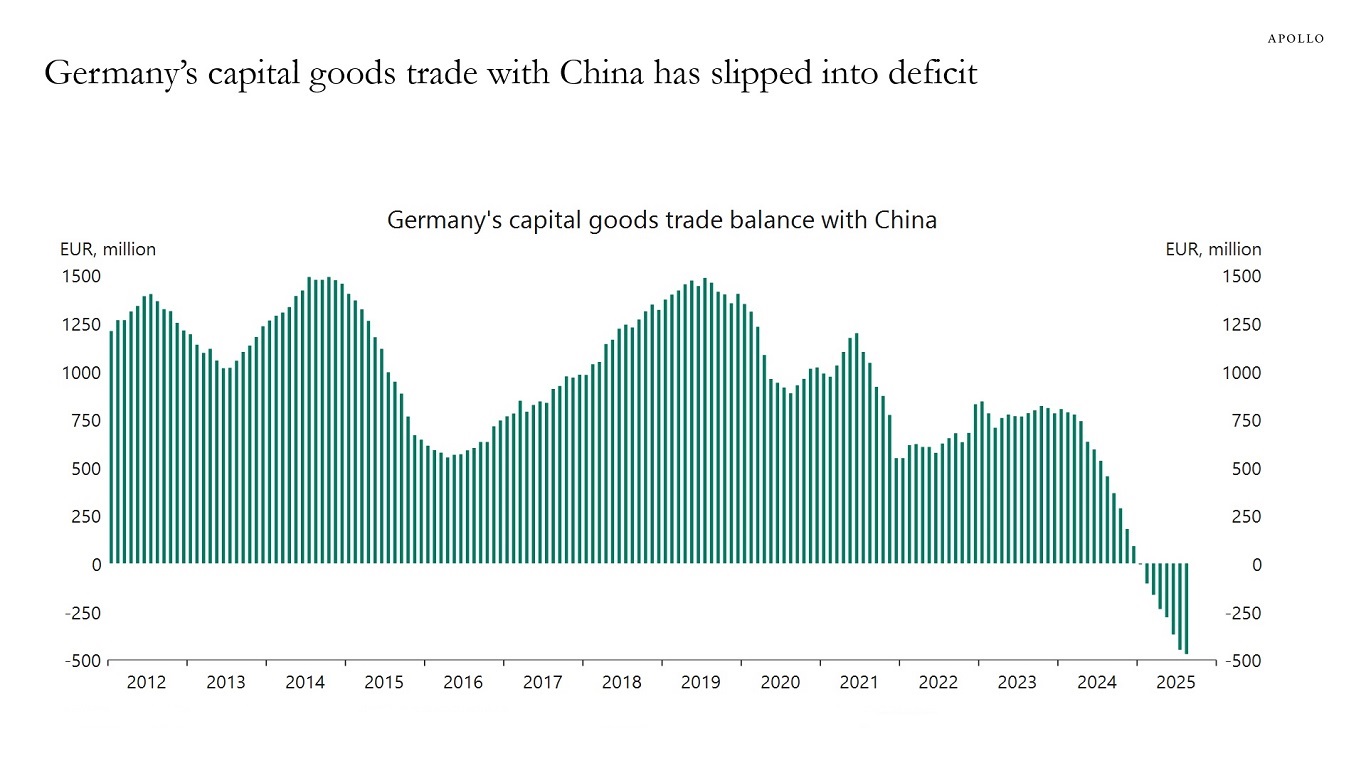
Germany used to dominate the global production of machinery and technology-intensive goods. But that has changed in 2025.
Germany now buys more capital goods from China than China buys from Germany, see chart below.
The competitive pressure on one of Germany’s core sectors is prompting the country to rethink its trade and industrial policies to reduce its dependence on China and bolster innovation at home.
This is not only happening in Germany. It is also taking place in many other countries.
Many countries are focusing on homeshoring advanced manufacturing capacity, investing in infrastructure, energy, defense, and supply chains.
It is not only deglobalization. We are entering a global industrial renaissance.
Note: Series shown as 12-month moving average. Sources: German Federal Statistics Office (Statistisches Bundesamt), Macrobond, Apollo Chief Economist See important disclaimers at the bottom of the page.
-
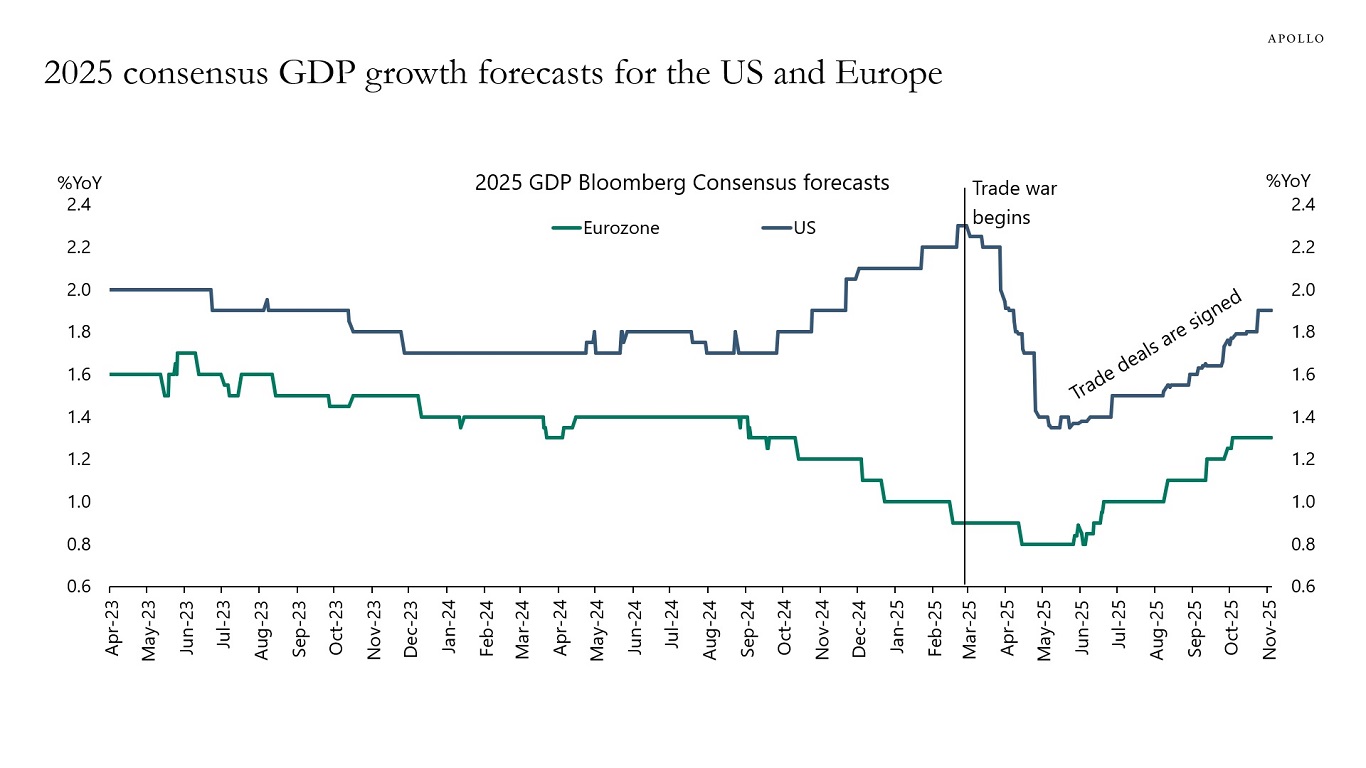
When the trade war started in March, the consensus began to revise down expectations for growth.
But as trade deals were signed with different countries over the summer and into the fall, growth expectations have been revised up, see chart below.
Looking ahead, growth is likely to reaccelerate in 2026, driven by lower trade war uncertainty, a lower dollar, and the positive effects of the One Big Beautiful Bill, which the CBO estimates will boost GDP growth by almost a full percentage point in 2026, mainly because of accelerated depreciation.
Sources: Bloomberg, Apollo Chief Economist See important disclaimers at the bottom of the page.
-
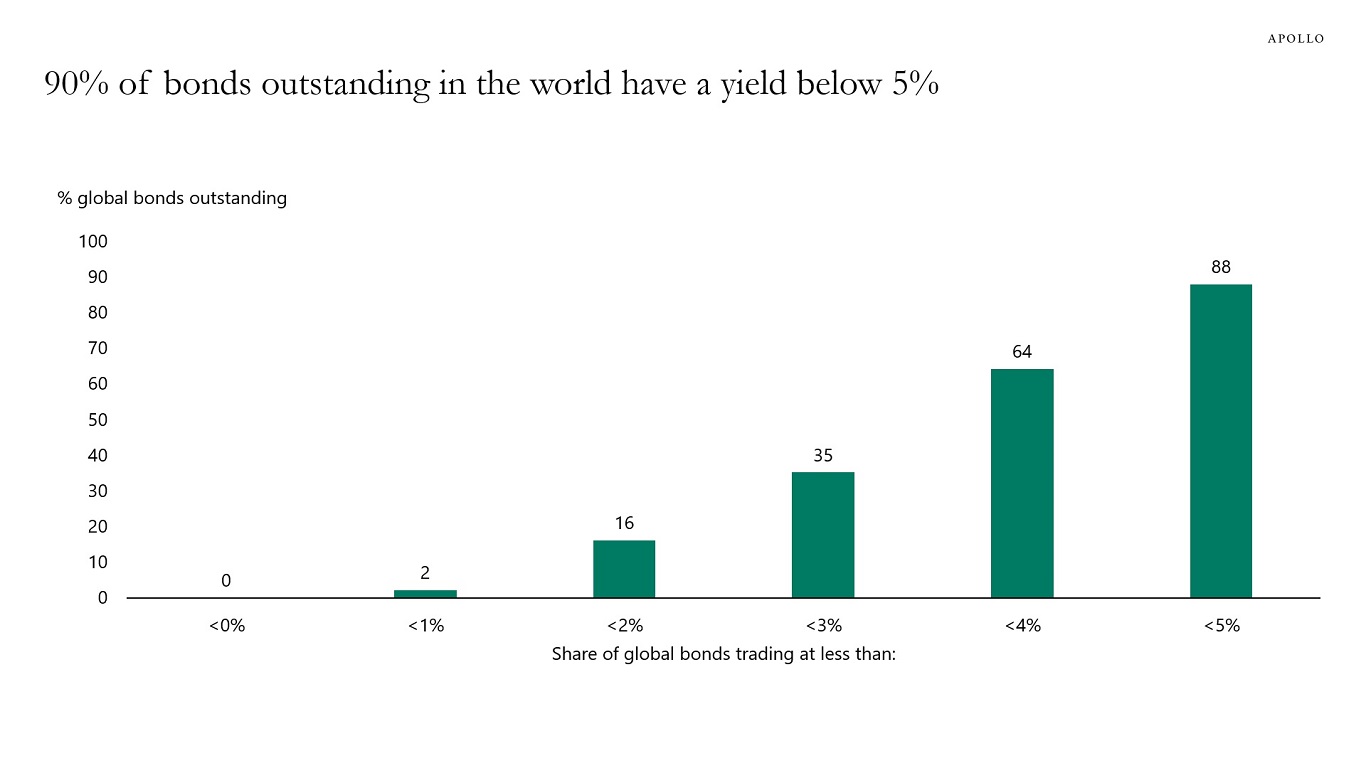
Ninety percent of all public fixed income outstanding in the world trades at a yield below 5%, see chart below.
Sources: Bloomberg, Apollo Chief Economist See important disclaimers at the bottom of the page.
-
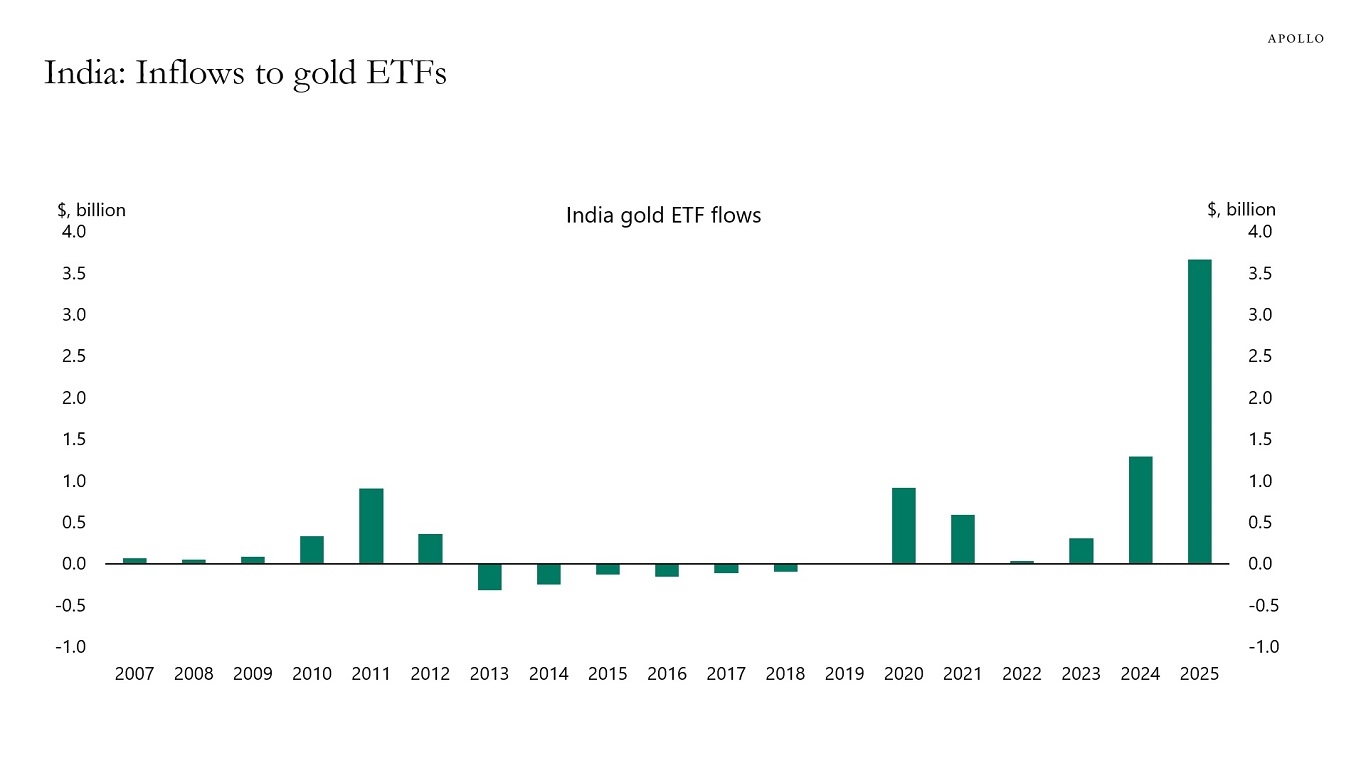
Inflows into gold ETFs in India in 2025 are on track to be triple the inflows seen in 2024, see chart below.
Note: 2025 data is annualized. Sources: World Gold Council, Apollo Chief Economist See important disclaimers at the bottom of the page.
-
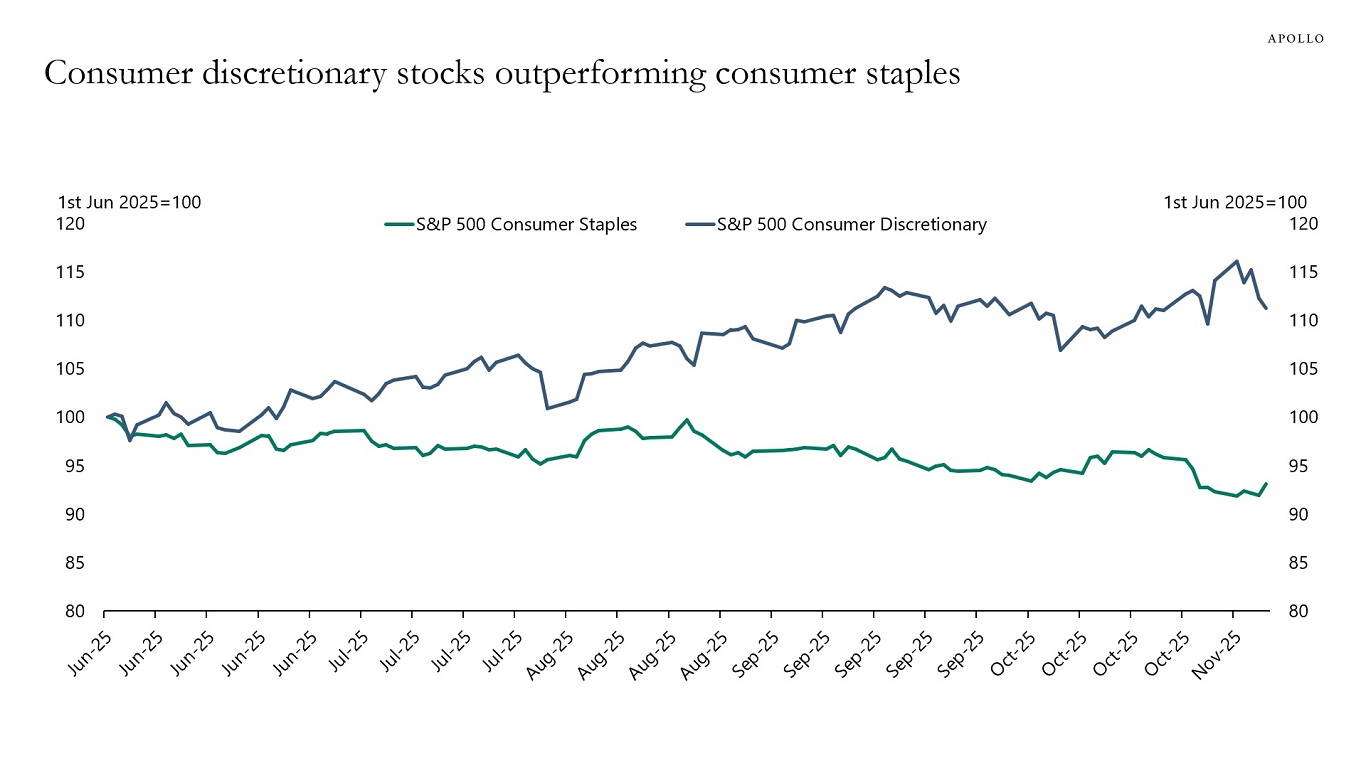
Higher-income households have seen their stock holdings rise and their home prices increase. At the same time, the cash flow received in fixed income, including private credit, is near the highest levels in decades.
This strength of higher-income household balance sheets relative to lower-income balance sheets is the reason why consumer discretionary stocks in recent months have been outperforming consumer staples, see chart below.
Sources: Bloomberg, Apollo Chief Economist See important disclaimers at the bottom of the page.

This presentation may not be distributed, transmitted or otherwise communicated to others in whole or in part without the express consent of Apollo Global Management, Inc. (together with its subsidiaries, “Apollo”).
Apollo makes no representation or warranty, expressed or implied, with respect to the accuracy, reasonableness, or completeness of any of the statements made during this presentation, including, but not limited to, statements obtained from third parties. Opinions, estimates and projections constitute the current judgment of the speaker as of the date indicated. They do not necessarily reflect the views and opinions of Apollo and are subject to change at any time without notice. Apollo does not have any responsibility to update this presentation to account for such changes. There can be no assurance that any trends discussed during this presentation will continue.
Statements made throughout this presentation are not intended to provide, and should not be relied upon for, accounting, legal or tax advice and do not constitute an investment recommendation or investment advice. Investors should make an independent investigation of the information discussed during this presentation, including consulting their tax, legal, accounting or other advisors about such information. Apollo does not act for you and is not responsible for providing you with the protections afforded to its clients. This presentation does not constitute an offer to sell, or the solicitation of an offer to buy, any security, product or service, including interest in any investment product or fund or account managed or advised by Apollo.
Certain statements made throughout this presentation may be “forward-looking” in nature. Due to various risks and uncertainties, actual events or results may differ materially from those reflected or contemplated in such forward-looking information. As such, undue reliance should not be placed on such statements. Forward-looking statements may be identified by the use of terminology including, but not limited to, “may”, “will”, “should”, “expect”, “anticipate”, “target”, “project”, “estimate”, “intend”, “continue” or “believe” or the negatives thereof or other variations thereon or comparable terminology.