The Daily Spark

Want it delivered daily to your inbox?

  • Daily and weekly data for the US economy shows that:

    1) Trade policy uncertainty is returning to more normal levels

    2) Economic policy uncertainty is returning to more normal levels

    3) Restaurant bookings remain solid

    4) US air travel remains robust

    5) Las Vegas visitor volumes and total nights occupied remain solid

    6) Same-store retail sales remain solid

    7) Hotel bookings remain solid

    8) Banks’ loan growth is increasing

    9) Bankruptcy filings are stable

    10) Broadway attendance and visits to the Statue of Liberty remain at normal levels

    Maybe the reason the labor market is softening is because of lower immigration and not because of a slowdown in the broader economy?

    Trade policy uncertainty improving
    Sources: Economic Policy Uncertainty, Macrobond, Apollo Chief Economist
    Economic policy uncertainty improving
    Sources: Economic Policy Uncertainty, Macrobond, Apollo Chief Economist
    Consumer expectations to business conditions
    Sources: Conference Board, Macrobond, Apollo Chief Economist
    Daily data for restaurant bookings
    Sources: OpenTable, Apollo Chief Economist
    Daily data for US air travel
    Sources: US Department of Homeland Security, Macrobond, Apollo Chief Economist
    Las Vegas tourism
    Sources: Bloomberg, Macrobond, Apollo Chief Economist
    Weekly data for same-store retail sales
    Sources: Redbook Research Inc., Macrobond, Apollo Chief Economist
    Weekly data for hotel demand
    Sources: STR, Haver Analytics, Apollo Chief Economist
    Weekly loan growth for banks
    Sources: Federal Reserve, Macrobond, Apollo Chief Economist
    Weekly bankruptcy filings
    Note: Filings are for companies with more than $50 mn in liabilities. For week ending on September 4th, 2025. Sources: Bloomberg, Apollo Chief Economist
    Weekly Broadway show attendance
    Sources: The Broadway League, Macrobond, Apollo Chief Economist
    Visits to the Statue of Liberty
    Sources: irma.nps.gov, Apollo Chief Economist

    Download daily and weekly chart book

    See important disclaimers at the bottom of the page.


  • Daily data for consumer spending shows growth is slowing in discretionaries and on goods that are impacted by tariffs, see tables below.

    Our chart book with daily data for consumer spending is available here.

    Consumer spending momentum: Essentials and Discretionary
    Note: Stable is defined as growth falling between 0.5 to -0.5 standard deviation of the past 90 days, rising momentum is higher than 0.5 standard deviation and falling momentum is -0.5 standard deviation. Past week ends on 29th August 2025. Sources: US Bloomberg Consumer Spending, Apollo Chief Economist
    Note: Stable is defined as growth falling between 0.5 to -0.5 standard deviation of the past 90 days, rising momentum is higher than 0.5 standard deviation and falling momentum is -0.5 standard deviation. Past week ends on 29th August 2025. Sources: US Bloomberg Consumer Spending, Apollo Chief Economist.

    Download high-res chart book

    See important disclaimers at the bottom of the page.


  • No Alpha Left in Public Markets

    Torsten Slok

    Apollo Chief Economist

    There are fewer public companies to invest in, and firms that decide to do an IPO are getting older and older.

    In 1999, the median age of IPOs was five years. In 2022, it was eight years, and today, the median age of IPOs has increased to 14 years, see chart below.

    The rise in the age of companies going public is not only a result of the Fed raising interest rates in 2022, but also the consequence of more companies wanting to stay private for longer to avoid the burdens of being public.

    Combined with the domination of passive investing, failure of active managers and high correlation in public markets, and high concentration in a few stocks, the reality is that there is no alpha left in public markets.

    The median age of IPOs is currently 14 years
    Sources: Jay Ritter, University of Florida, Apollo Chief Economist

    Download high-res chart

    See important disclaimers at the bottom of the page.


  • Extreme Concentration in the S&P 500

    Torsten Slok

    Apollo Chief Economist

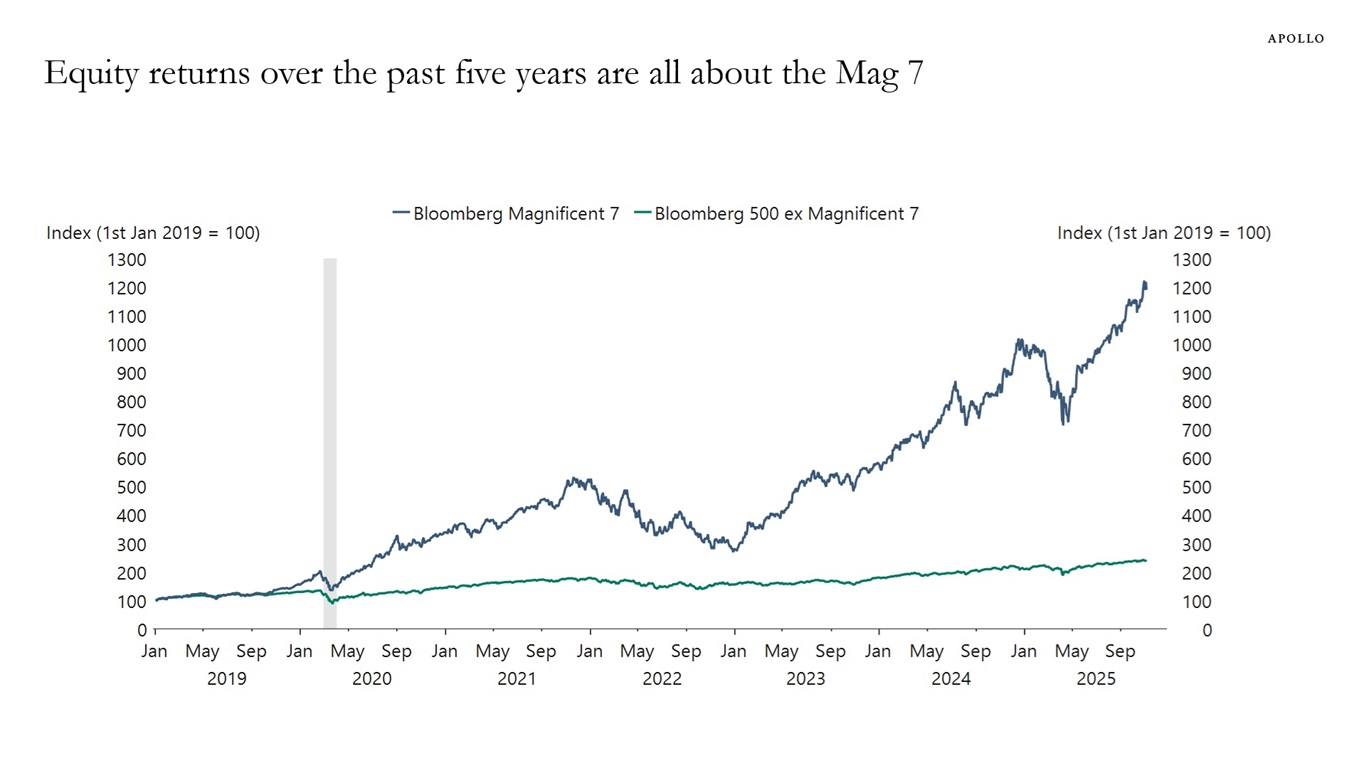
    Our chart book—available here—documents the extreme AI concentration within the S&P 500’s market cap, returns, earnings and capex.

    Another measure of market cap concentration
    Sources: Bloomberg, Apollo Chief Economist
    Performance of tech index relative to S&P 500 higher than tech bubble
    Sources: Bloomberg, Macrobond, Apollo Chief Economist
    Earnings growth concentrated in the Magnificent 7 and slowing down
    Sources: FactSet, Apollo Chief Economist
    The AI bubble today is bigger than the IT bubble in the 1990s
    Note: Data as of July 2025. Top 4 and top 10 companies are by market cap. Sources: Bloomberg, Apollo Chief Economist
    Hyperscalers’ capital expenditure share of US private domestic investment has doubled since 2023
    Sources: Bloomberg, Apollo Chief Economist
    Capital expenditure share of GDP much higher for hyperscalers today vs. telecom companies during dot-com bubble
    Note: Hyperscaler companies include Oracle, Microsoft, Meta, Amazon and Google. Telecom companies include Level 3 Communications, WorldCom, Global Crossing, Nortel Networks, Verizon, AT&T, Nokia, Cisco Systems, Williams Companies and XO Communications. Sources: Bloomberg, FactSet, Apollo Chief Economist

    Download high-res chart book

    See important disclaimers at the bottom of the page.


  • AI Adoption Rate Trending Down for Large Companies

    Torsten Slok

    Apollo Chief Economist

    The US Census Bureau conducts a biweekly survey of 1.2 million firms, and one question is whether a business has used AI tools such as machine learning, natural language processing, virtual agents or voice recognition to help produce goods or services in the past two weeks. Recent data by firm size shows that AI adoption has been declining among companies with more than 250 employees, see chart below.

    The bottom line is that the biweekly Census data is starting to show a slowdown in AI adoption for large companies.

    AI adoption rates starting to decline for larger firms
    Note: Data is six-survey moving average. The survey is conducted biweekly. Sources: US Census Bureau, Macrobond, Apollo Chief Economist

    Download high-res chart

    See important disclaimers at the bottom of the page.


  • Job Growth Negative in Tariff-Impacted Sectors

    Torsten Slok

    Apollo Chief Economist

    Splitting employment growth into tariff-impacted sectors and sectors not directly impacted by tariffs shows that the slowdown in job growth is broad-based, and job growth in tariff-impacted sectors is now negative, see chart below.

    Job growth negative in tariff-impacted sectors
    Note: Sectors impacted by tariffs include manufacturing, mining and logging, construction, wholesales trade, retail trade, transportation and warehousing. Sources: US Bureau of Labor Statistics (BLS), Macrobond, Apollo Chief Economist

    Download high-res chart

    See important disclaimers at the bottom of the page.


  • One important reason why growth is structurally lower in Europe is that the European financial system is less developed.

    Importantly, securitization accounts for 50% of GDP in the US and 7% in Europe, see also here.

    Securitization lowers the costs of borrowing for consumers and firms, enhances credit availability, distributes risk and creates new investment opportunities for investors.

    The bottom line is that expanding the securitization market in Europe would unlock significant GDP growth and benefit European consumers, firms and retirees.

    For more discussion, see here and here.

    Securitization: Europe still far behind the US
    Note: US is the sum of ABS and agency and nonagency MBS. Europe includes EU, UK and Switzerland. Sources: SIFMA, AFME, Apollo Chief Economist

    Download high-res chart

    See important disclaimers at the bottom of the page.


  • US Housing Outlook

    Torsten Slok

    Apollo Chief Economist

    Demand for housing is slowing because of high home prices, high mortgage rates and declining immigration, see charts below.

    Housing supply is steady because existing homeowners are reluctant to sell their homes, since they’re locked into lower mortgage rates and don’t want to take on higher ones. Housing supply of new homes is rising, see again charts below.

    The bottom line is that there is downward pressure on home prices coming from falling demand and rising supply.

    Traffic of prospective homebuyers
    Sources: National Association of Home Builders, Macrobond, Apollo Chief Economist
    Monthly mortgage payment on a new mortgage: $2,813
    Note: Calculation of monthly payment using the 30-year purchase loan application size and the 30-year effective rate. Sources: Bloomberg L.P., Apollo Chief Economist
    Homebuyer and homebuilder confidence lower because of affordability
    Sources: University of Michigan, National Association of Home Builders, Macrobond, Apollo Chief Economist
    Household formation slowing down
    Note: Household formation estimates for 2025 and 2026 are based on projected natural population growth and legal immigration. We assume unauthorized immigration drops to zero under potential Trump policy scenario. To reflect this, we use natural population growth plus 65% total net migration—based on CBO estimates and Migration Policy Institute’s estimates of 0.9 million rise in unauthorized immigrants in 2023—divided by the average US household size. Sources: Census Bureau, Haver, Apollo Chief Economist
    International homebuyers
    Note: Based on transactions in the 12 months ending March of each year. Sources: National Association of Realtors (NAR), Apollo Chief Economist
    Total housing inventory per person is very low
    Sources: US Census Bureau, Macrobond, Apollo Chief Economist
    New and existing home sales lower than normal because of affordability and low inventory
    Sources: NAR, US Census Bureau, Macrobond, Apollo Chief Economist
    New homes supply indicates slower market turnover
    Sources: US Census Bureau, Macrobond, Apollo Chief Economist

    Download high-res chart book

    See important disclaimers at the bottom of the page.


  • Downside Risks to Job Growth Over the Coming Months

    Torsten Slok

    Apollo Chief Economist

    Sentiment indicators for consumers and firms are pointing to a weaker employment report for August.

    First, consumer sentiment about the outlook for the labor market has historically been a leading indicator for job growth. Using the historical relationship to predict the August employment report suggests that nonfarm payrolls on Friday could come in lower than the 90,000 expected by the consensus, see the first chart below.

    Second, small businesses saying that they are experiencing poor sales has also been a leading indicator for the unemployment rate, and the current reading suggests the unemployment rate could rise over the coming months, see the second chart.

    The bottom line is that sentiment indicators are suggesting that the labor market will continue to weaken.

    Downside risks to nonfarm payrolls over the coming months
    Note: University of Michigan’s expected change in unemployment during the next year August numbers are preliminary estimates. Sources: US Bureau of Labor Statistics (BLS), University of Michigan, Macrobond, Apollo Chief Economist
    Upside risks to the unemployment rate over the coming months
    Sources: National Federation of Independent Business, US Bureau of Labor Statistics (BLS), Macrobond, Apollo Chief Economist

    Download high-res charts

    See important disclaimers at the bottom of the page.


  • Linkages Between the US and Europe

    Torsten Slok

    Apollo Chief Economist

    Sales by European companies in the US are about eight times bigger than US goods imports from Europe, see the first chart.

    Similarly, US companies’ sales in Europe are dramatically higher than European goods imports from the US, see the second chart.

    The bottom line is that the US and European economies are not only linked via goods trade but also via sales of European companies in the US and sales of US companies in Europe.

    Europe sells more in the US through local affiliates than through trade
    Data as of 2022. Sources: US Bureau of Economic Analysis (BEA), Macrobond, Apollo Chief Economist
    The US sells more in Europe through local affiliates than through trade
    Data as of 2022. Sources: US Bureau of Economic Analysis (BEA), Macrobond, Apollo Chief Economist

    Download high-res charts

    See important disclaimers at the bottom of the page.


This presentation may not be distributed, transmitted or otherwise communicated to others in whole or in part without the express consent of Apollo Global Management, Inc. (together with its subsidiaries, “Apollo”).

Apollo makes no representation or warranty, expressed or implied, with respect to the accuracy, reasonableness, or completeness of any of the statements made during this presentation, including, but not limited to, statements obtained from third parties. Opinions, estimates and projections constitute the current judgment of the speaker as of the date indicated. They do not necessarily reflect the views and opinions of Apollo and are subject to change at any time without notice. Apollo does not have any responsibility to update this presentation to account for such changes. There can be no assurance that any trends discussed during this presentation will continue.

Statements made throughout this presentation are not intended to provide, and should not be relied upon for, accounting, legal or tax advice and do not constitute an investment recommendation or investment advice. Investors should make an independent investigation of the information discussed during this presentation, including consulting their tax, legal, accounting or other advisors about such information. Apollo does not act for you and is not responsible for providing you with the protections afforded to its clients. This presentation does not constitute an offer to sell, or the solicitation of an offer to buy, any security, product or service, including interest in any investment product or fund or account managed or advised by Apollo.

Certain statements made throughout this presentation may be “forward-looking” in nature. Due to various risks and uncertainties, actual events or results may differ materially from those reflected or contemplated in such forward-looking information. As such, undue reliance should not be placed on such statements. Forward-looking statements may be identified by the use of terminology including, but not limited to, “may”, “will”, “should”, “expect”, “anticipate”, “target”, “project”, “estimate”, “intend”, “continue” or “believe” or the negatives thereof or other variations thereon or comparable terminology.