



The Daily Spark has moved to Apollo.com— read the latest from Torsten Slok here.
Want it delivered daily to your inbox?
-
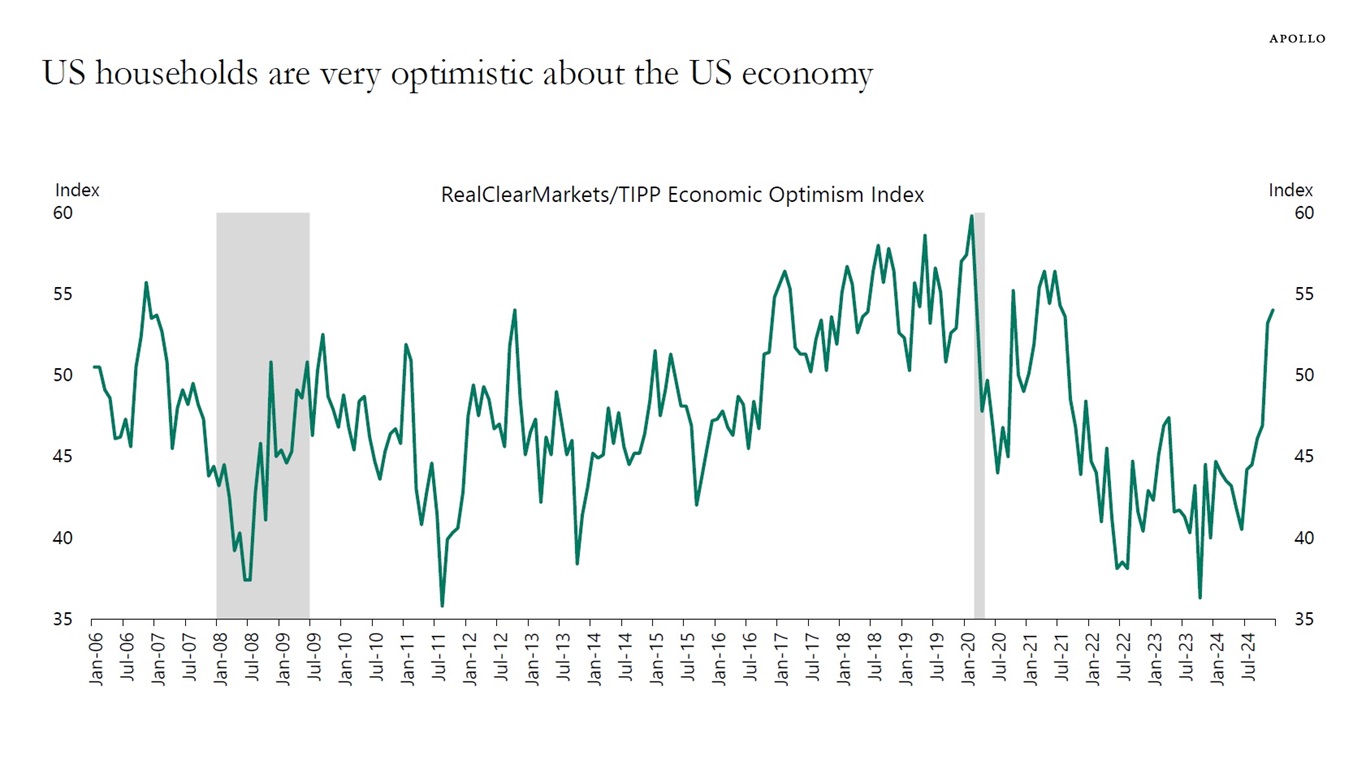
The RealClearMarkets/TIPP Economic Optimism Index measures Americans’ optimism about the US economy.
Specifically, the index is based on a nationwide survey of 1,300 adults and is made up of three subindexes, including one for the respondent’s economic outlook six months into the future, the respondent’s personal financial outlook, and how the respondent views current federal policies.
The latest data shows that US households have turned very optimistic about the US economic outlook in recent months, see chart below.

Source: Technometrica Market Intelligence/RealClearMarkets, Apollo Chief Economist See important disclaimers at the bottom of the page.
-
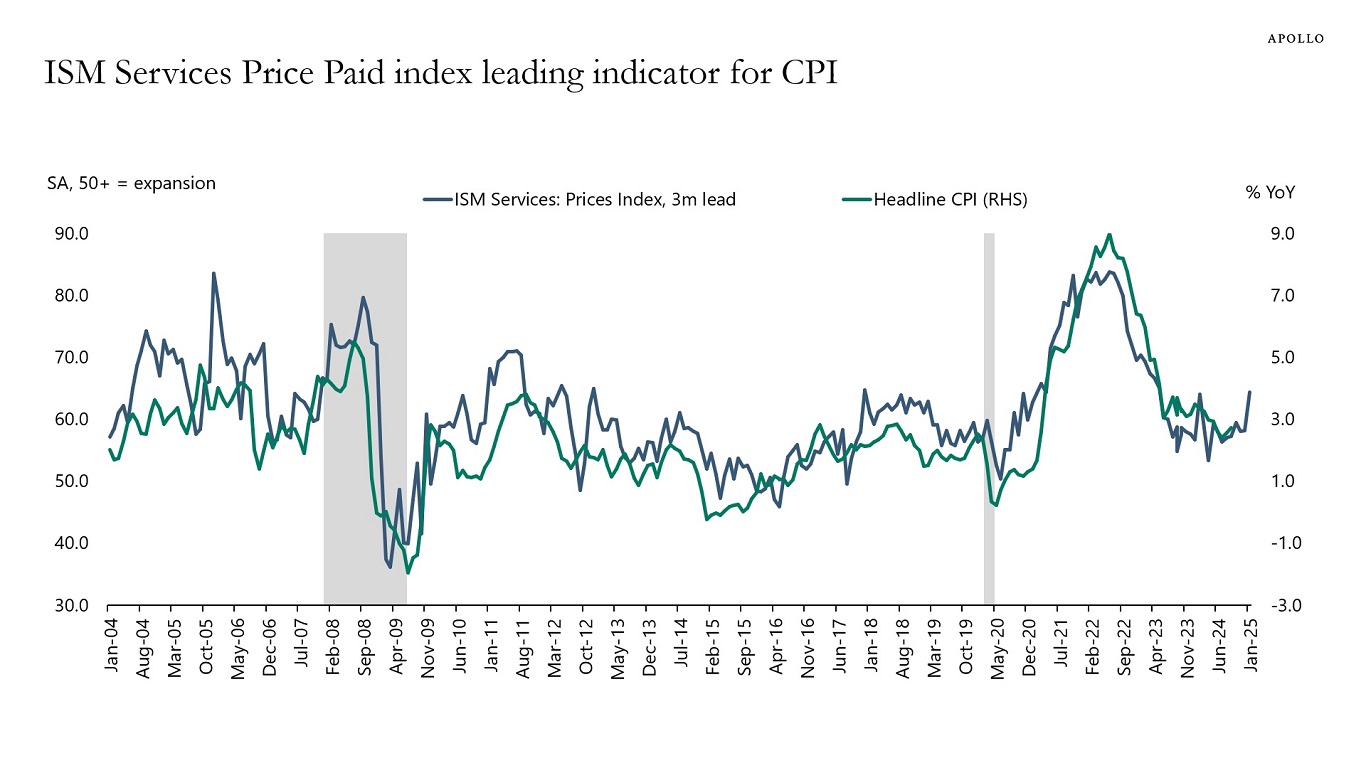
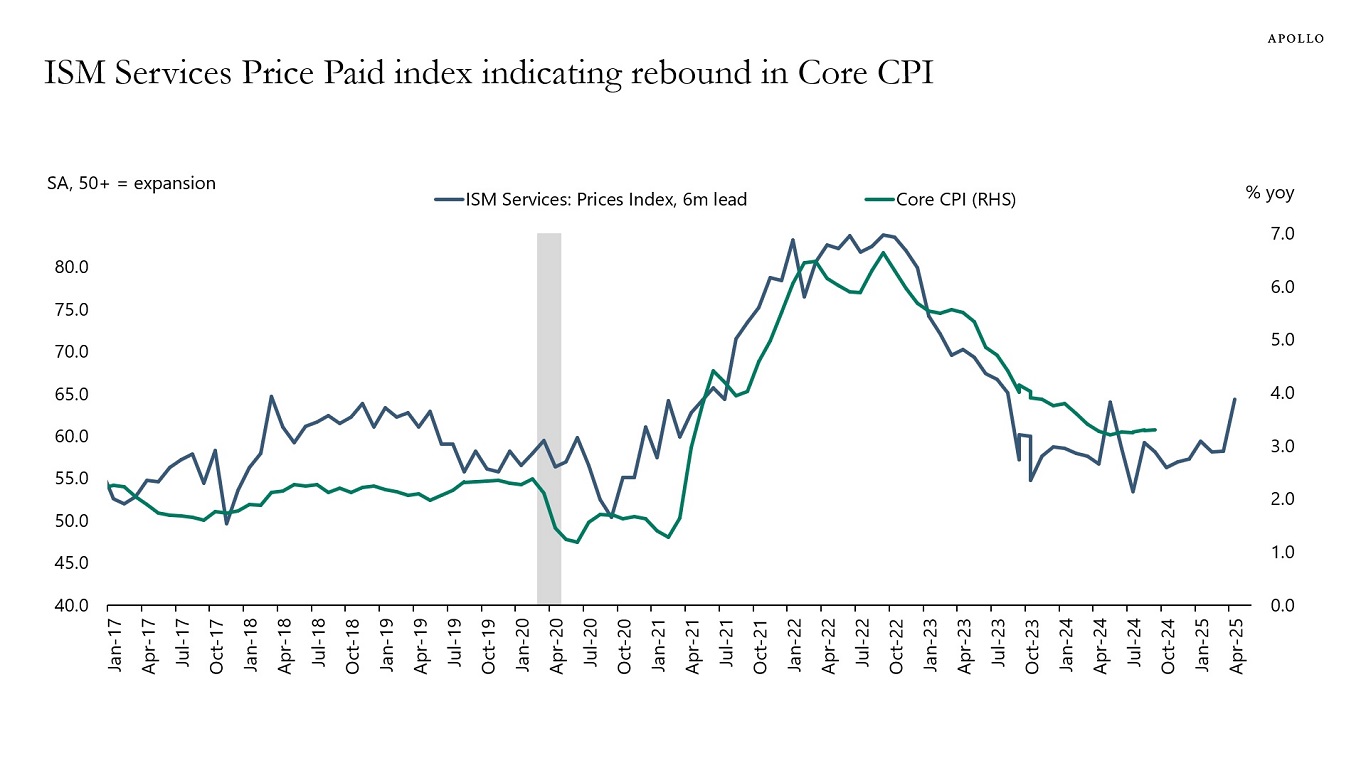
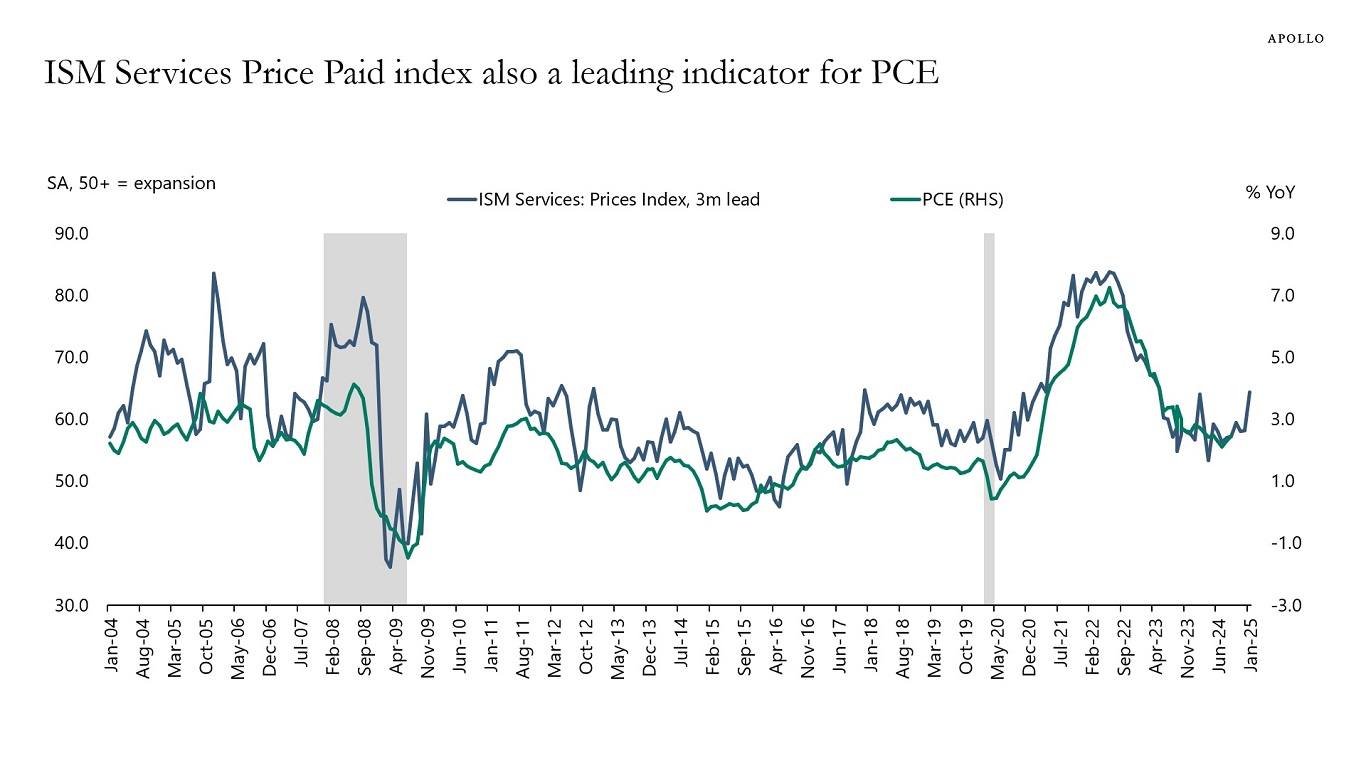
The recent jump in ISM Prices Paid points to a coming reacceleration in both headline and core inflation, see charts below.
Source: BLS, ISM, Haver Analytics, Apollo Chief Economist Source: BLS, ISM, Haver Analytics, Apollo Chief Economist Source: BEA, ISM, Haver Analytics, Apollo Chief Economist Source: BEA, ISM, Haver Analytics, Apollo Chief Economist See important disclaimers at the bottom of the page.
-
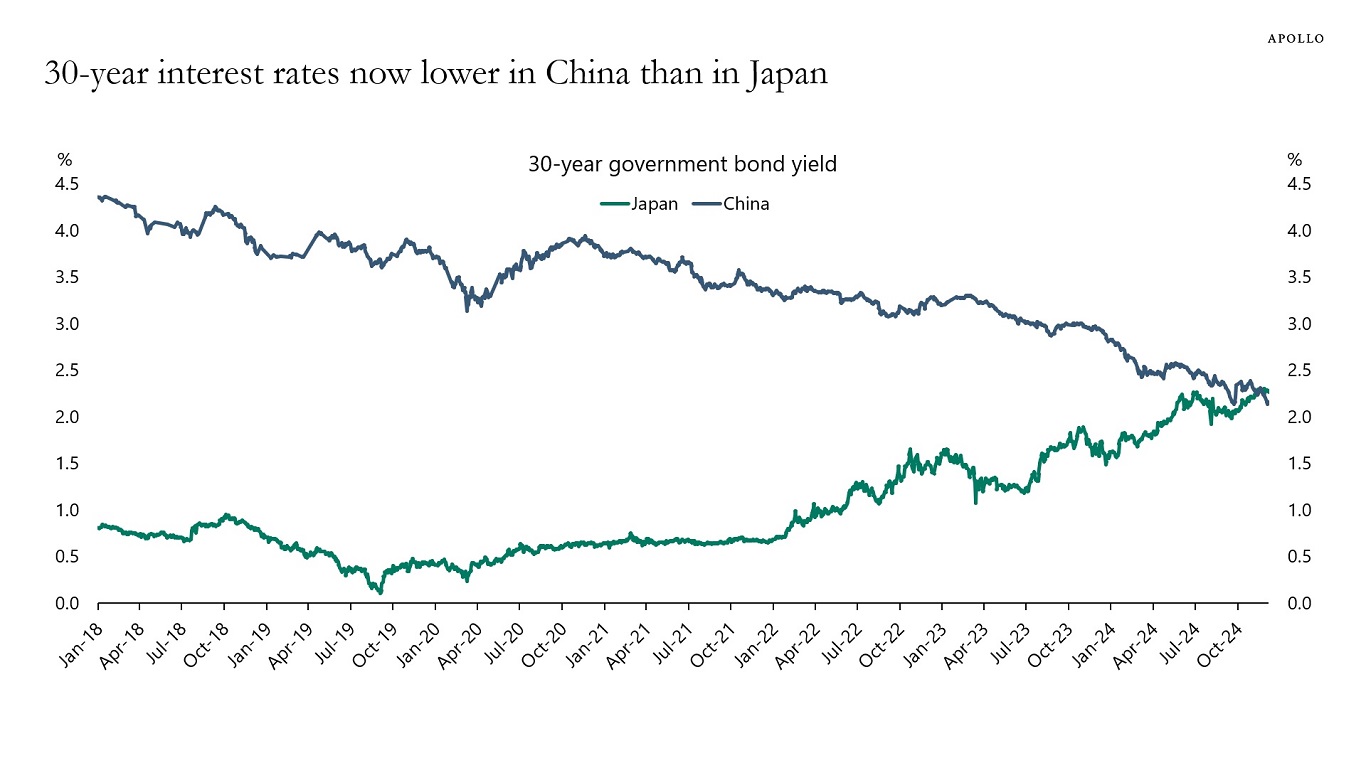
Growth and inflation are rising in Japan and falling in China. As a result, 30-year government bond yields are now lower in China than in Japan, see chart below.
Source: Bloomberg, Apollo Chief Economist See important disclaimers at the bottom of the page.
-
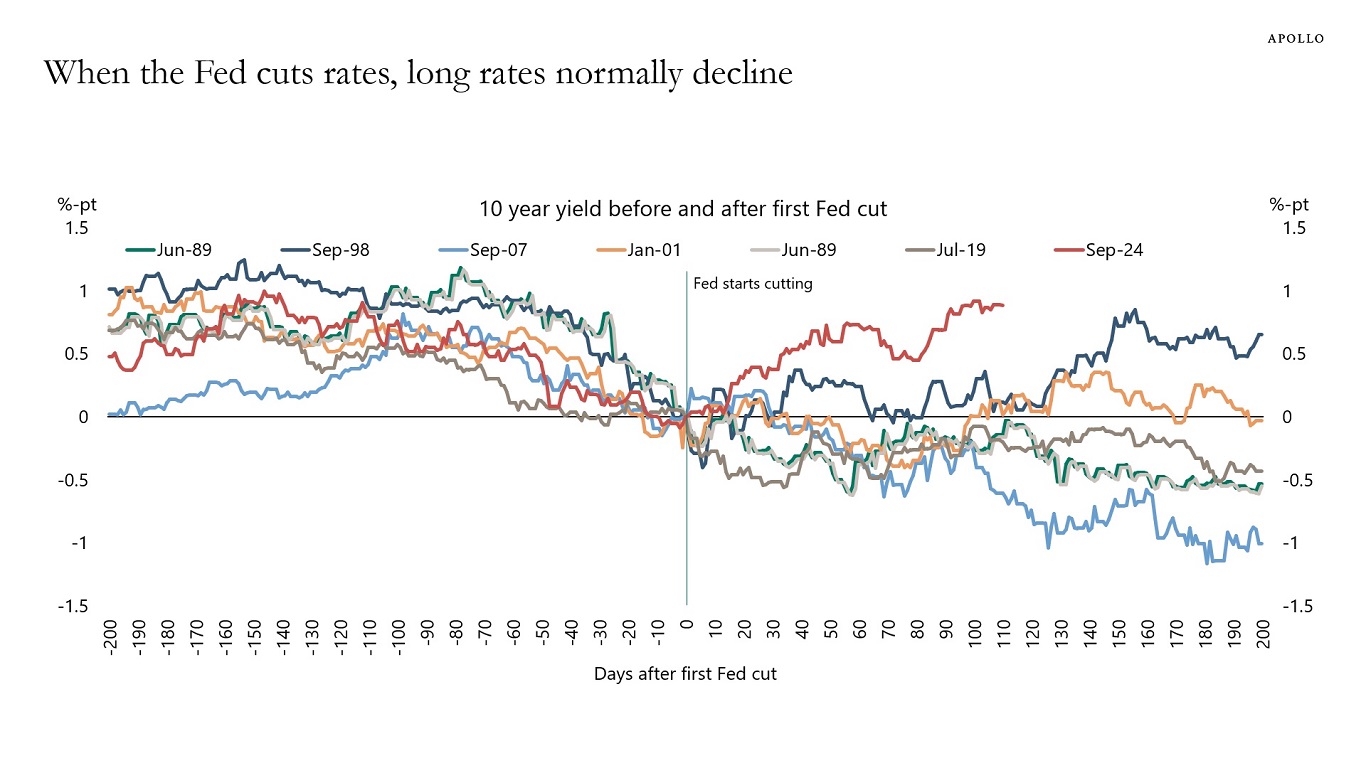
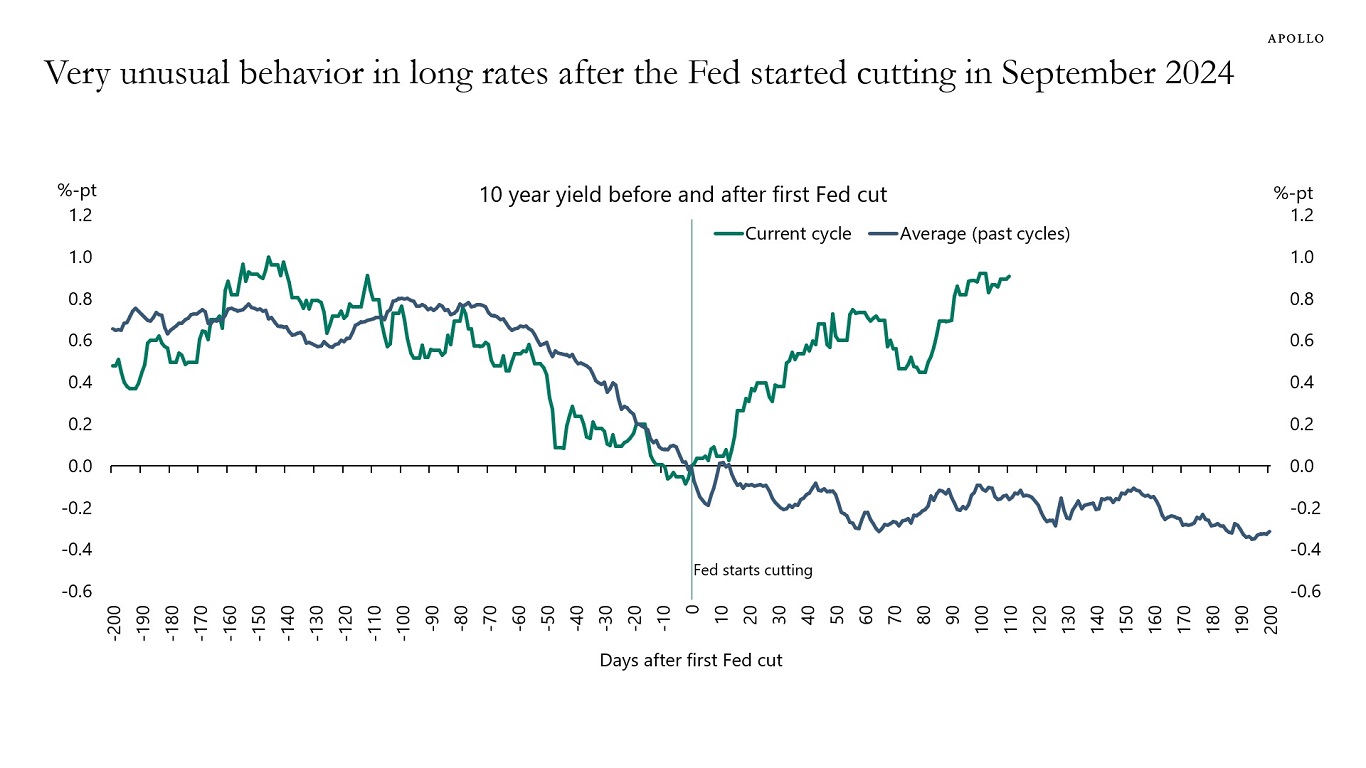
The Fed has cut interest rates 100 basis points since September, and over the same period, 10-year interest rates are up 100 basis points. This is highly unusual, see charts below. Is it fiscal worries? Is it less demand from abroad? Or maybe Fed cuts were not justified? The market is telling us something, and it is very important for investors to have a view on why long rates are going up when the Fed is cutting.
Source: Bloomberg, Apollo Chief Economist Source: Bloomberg, Apollo Chief Economist See important disclaimers at the bottom of the page.
-
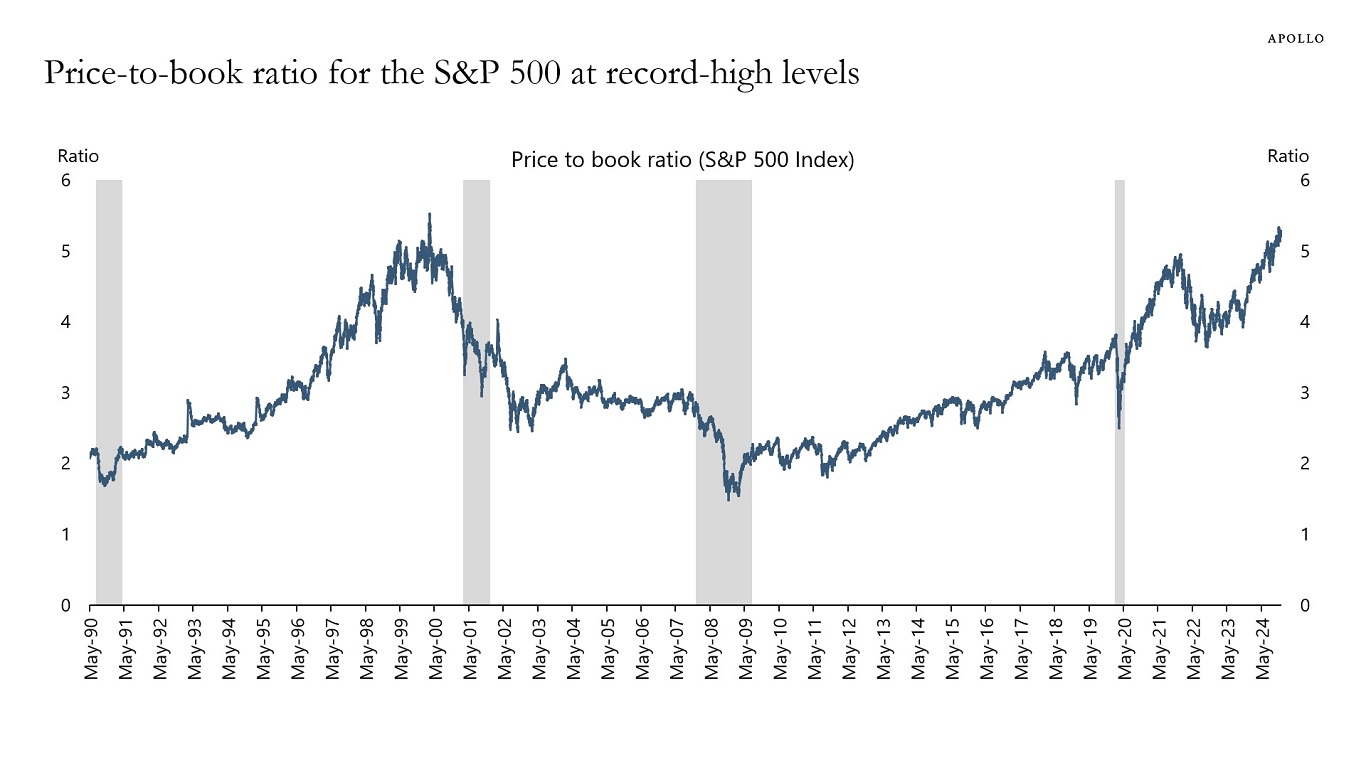
The price-to-book ratio for the S&P 500 is at record-high levels, see chart below. This is another piece of evidence that stocks are expensive at the moment.
Source: Bloomberg, Apollo Chief Economist See important disclaimers at the bottom of the page.
-
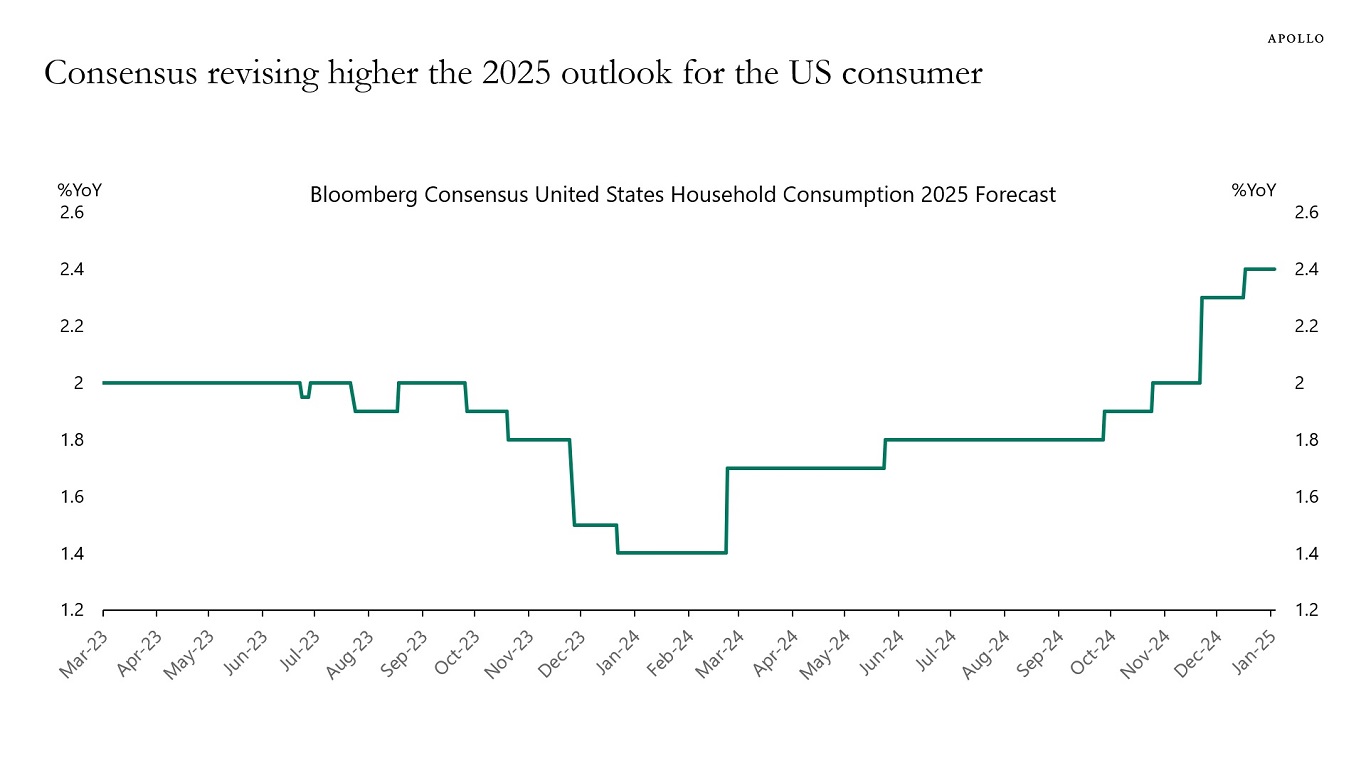
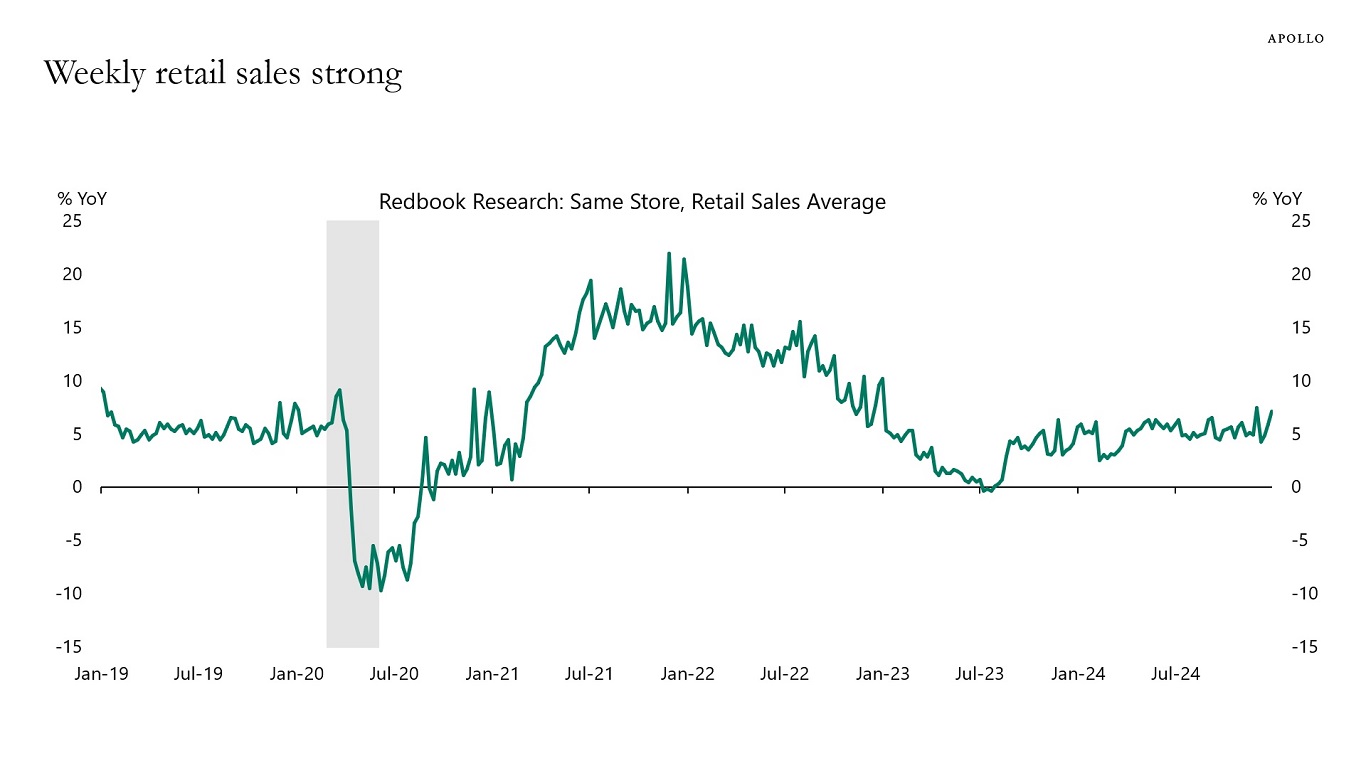
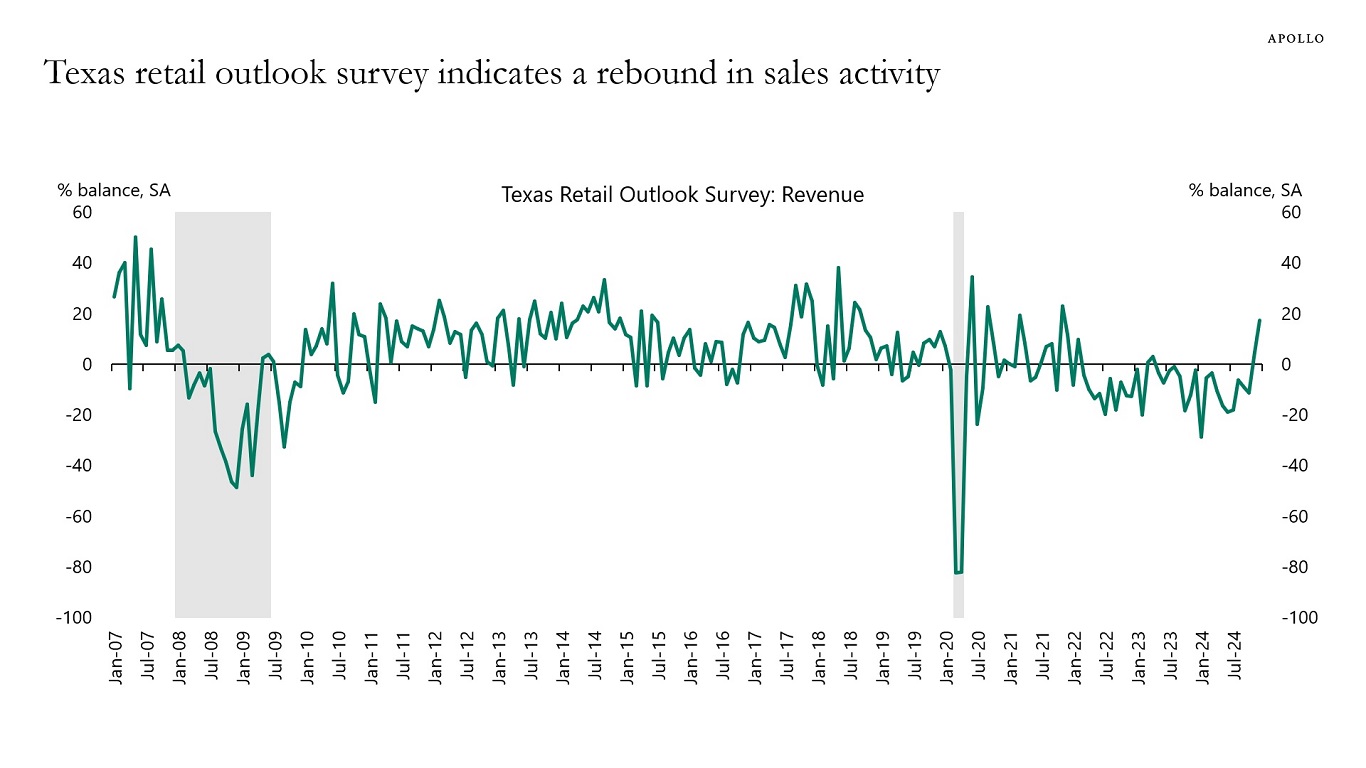
The US consumer is in incredible shape.
Specifically:
– The incoming weekly data shows continued strength in consumer spending, and outlook surveys show continued strength ahead (Charts 1 to 3).
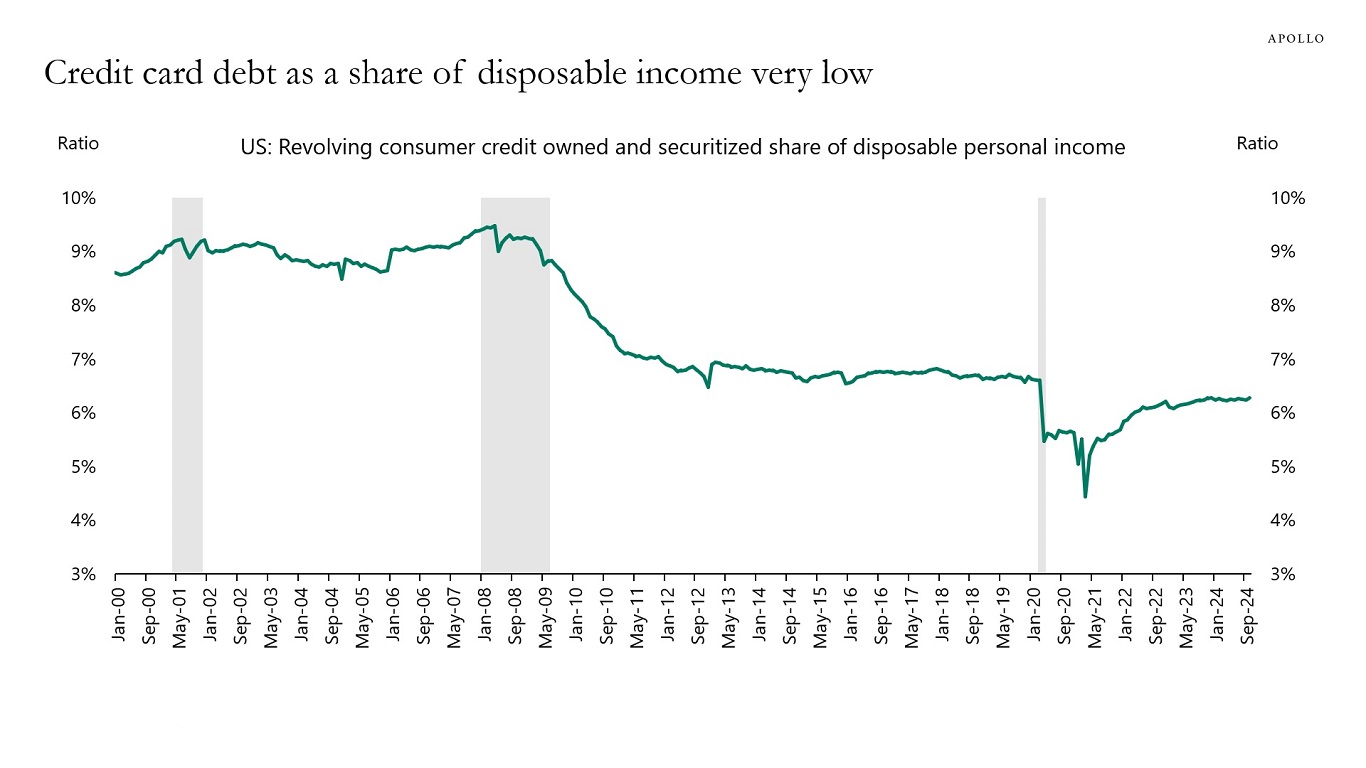
– Credit card debt as a share of disposable income is below pre-pandemic levels (Chart 4).
– The effective interest rate on mortgage debt outstanding is only 4% (Chart 5).
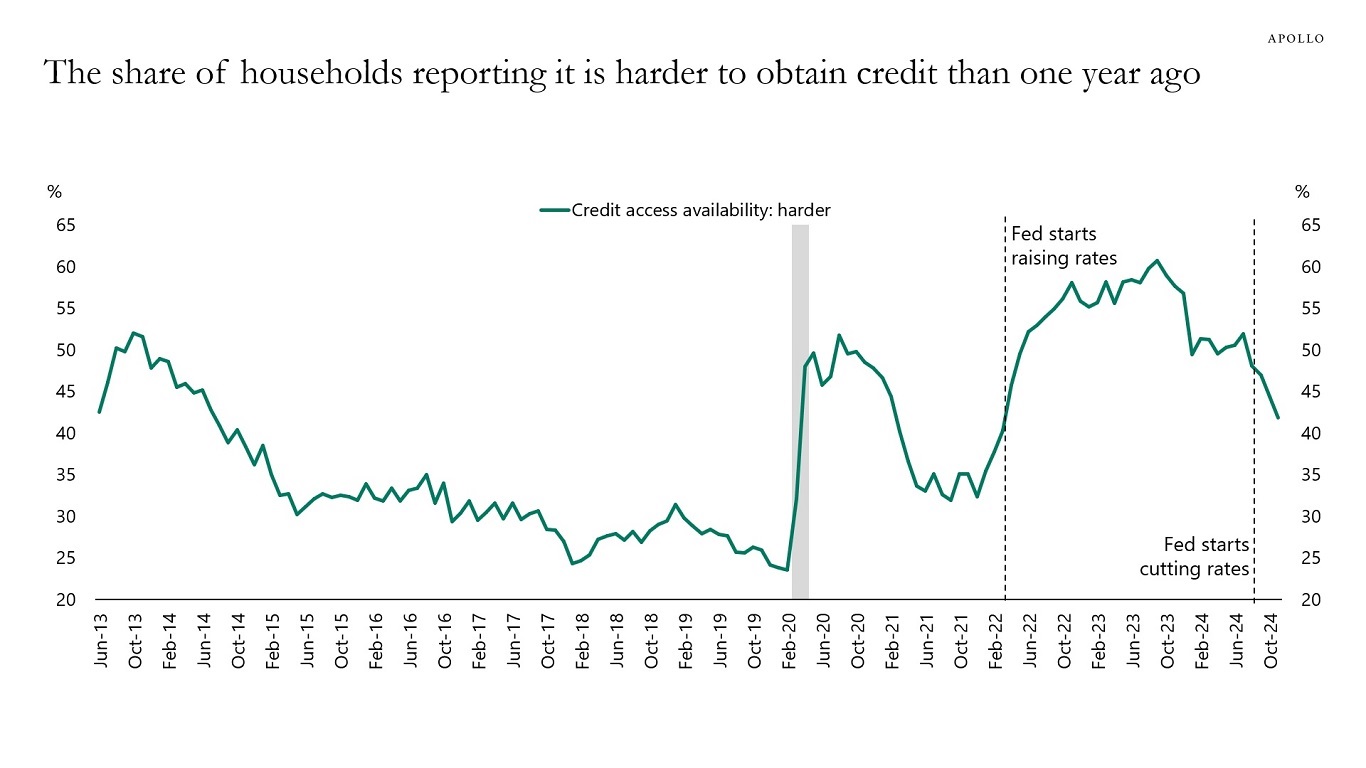
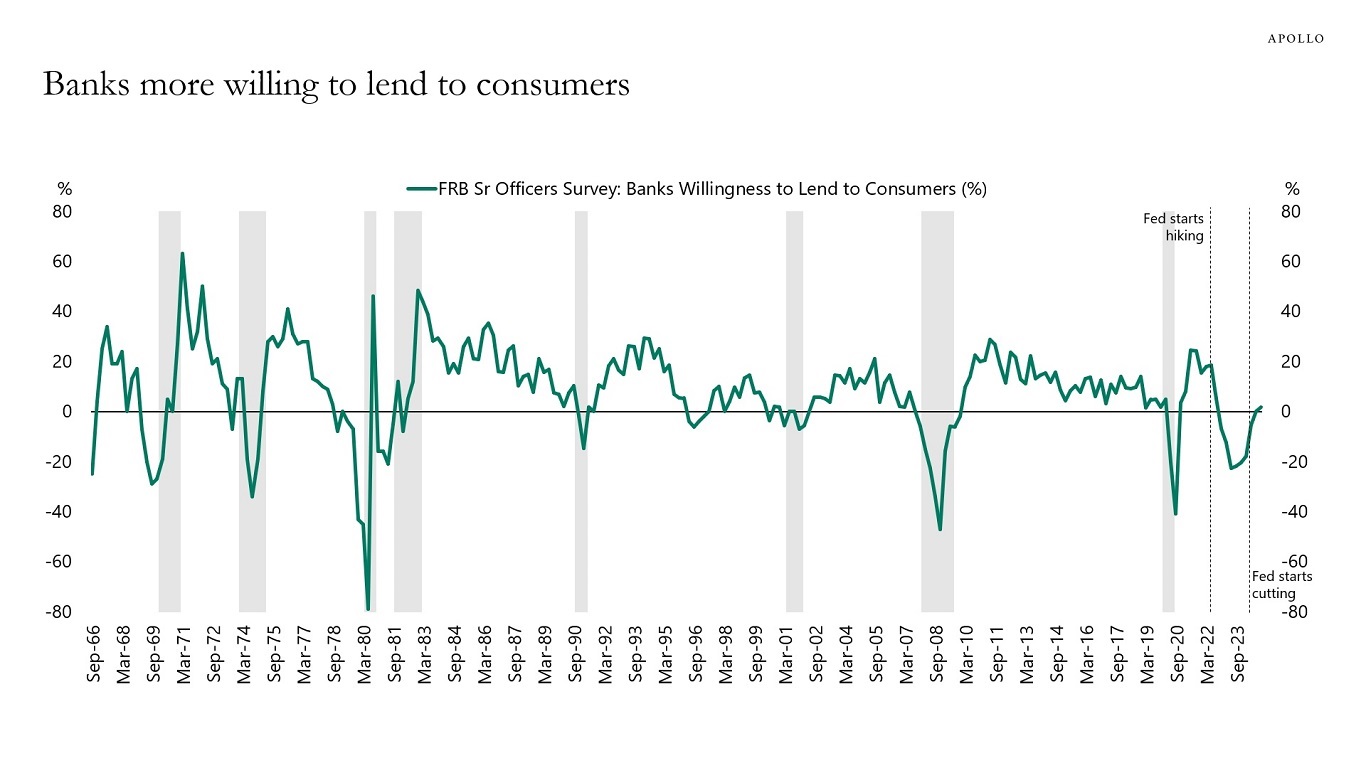
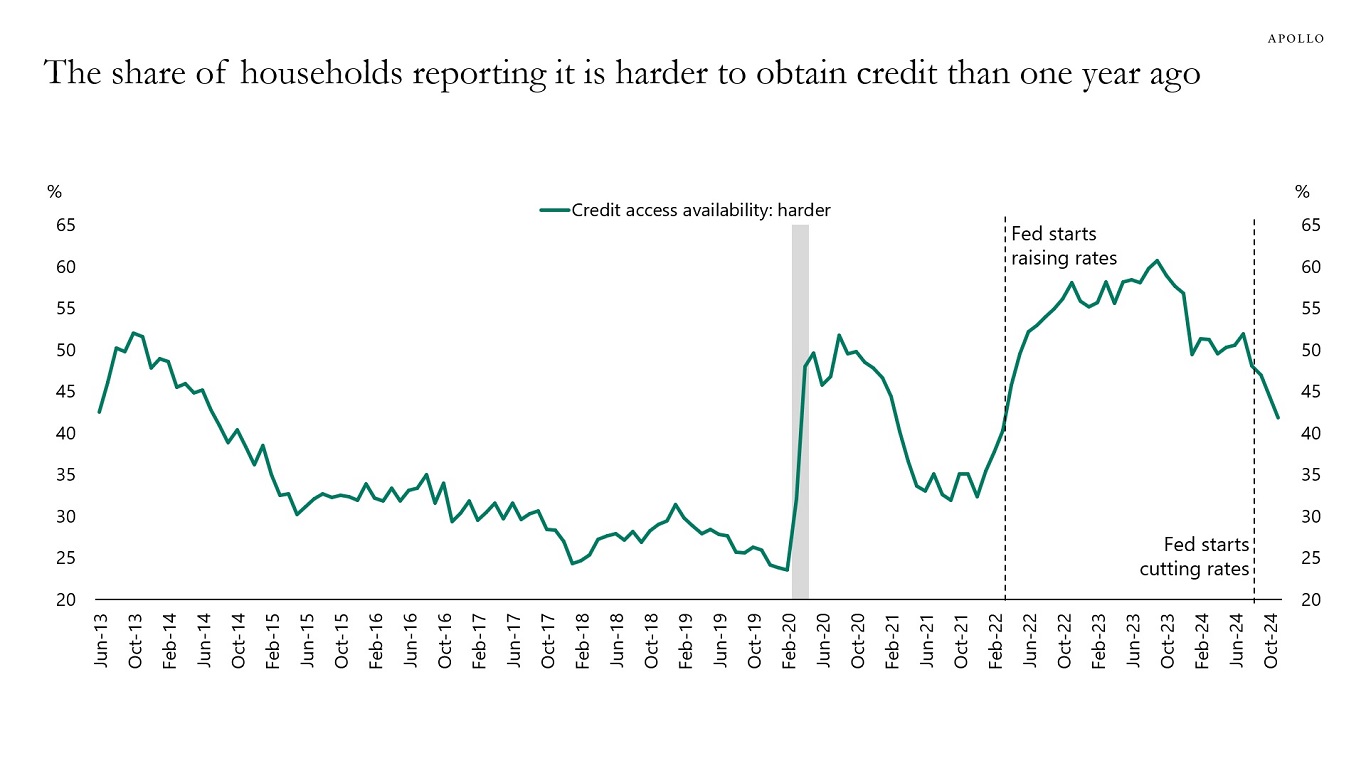
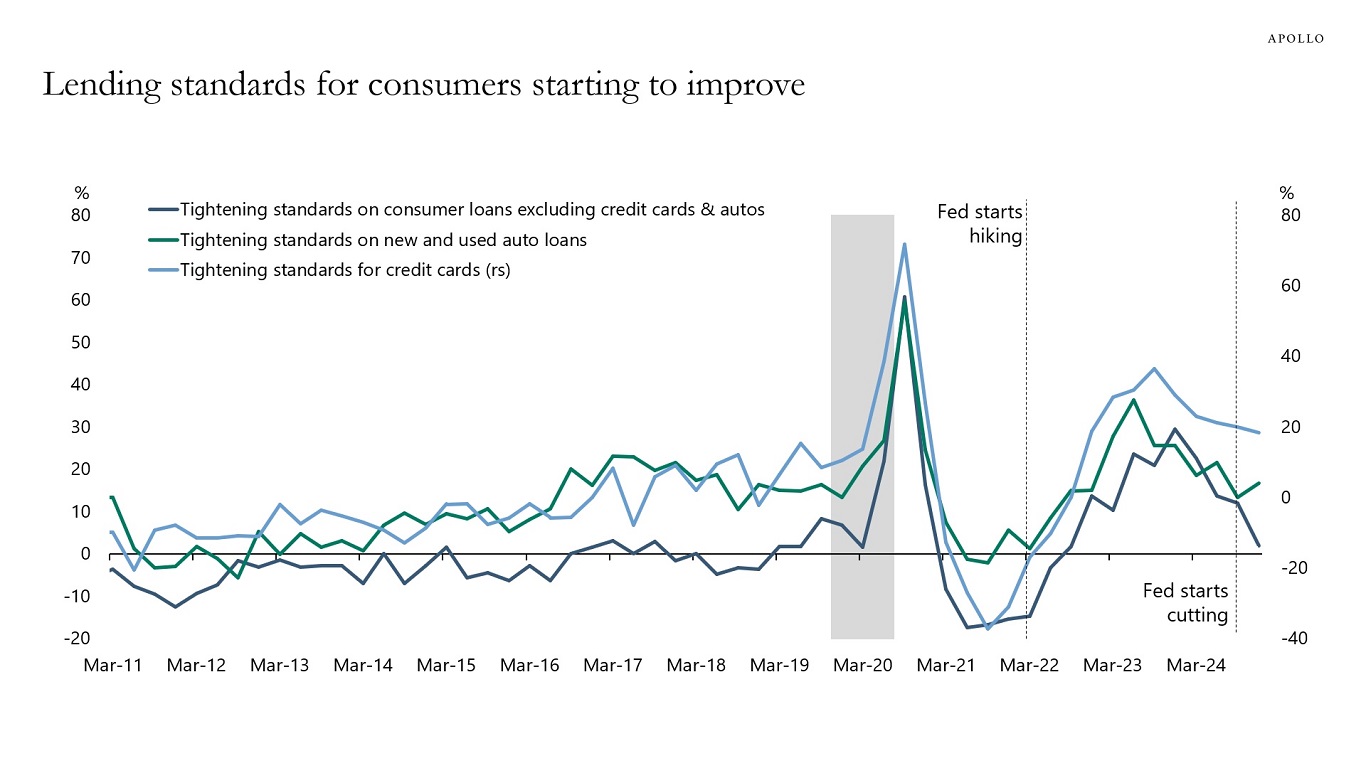
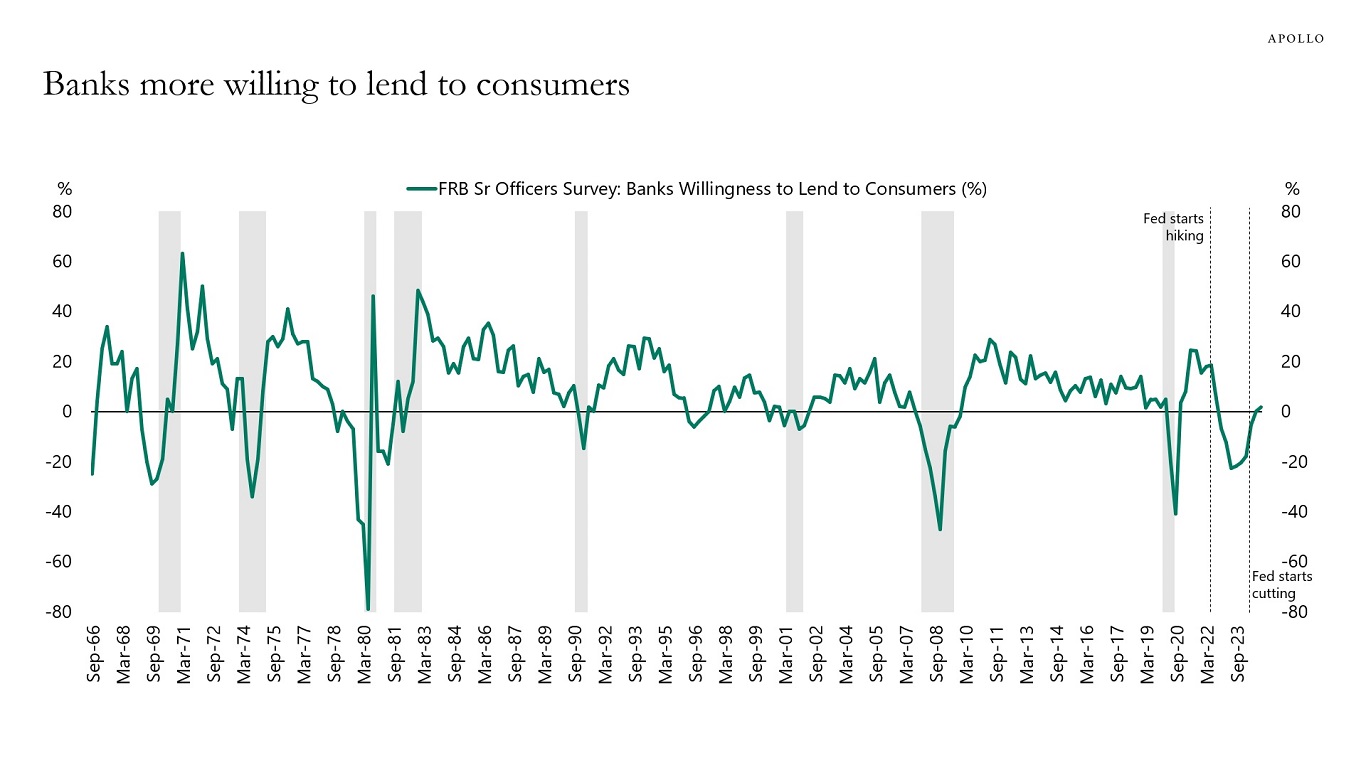
– Households are reporting that it is easier to get access to credit, and banks are more willing to lend to consumers (Charts 6 and 7).
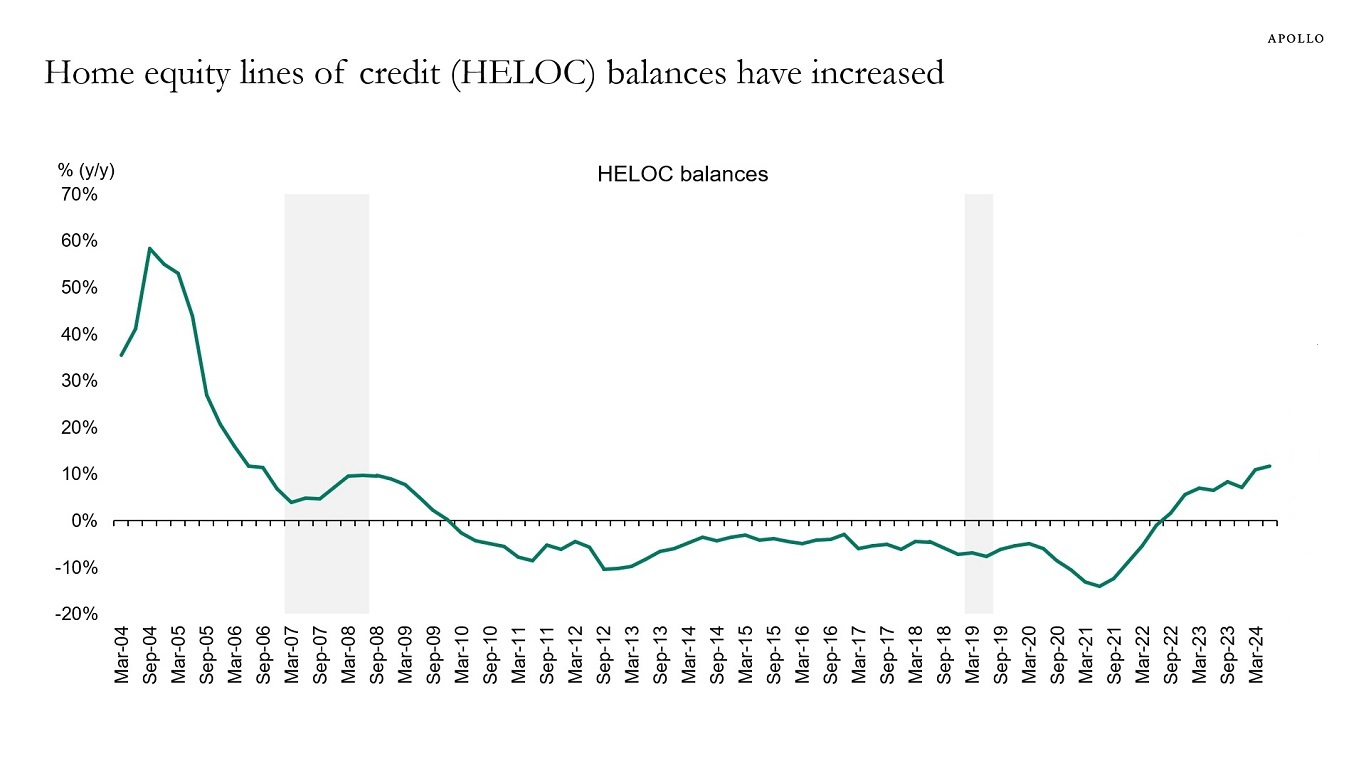
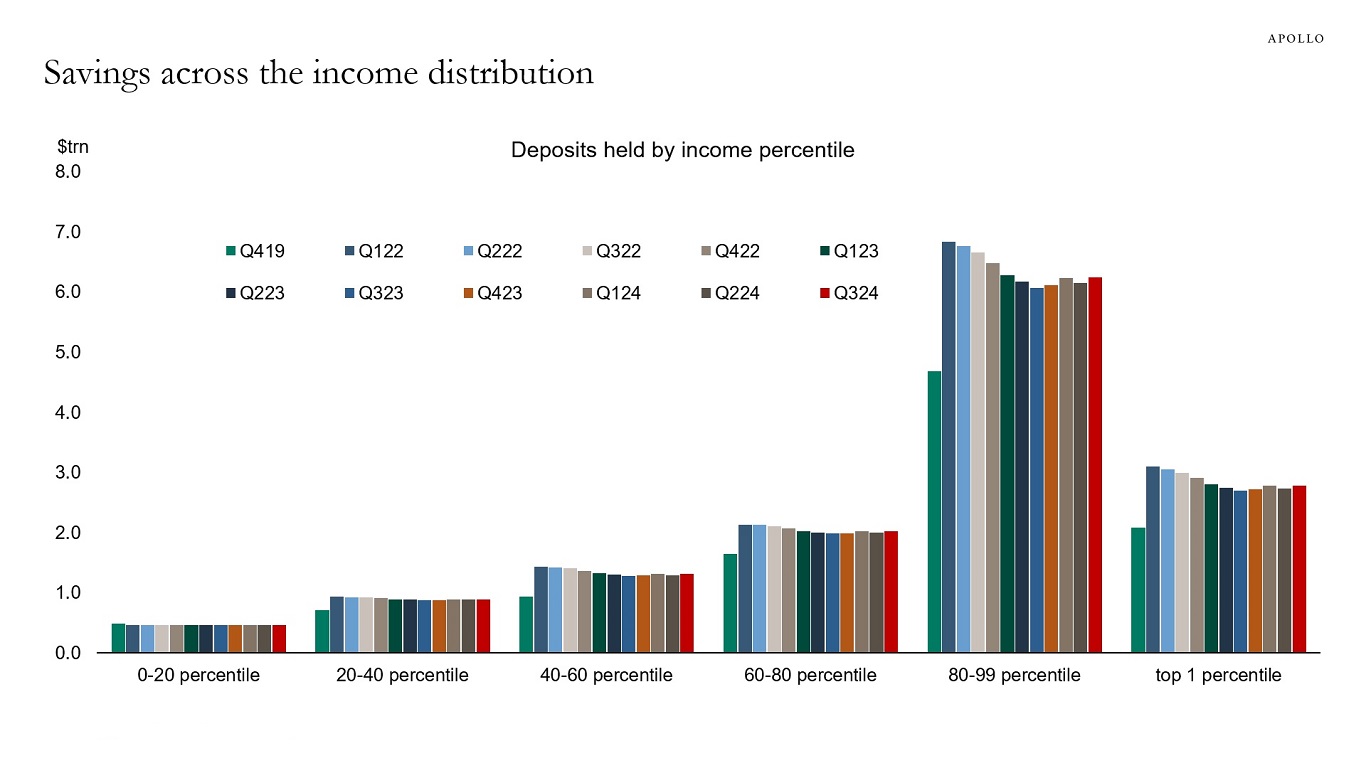
– HELOC balances are rising, and savings are rising for most households across the income distribution (Charts 8 and 9).
– Debt to disposable income is declining, and US households are in much better shape than households in Canada and Australia (Chart 10).
The bottom line is that incomes are high, stock prices are high, home prices are high, debt levels are low, interest rate sensitivity is low, and banks are more willing to lend to households.
There are significant upside risks to US growth, inflation, and interest rates as we enter 2025.
Source: Bloomberg, Apollo Chief Economist Source: Redbook, Haver Analytics, Apollo Chief Economist Note: Data was collected December 17–25, and 271 of the 379 Texas service sector business executives surveyed submitted responses. The Dallas Fed conducts the Texas Service Sector Outlook Survey monthly to obtain a timely assessment of the state’s service sector activity. Firms are asked whether revenue, employment, prices, general business activity and other indicators increased, decreased or remained unchanged over the previous month. Source: Federal Reserve Bank of Dallas, Haver Analytics, Apollo Chief Economist Source: FRB, BEA, Haver Analytics, Apollo Chief Economist Note: The effective interest rate (%) reflects the amortization of initial fees and charges over a 10-year period, which is the historical assumption of the average life of a mortgage loan. Source: Freddie Mac, BEA, Bloomberg, Apollo Chief Economist Note: Harder = much harder + somewhat harder. Source: FRBNY, Haver Analytics, Apollo Chief Economist Source: FRB, Bloomberg, Apollo Chief Economist Source: New York Fed Consumer Credit Panel/ Equifax, Apollo Chief Economist Source: FRB, Haver Analytics, Apollo Chief Economist Source: Statistics Canada, Reserve Bank of Australia, Bloomberg, Apollo Chief Economist See important disclaimers at the bottom of the page.
-
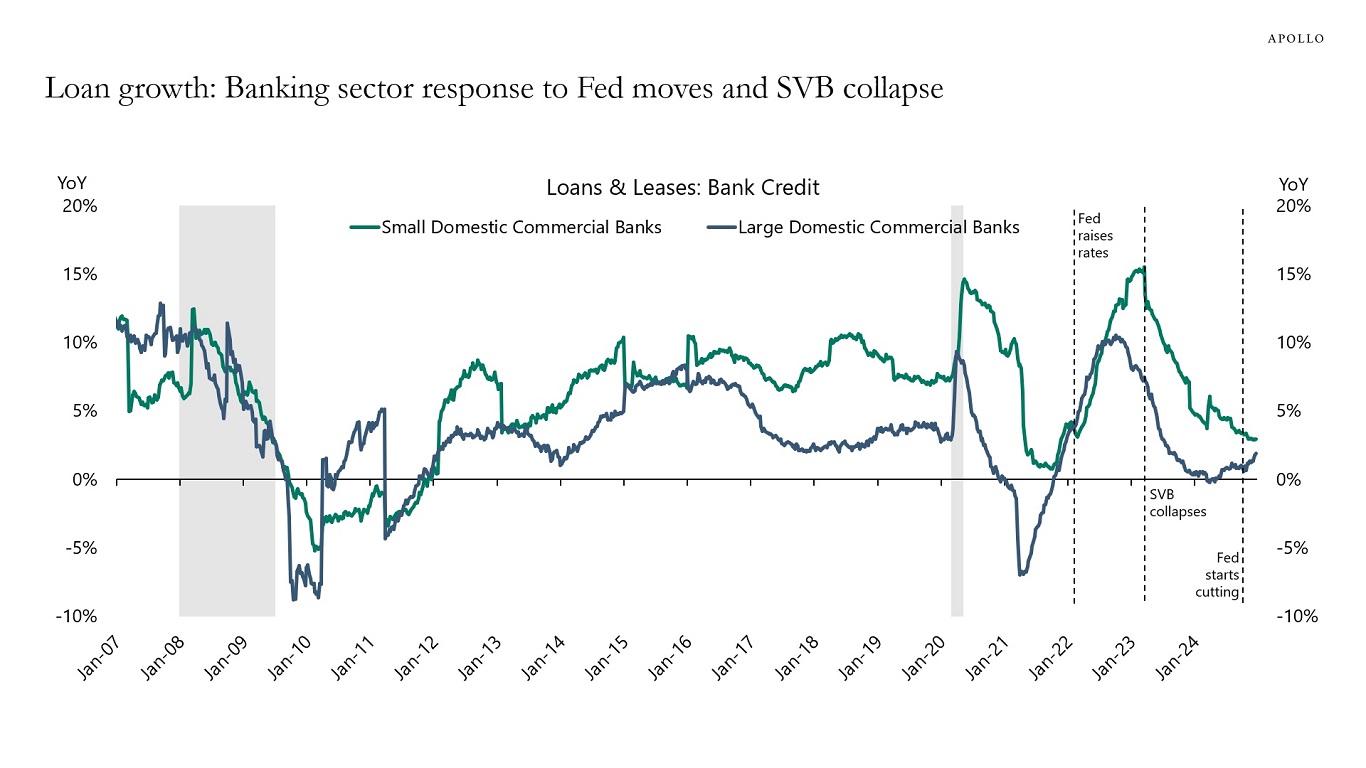
After the Fed started raising interest rates in March 2022, the banking sector started pulling back, and the decline in credit growth was magnified by the regional banking crisis in March 2023.
With the Fed signaling throughout 2024 that rate cuts are coming, banks are now showing more willingness to lend.
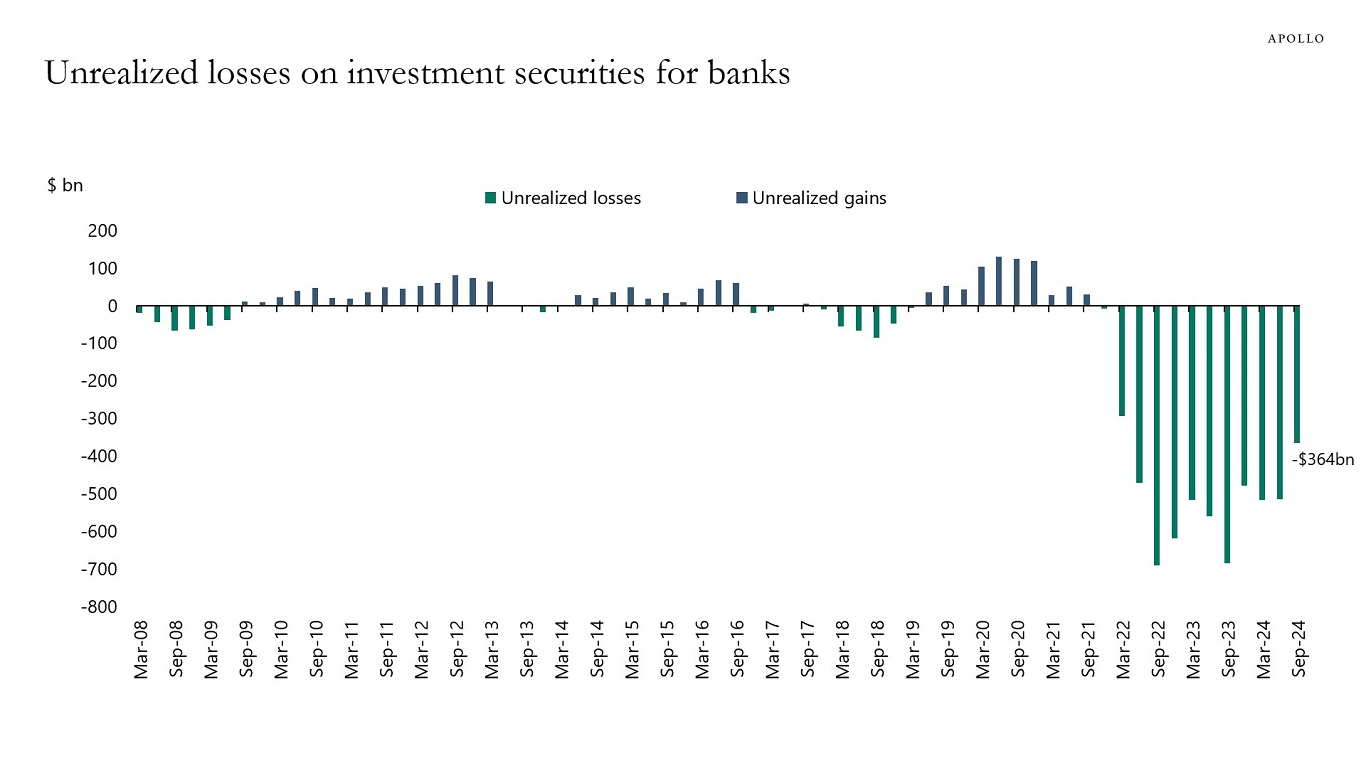
Our updated US banking sector outlook is available here. The charts below show that unrealized losses on investment securities are improving, the share of households reporting that it is harder to obtain credit than a year ago is declining, lending standards on consumer loans are improving, banks are more willing to lend, and loan growth is rising, driven by the large banks.
The bottom line is that tailwinds to the economic outlook in 2025 are driven not only by high stock prices, high home prices, low unemployment, and potential Trump economic policies, but also by banks easing credit conditions as a result of the Fed signaling lower rates ahead.
Source: FDIC, Apollo Chief Economist Note: Harder = much harder + somewhat harder. Source: FRBNY, Haver Analytics, Apollo Chief Economist Source: FRB, Bloomberg, Apollo Chief Economist Source: FRB, Bloomberg, Apollo Chief Economist Source: Federal Reserve Board, Haver Analytics, Apollo Chief Economist See important disclaimers at the bottom of the page.
-
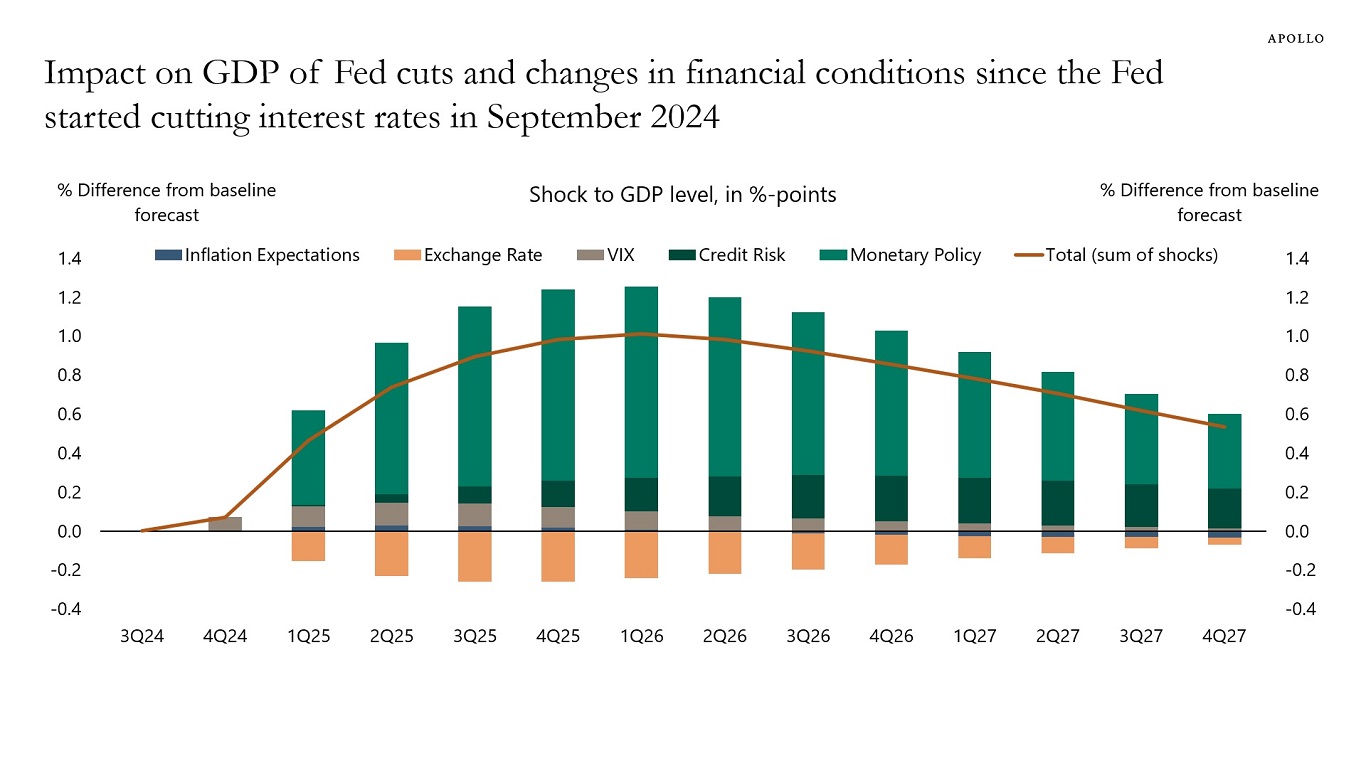
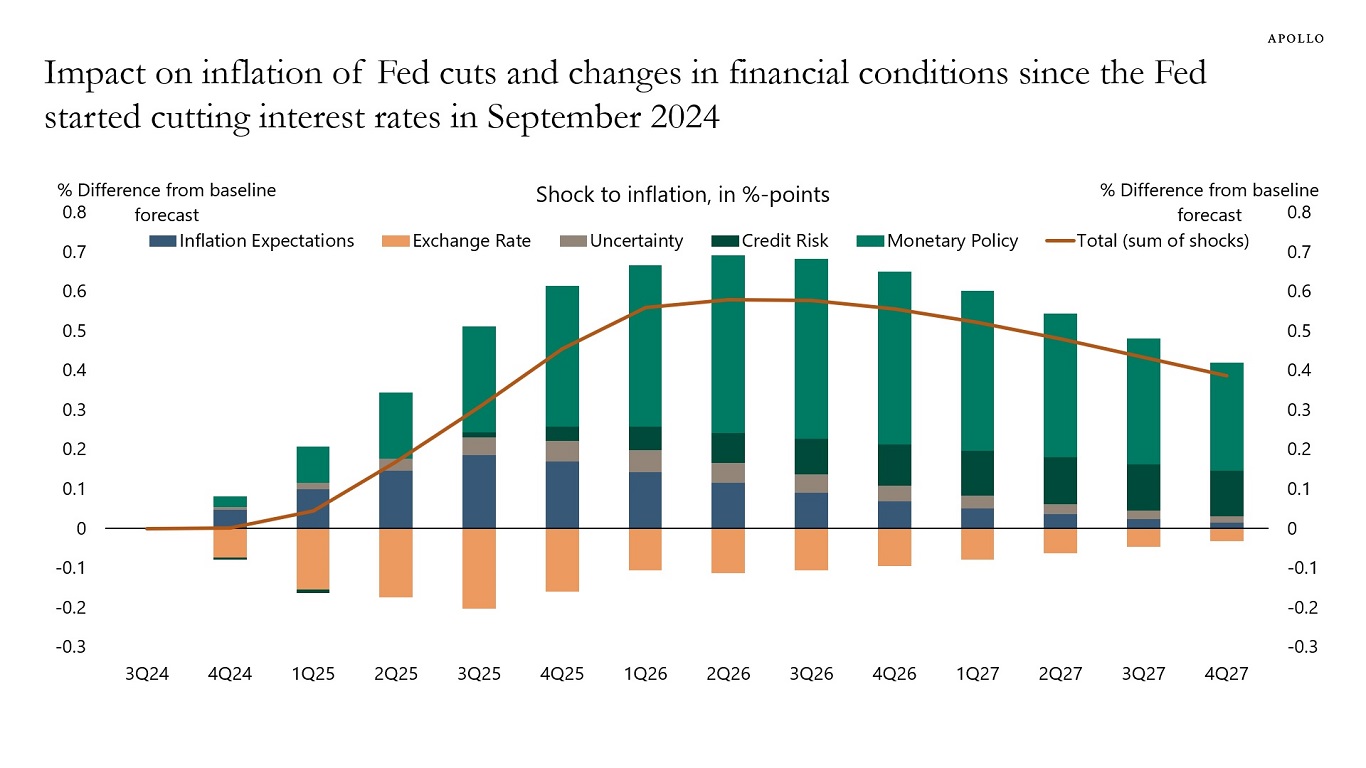
Since the Fed started cutting interest rates in September, financial conditions have eased with a rise in the stock market, a tightening of credit spreads, a decline in the VIX, a rise in inflation expectations, and an appreciation of the US dollar.
The charts below show the net effects of these developments on GDP and inflation using a model of the US economy that is similar to the Fed’s model, FRBUS.
The bottom line is that Fed cuts and associated developments in financial markets will boost GDP over the coming quarters by 1 percentage point and boost inflation by 0.5 percentage points.
In short, there are significant tailwinds in the pipeline to growth and inflation coming from the Fed having started to cut interest rates and the associated easing in financial conditions.
Combined with the ongoing fiscal outlook, we continue to worry more about the upside risks to growth, inflation, and interest rates over the coming quarters.
Note: The following shocks are applied to Q4 2024: A 0.2 percentage point rise in inflation expectations, 7% appreciation in the exchange rate, 0.5 standard deviation fall in VIX, 30 bps tightening of credit spreads, -100 bps rate cuts, and -50 bps forward guidance. Source: Bloomberg SHOK model, Apollo Chief Economist Note: The following shocks are applied to Q4 2024: A 0.2 percentage point rise in inflation expectations, 7% appreciation in the exchange rate, 0.5 standard deviation fall in VIX, 30 bps tightening of credit spreads, -100 bps rate cuts, and -50 bps forward guidance. Source: Bloomberg SHOK model, Apollo Chief Economist See important disclaimers at the bottom of the page.
-
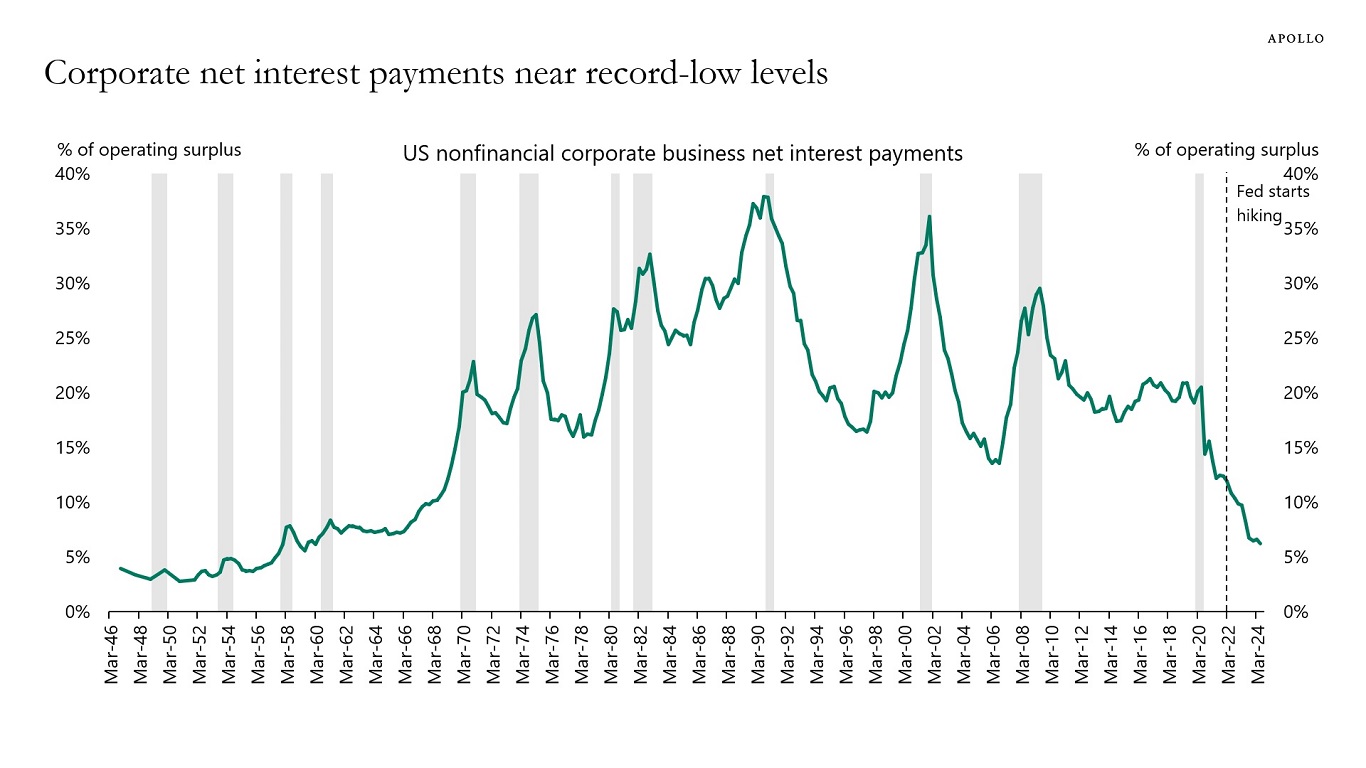
The first chart below shows that Fed hikes have not had the desired effects on firms. You would normally expect that when interest rates go up, corporates see an increase in debt-servicing costs.
But because of locked-in low interest rates combined with strong corporate earnings, net interest payments as a share of operating surplus have been going down.
The bottom line is that Fed hikes have not only had a limited negative impact on consumers because of locked-in low mortgage rates (see the second chart) but they have also had a very small impact on corporates because of locked-in low interest rates and rising earnings.
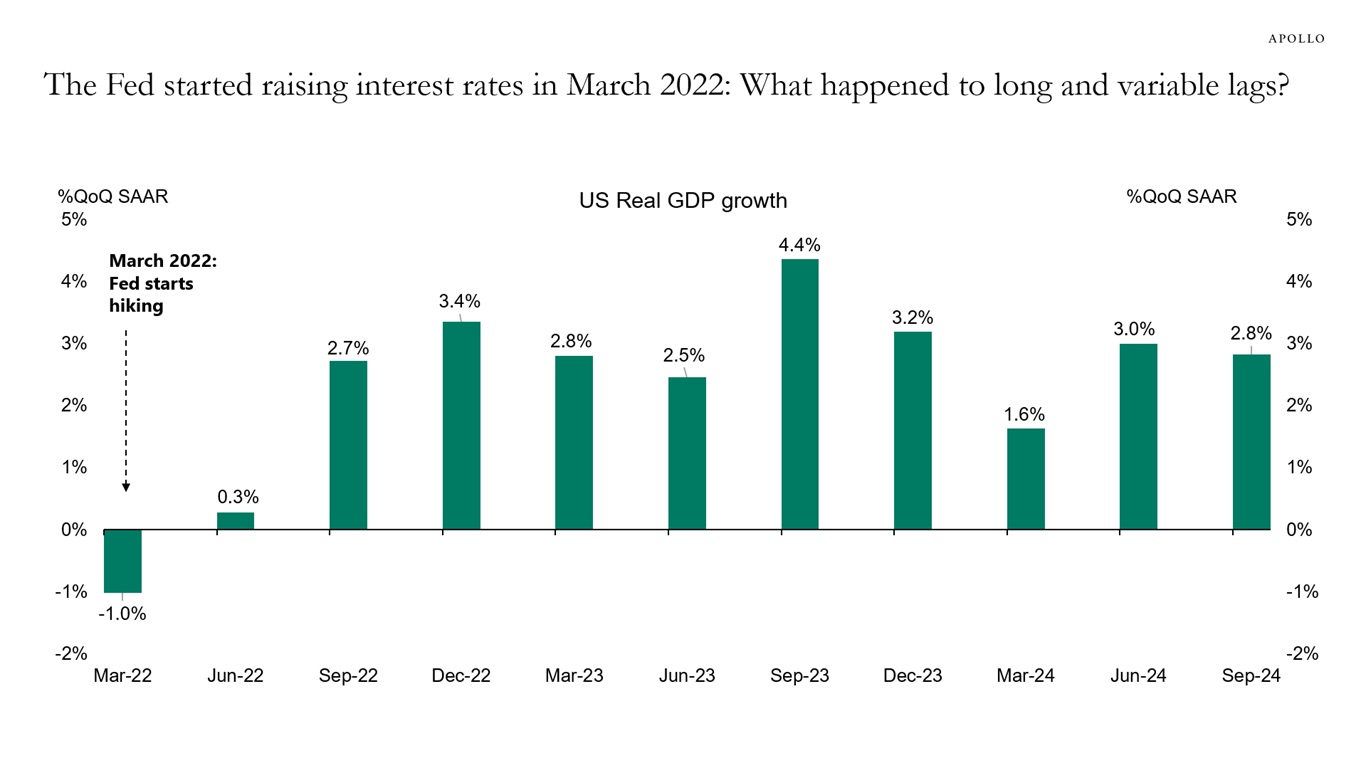
In short, the transmission mechanism of monetary policy has been much weaker than the economics textbook would have predicted. This is because consumers and firms locked in low interest rates during the pandemic.
As a result, the economy never slowed down when the Fed raised interest rates, see the third chart. And now the Fed is cutting, boosting asset prices and growth in consumer spending and capex spending further.
To be sure, households and firms with weak earnings, weak revenue, and weak cash flows have been hit by Fed hikes. But the aggregate outcome seen in the charts below shows that, from a macro perspective, the negative effects of Fed hikes on corporates and consumers have been small.
Source: Federal Reserve Board, Haver Analytics, Apollo Chief Economist Note: The effective interest rate (%) reflects the amortization of initial fees and charges over a 10-year period, which is the historical assumption of the average life of a mortgage loan. Source: Freddie Mac, BEA, Bloomberg, Apollo Chief Economist Source: BEA, Haver Analytics, Apollo Chief Economist See important disclaimers at the bottom of the page.
-
Our 2025 outlook for private markets is available here. Happy New Year.
See important disclaimers at the bottom of the page.





This presentation may not be distributed, transmitted or otherwise communicated to others in whole or in part without the express consent of Apollo Global Management, Inc. (together with its subsidiaries, “Apollo”).
Apollo makes no representation or warranty, expressed or implied, with respect to the accuracy, reasonableness, or completeness of any of the statements made during this presentation, including, but not limited to, statements obtained from third parties. Opinions, estimates and projections constitute the current judgment of the speaker as of the date indicated. They do not necessarily reflect the views and opinions of Apollo and are subject to change at any time without notice. Apollo does not have any responsibility to update this presentation to account for such changes. There can be no assurance that any trends discussed during this presentation will continue.
Statements made throughout this presentation are not intended to provide, and should not be relied upon for, accounting, legal or tax advice and do not constitute an investment recommendation or investment advice. Investors should make an independent investigation of the information discussed during this presentation, including consulting their tax, legal, accounting or other advisors about such information. Apollo does not act for you and is not responsible for providing you with the protections afforded to its clients. This presentation does not constitute an offer to sell, or the solicitation of an offer to buy, any security, product or service, including interest in any investment product or fund or account managed or advised by Apollo.
Certain statements made throughout this presentation may be “forward-looking” in nature. Due to various risks and uncertainties, actual events or results may differ materially from those reflected or contemplated in such forward-looking information. As such, undue reliance should not be placed on such statements. Forward-looking statements may be identified by the use of terminology including, but not limited to, “may”, “will”, “should”, “expect”, “anticipate”, “target”, “project”, “estimate”, “intend”, “continue” or “believe” or the negatives thereof or other variations thereon or comparable terminology.