We are monitoring the unemployment rate in the Philippines and India for any signs that AI is reducing the need for outsourced workers in corporate America. So far, there are no signs of AI replacing offshore workers, see chart below.
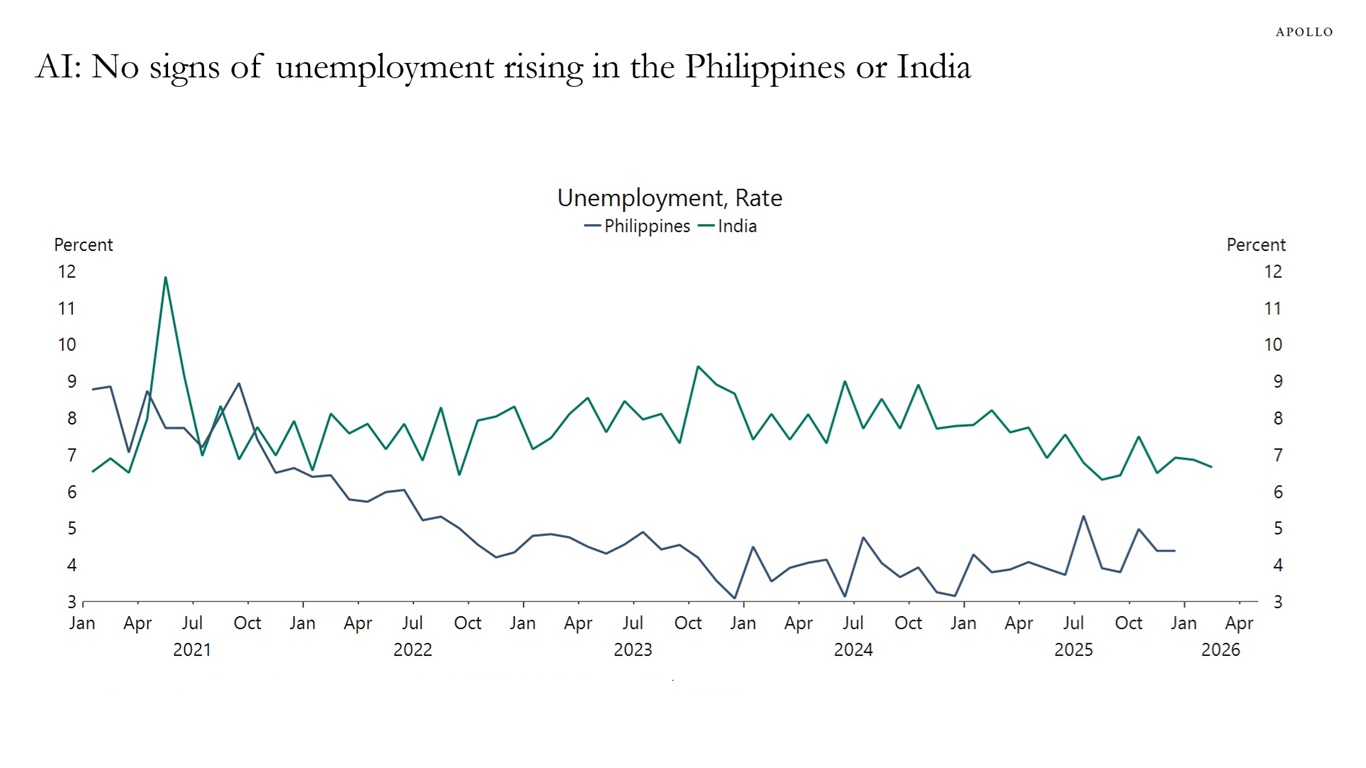


We are monitoring the unemployment rate in the Philippines and India for any signs that AI is reducing the need for outsourced workers in corporate America. So far, there are no signs of AI replacing offshore workers, see chart below.
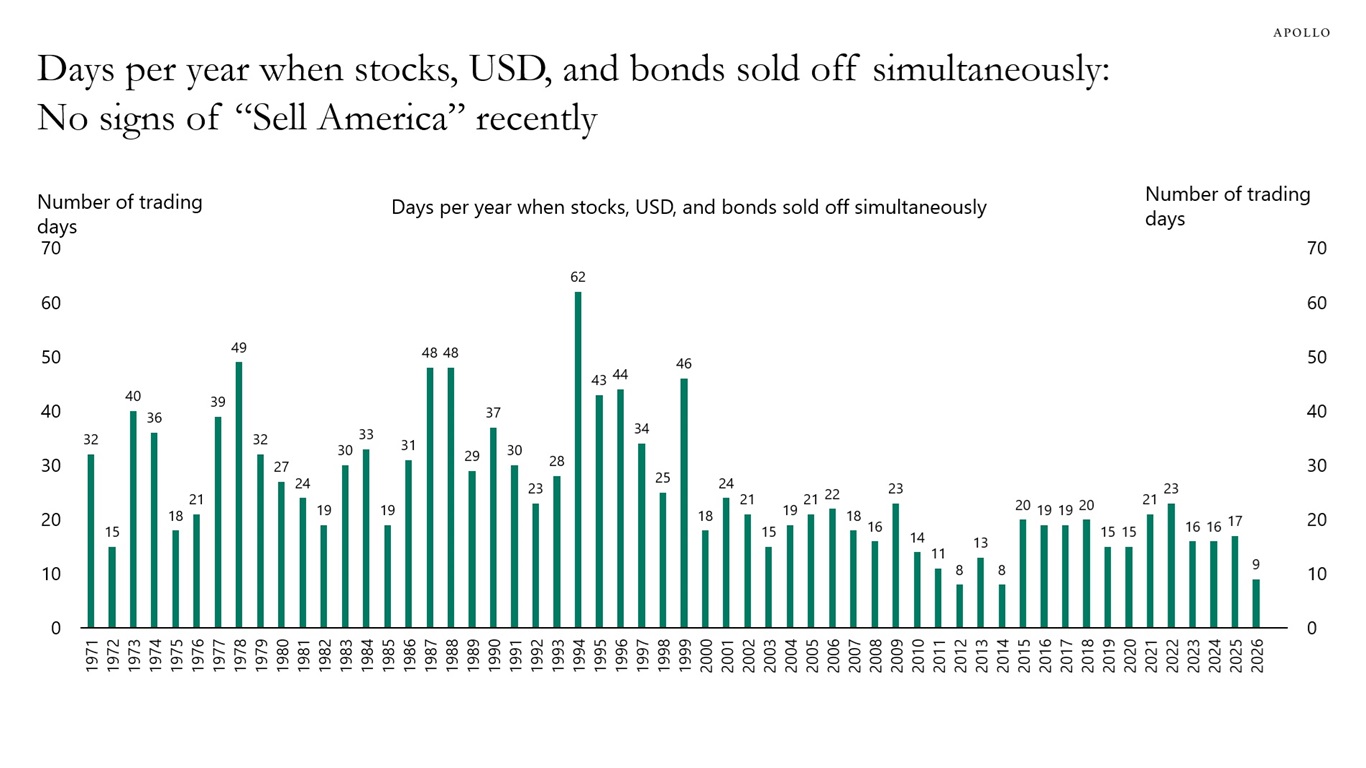
There are a lot of conversations in markets about the “Sell America” trade, i.e. the trade in which prices of US stocks, bonds and the dollar fall at the same time. But counting the number of days when this has happened shows no signs of 2025 and 2026 being anything special. In fact, the chart below shows that there has been no particular “Sell America” trade for the past 25 years.
The bottom line is that the US remains the most dynamic and innovative economy in the world, delivering the best and most steady returns for domestic and global investors.
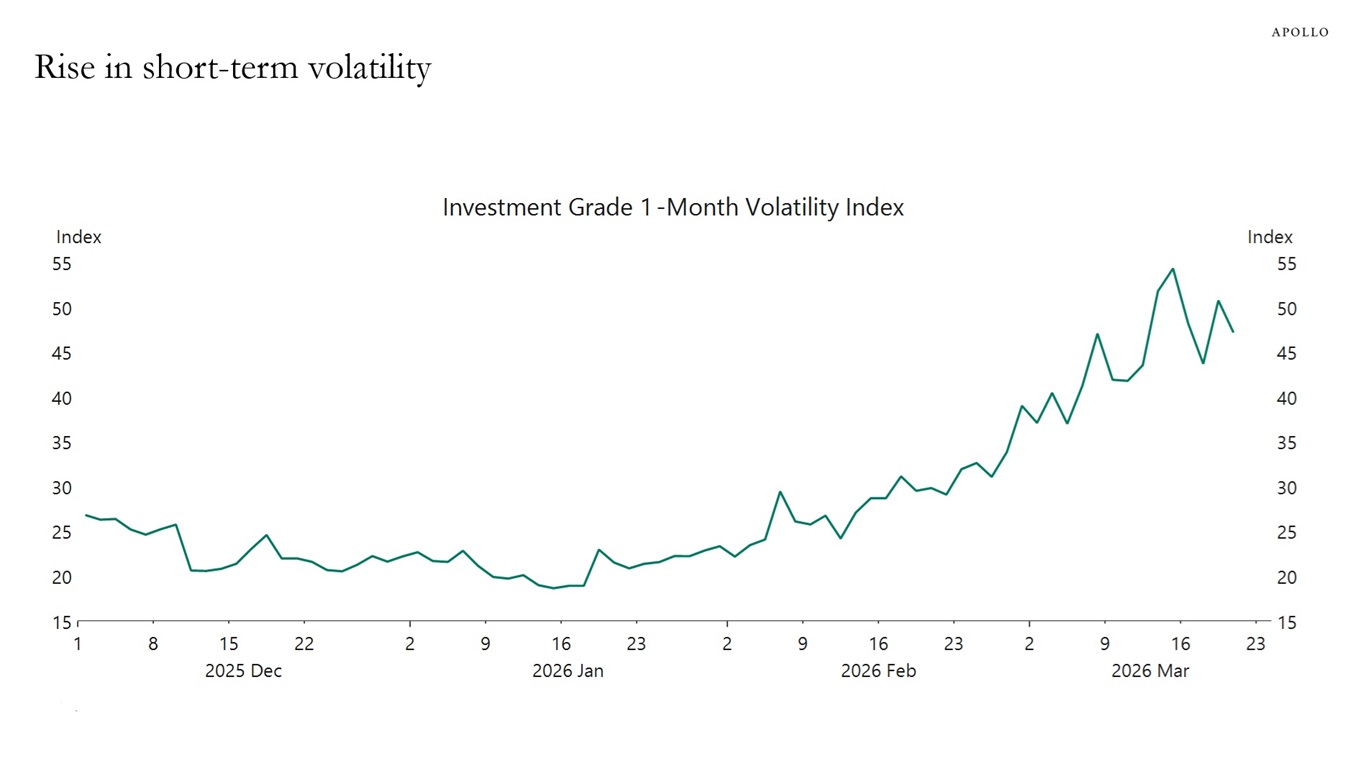
Markets are too focused on the near-term challenges from higher oil prices, see chart below. The real trade-off for investors is 4 to 6 weeks of instability, paying off 50 years of stability in oil markets, supply chains and geopolitics. The Gulf region will be more stable and even more closely integrated with the global economy. For the Fed, the rise in inflation because of higher oil prices is temporary, and once the conflict is over, Fed cuts will be priced in again and long rates will come down again.
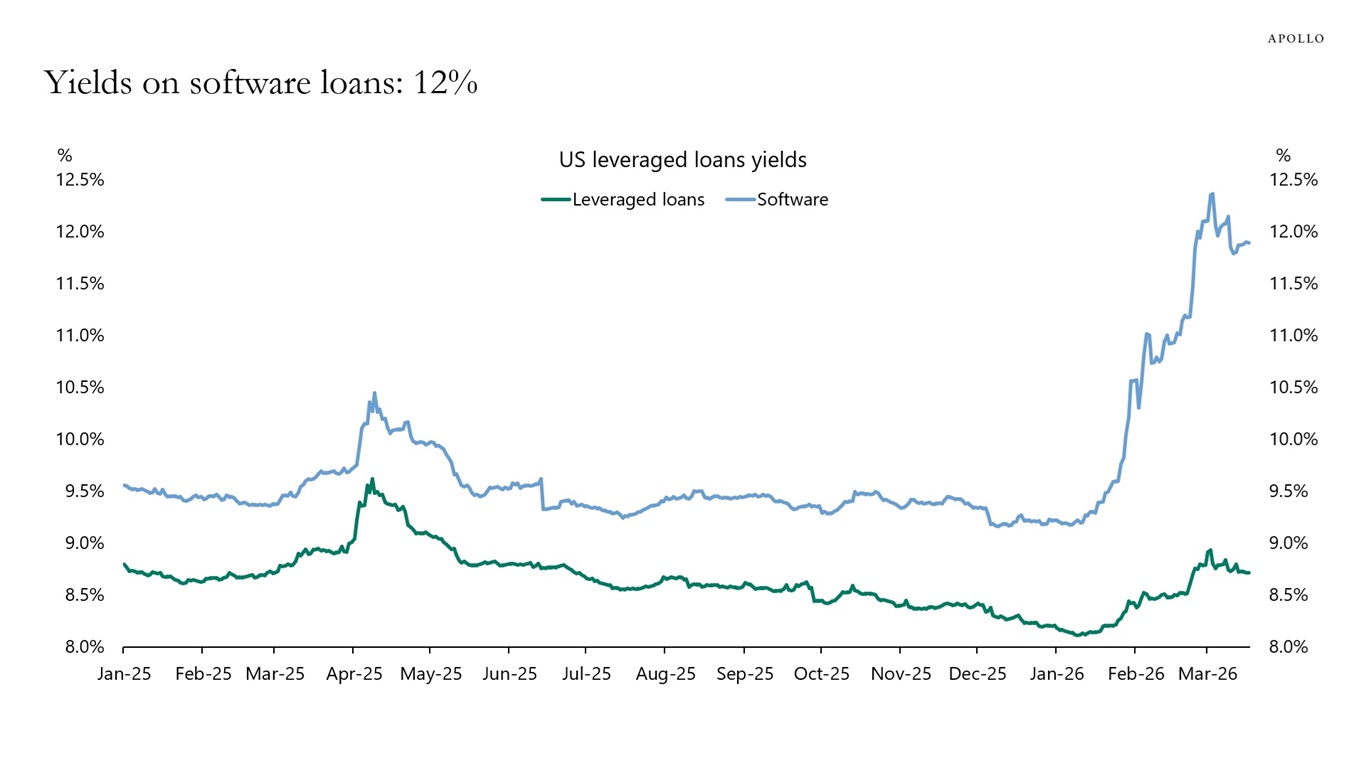
While the yield on software loans has increased significantly, yields on loans more generally have actually been going down, see chart below.
This suggests that the distress in software is largely idiosyncratic, rather than driven by a broad-based macro deterioration in credit conditions.
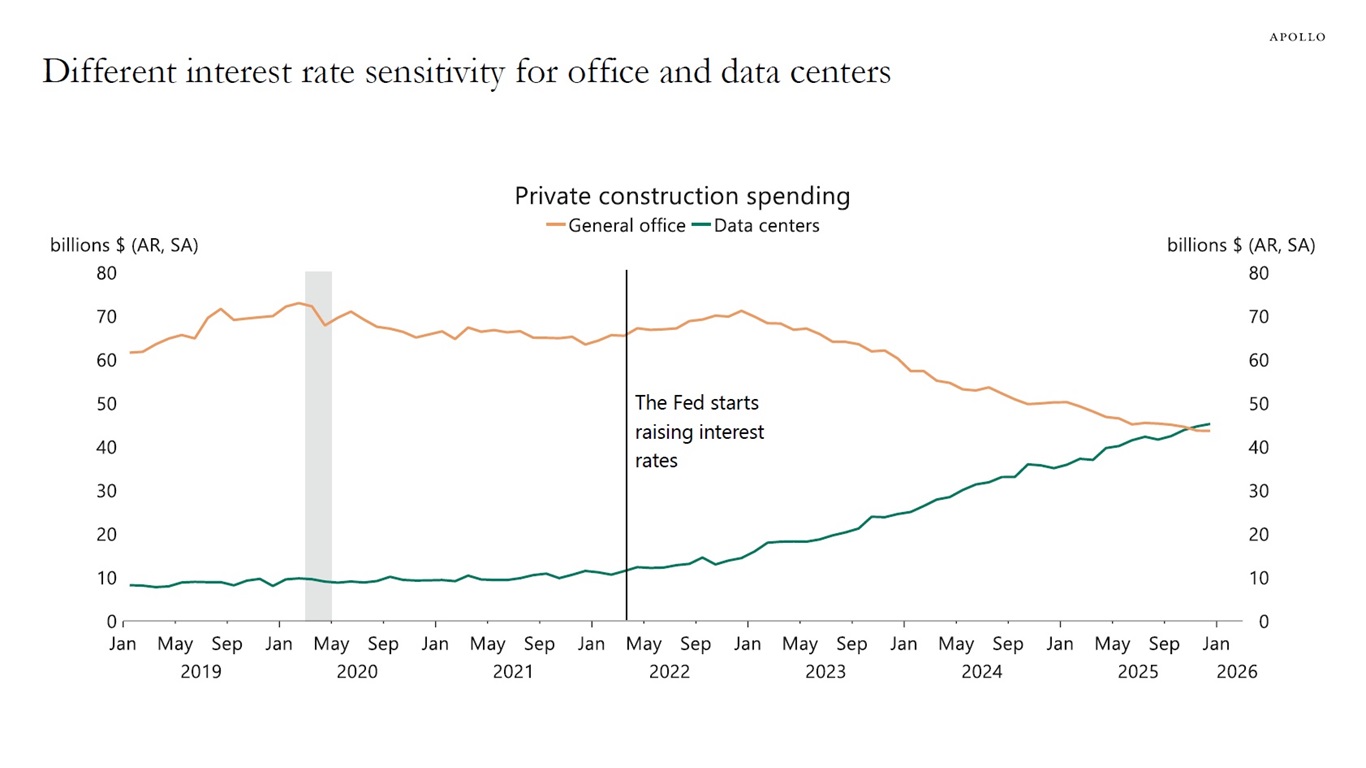
When the Fed began hiking in 2022, traditional rate-sensitive sectors like office construction rolled over quickly. But data center construction continued to surge, as investors and hyperscalers judged that AI-driven returns would exceed the higher cost of capital.
In effect, one of the traditional channels through which monetary tightening slows activity, a pullback in commercial construction, has been partially offset by structurally strong demand for digital infrastructure.
High expected returns and strategic capacity needs in data centers help explain why tighter monetary policy has cooled the economy less than in past cycles.
Combined with the positive growth impulse from the One Big Beautiful Bill, we expect economic growth to remain firm through 2026.
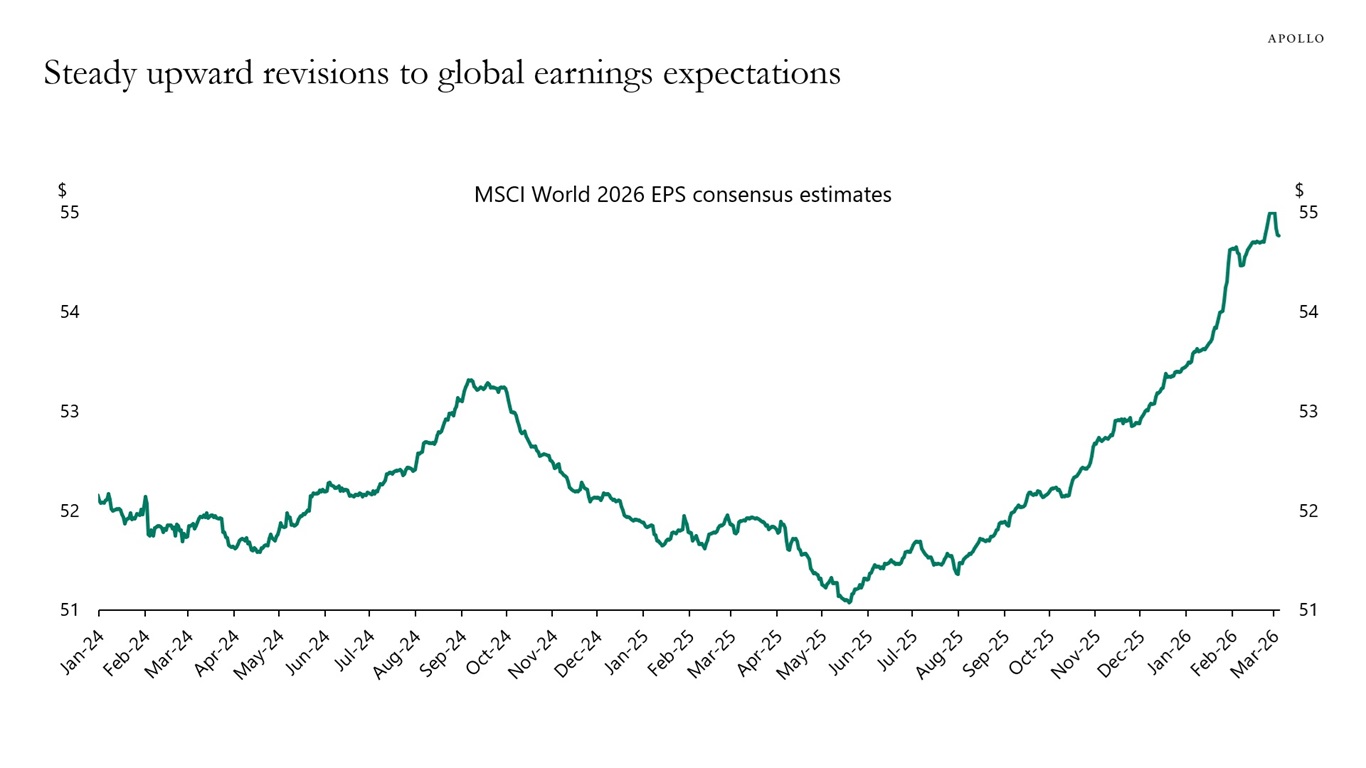
There are no signs of a slowdown in corporate earnings expectations, see chart below.

After a rate-driven repricing that began in 2022, real estate valuations have adjusted meaningfully while underlying fundamentals have remained intact. With capital values reset, supply constrained and income growth resilient, 2026 may represent a favorable point in the cycle to reengage with private real estate.
Key Takeaways:
The information herein is provided for educational purposes only and should not be construed as financial or investment advice, nor should any information in this document be relied on when making an investment decision. Opinions and views expressed reflect the current opinions and views of the authors and Apollo Analysts as of the date hereof and are subject to change. Please see the end of this document for important disclosure information.
Important Disclosure Information
This presentation is for educational purposes only and should not be treated as research. This presentation may not be distributed, transmitted or otherwise communicated to others, in whole or in part, without the express written consent of Apollo Global Management, Inc. (together with its subsidiaries, “Apollo”).
The views and opinions expressed in this presentation are the views and opinions of the author(s) of the White Paper. They do not necessarily reflect the views and opinions of Apollo and are subject to change at any time without notice. Further, Apollo and its affiliates may have positions (long or short) or engage in securities transactions that are not consistent with the information and views expressed in this presentation. There can be no assurance that an investment strategy will be successful. Historic market trends are not reliable indicators of actual future market behavior or future performance of any particular investment which may differ materially, and should not be relied upon as such. Target allocations contained herein are subject to change. There is no assurance that the target allocations will be achieved, and actual allocations may be significantly different than that shown here. This presentation does not constitute an offer of any service or product of Apollo. It is not an invitation by or on behalf of Apollo to any person to buy or sell any security or to adopt any investment strategy, and shall not form the basis of, nor may it accompany nor form part of, any right or contract to buy or sell any security or to adopt any investment strategy. Nothing herein should be taken as investment advice or a recommendation to enter into any transaction.
Hyperlinks to third-party websites in this presentation are provided for reader convenience only. There can be no assurance that any trends discussed herein will continue. Unless otherwise noted, information included herein is presented as of the dates indicated. This presentation is not complete and the information contained herein may change at any time without notice. Apollo does not have any responsibility to update the presentation to account for such changes. Apollo has not made any representation or warranty, expressed or implied, with respect to fairness, correctness, accuracy, reasonableness, or completeness of any of the information contained herein, and expressly disclaims any responsibility or liability therefore. The information contained herein is not intended to provide, and should not be relied upon for, accounting, legal or tax advice or investment recommendations. Investors should make an independent investigation of the information contained herein, including consulting their tax, legal, accounting or other advisors about such information. Apollo does not act for you and is not responsible for providing you with the protections afforded to its clients.
Certain information contained herein may be “forward-looking” in nature. Due to various risks and uncertainties, actual events or results may differ materially from those reflected or contemplated in such forward-looking information. As such, undue reliance should not be placed on such information. Forward-looking statements may be identified by the use of terminology including, but not limited to, “may”, “will”, “should”, “expect”, “anticipate”, “target”, “project”, “estimate”, “intend”, “continue” or “believe” or the negatives thereof or other variations thereon or comparable terminology.
The Standard & Poor’s 500 (“S&P 500”) Index is a market-capitalization-weighted index of the 500 largest U.S. publicly traded companies by market value.
Additional information may be available upon request.
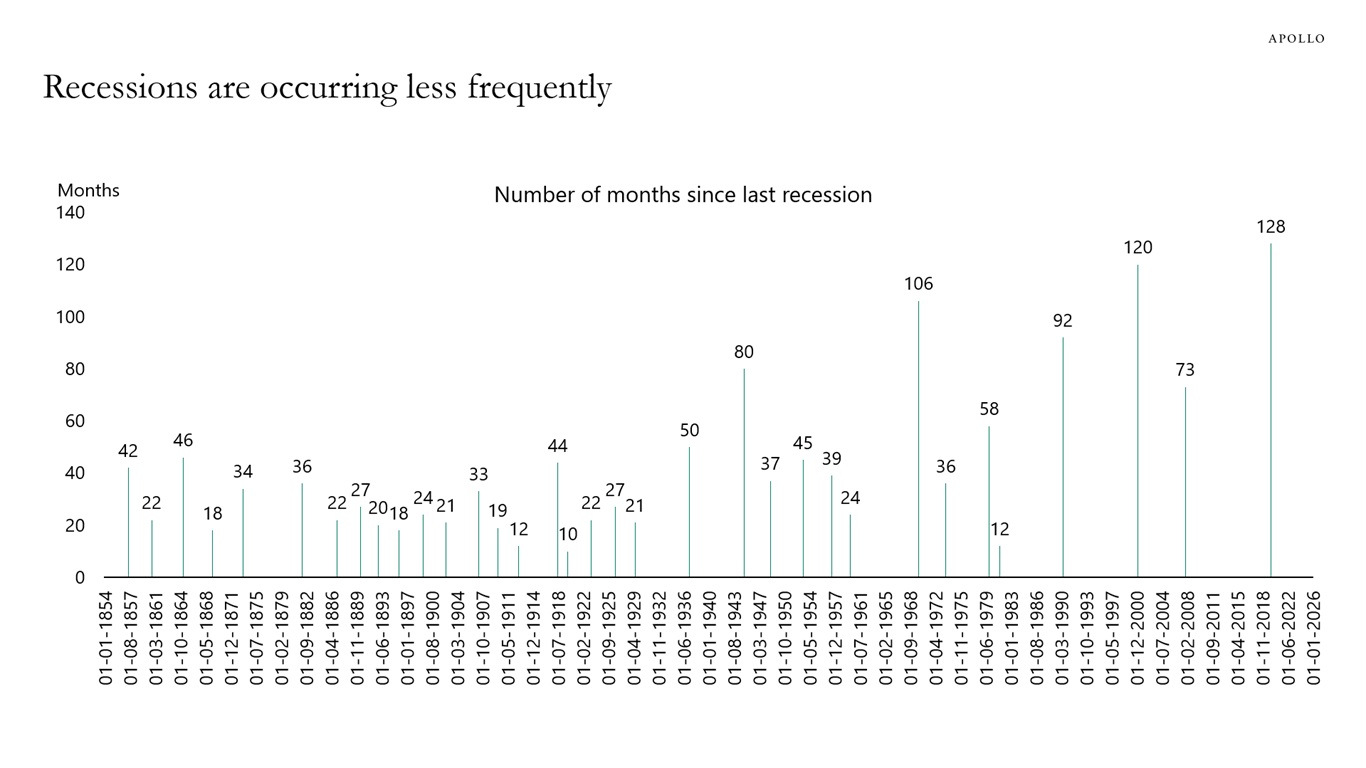
Recessions are occurring less frequently, see chart below. For investors, this means full-blown credit cycles occur less often.
Between recessions, investors should prepare for sector-specific cycles, such as the current downturn in software, where one or two subsectors face distress while the rest of the economy is fine.
The bottom line is that credit opportunities arise not just during recessions, but also when there are sector-specific cycles during expansions. Examples are the energy credit cycle from 2014 to 2016, the brick-and-mortar retail cycle from 2016 to 2019, the commercial real estate cycle from 2022 to 2024 and the software cycle since late 2025.
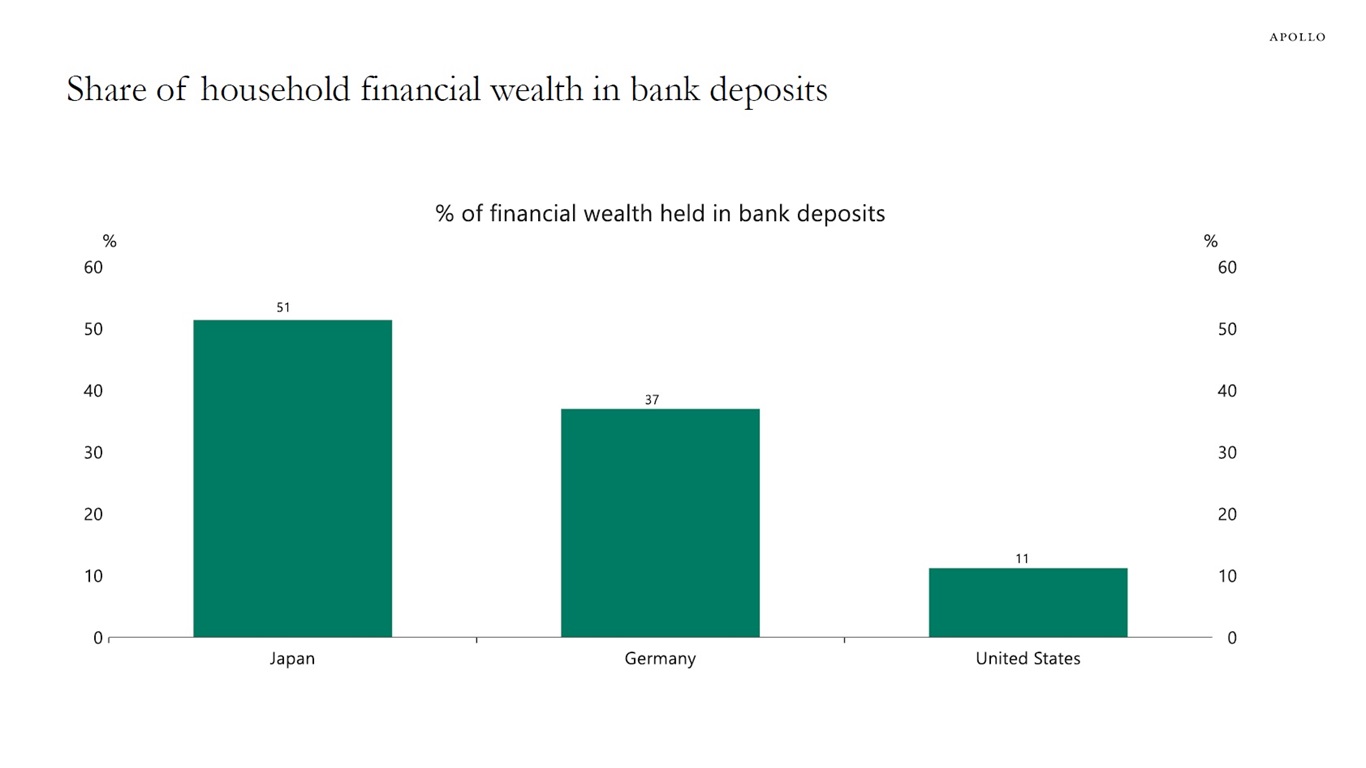
The share of financial wealth in bank deposits is 51% in Japan, 37% in Germany and 11% in the United States, see chart below.
The bottom line is that there is enormous potential for consumers to put more money into yield products.
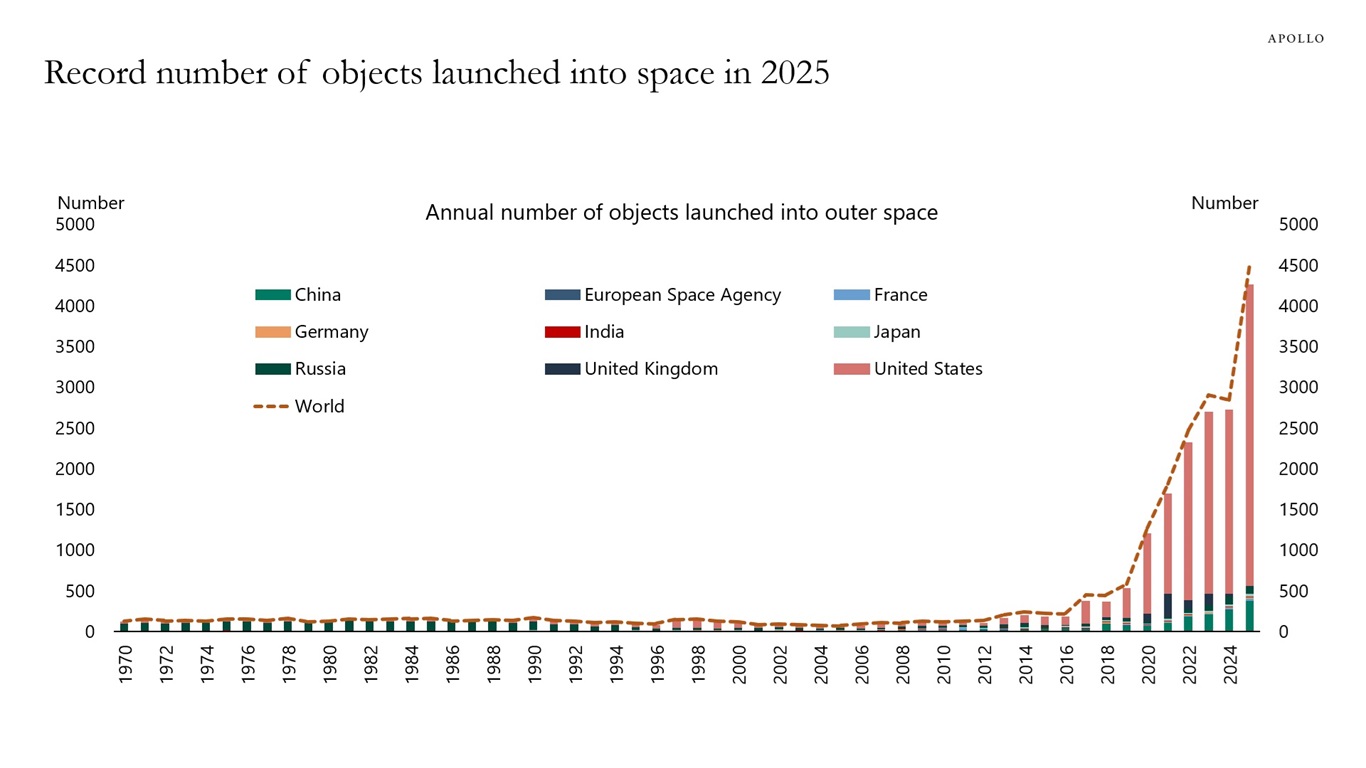
More than 4,500 objects were launched into space in 2025, up from 600 in 2019.