• Apollo.com
  • Login
  • Register Now
light site-logo
  • The Academy
  • Upcoming Events
        • Upcoming Events

  • Learning Center
        • New & UpdatedAlternative Investing Course 2.0

        • Alternative Investing Essentials Part OnePrivate Equity, Venture Capital, Private Credit
        • Alternative Investing Essentials Part TwoReal Estate, Infrastructure, Digital Assets, Hedge Funds
        • Practical ConsiderationsAsset Allocation, Risk Considerations, Fund Structures, Fees
        • Introductory Videos

          View All Videos

        •  Recent Classes & Videos

        • • The Evolution of DC Portfolios: Rethinking Income, Risk and Diversification
        • • 2026 Outlook
        • • Private Equity’s Edge: Delivering Alpha in a Changing Market
        • • Powering Innovation: Infrastructure Investing Across the AI Value Chain
        • • Mid-Year Outlook: At the Crossroads of Stagflation — What’s Next?
        • • Hybrid Investments: Flexible Structures for Volatile Times
        • • Private Credit Investing in Volatile Times
        • View All Classes

  • Alternative Perspectives
        • Investment Knowledge
        • The View from Apollo
          • Investment Knowledge

            A Reset in Software — And Why Discipline Always Matters

            March 31, 2026
          • The View From Apollo

            Private Equity Portfolios: Three Key Dimensions of Diversification

            March 31, 2026
          • Investment Knowledge White Papers

            Why Real Estate in 2026?

            March 17, 2026
  • The Daily Spark
  • Register for Apollo Academy: Alternative Investing Course
  • Login
  • About Apollo Academy
  • Upcoming Events
  • Learning Center
  • Alternative Perspectives
  • The Daily Spark
  • Register for Apollo Academy: Alternative Investing Course
  • Login
  • Alternative Investing Course 2.0
  • 2026 Outlook
  • Private Equity’s Edge: Delivering Alpha in a Changing Market
  • Powering Innovation: Infrastructure Investing Across the AI Value Chain
  • Mid-Year Outlook: At the Crossroads of Stagflation — What’s Next?
  • Hybrid Investments: Flexible Structures for Volatile Times
  • Private Credit Investing in Volatile Times
  • View All Classes
  • Introductory Videos
  • Alternative Investing Essentials Part One • Now Available On Demand
  • Alternative Investing Essentials Part Two • Now Available On Demand
  • Practical Considerations • Now Available On Demand
  • Investment Knowledge
  • The View from Apollo
Home March 2026

A Reset in Software — And Why Discipline Always Matters

Software has been one of private equity’s most active and crowded sectors over the past decade, underpinned by a value creation model built on assumptions of durable revenue growth, plentiful leverage and high multiples at exit. Indeed, software transactions have accounted for approximately 40% of deal flow in recent years[1], reflecting expectations that are now being questioned.

Key Takeaways:

  • Software valuations and growth assumptions are being reset as higher rates and AI challenge long-standing private equity underwriting models.
  • A significant portion of prior value creation in software was driven by multiple expansion rather than operational improvement.
  • Realized outcomes, including DPI, may diverge from prior marks as exits test valuation assumptions and fund rankings.
  • The next cycle may favor disciplined underwriting, cash flow generation and assets with more durable and controllable value drivers.

The current reset is not a dismissal of software’s long-term relevance, but a reassessment of business models, valuation and financing — namely the assumptions regarding growth durability, capital structures and exit multiples in a world shaped by higher rates and accelerating AI disruption.

Against a backdrop of crowding, high valuations and high leverage, we have maintained zero exposure to growth software in our last two private equity vintages. In any environment, we believe underwriting discipline — particularly around growth durability, pricing power and capital structure — is critical. Our position reflects a deliberate risk management decision grounded in downside protection, balance sheet resilience, controllable operational value creation and a strict policy of diversification.

Initially, private equity’s involvement in software was primarily through growth equity investments. This was before large-scale buyouts became common, and these were typically minority investments with little, if any, leverage. Over the past decade, the opportunity set evolved. As recurring revenue models of software companies scaled and margins expanded, software deals increasingly moved from growth equity portfolios into leveraged buyout strategies. The appeal of predictable recurring revenue, mission-critical applications, rising user growth, high customer retention and operating leverage supported higher purchase multiples, value creation opportunities and greater use of leverage.

But public software valuations have corrected sharply, with the S&P North American Technology Software Index falling as much as 35% from its September 2025 peak. In private markets, valuation adjustments tend to occur through new transactions, exits and comparable deal activity, meaning the full impact will emerge over time. That said, with mostly unlevered software companies having traded down by almost one-fifth, levered private software companies are expected to be marked down further while we await a final resolution.

The SaaSpocalypse — Or at Least a Structural Reset

The narrative that “software is eating the world” was directionally sound. But as in other cycles, a compelling trend did not mean correct price. 

A significant share of US buyout volume in recent years was concentrated in software, reflecting not only strong secular growth but also a structural shift within private equity. What was once the domain of sector specialists increasingly became a core focus for scaled generalist firms that built dedicated software capabilities. At the peak, growth software combined high purchase prices, elevated leverage and in many cases limited free cash flow. According to industry data, average purchase multiples approached 15–20x EBITDA with approximately 6x leverage and were often materially higher for premium assets.[2]    

AI did not create the risk of structural disruption to software business models. It accelerated these dynamics by lowering barriers to entry, increasing competition and heightening uncertainty around pricing power and the durability of growth. In practical terms, this may manifest through increased pricing pressure, faster product replication and shorter innovation cycles. As AI reduces development costs and accelerates feature parity, differentiation may erode in more commoditized segments of software, compressing margins and making growth less durable than historical underwriting assumptions suggested. As a result and as we’ve noted, private equity is now confronting a reset in valuations as investors rethink the economic model and growth durability of software businesses.

Software moats are not disappearing — they are becoming more permeable and less predictable. The old assumption that seats, annual recurring revenue and multiples would expand predictably is being challenged. This is not uniform across the sector. Mission-critical systems of record, deeply embedded workflows and core infrastructure software may retain durability, while more tool-like or workflow-adjacent applications face greater risk of disruption as AI lowers barriers to entry. Meanwhile adoption is likely to be uneven and slower in enterprise environments, where reliability, integration and compliance requirements can delay disruption, even if long-term competitive dynamics are shifting — questions and uncertainty have now replaced stability and confidence, which is not conducive to strong valuations.

From Unlevered Growth to Leveraged Buyouts 

It is worth remembering that software was once largely an unlevered growth equity investment. Over time, it migrated into mainstream leveraged buyout portfolios. 

In 2021 alone, private equity deployed record capital into software — $348 billion globally — often at peak valuations.[3] Capital structures increasingly incorporated elevated leverage and underwriting assumptions predicated on durable growth, stable cash flows and exit multiple resilience. When two of the three traditional value levers — growth and exit multiples — come under pressure, leverage magnifies the downside risk. The consequences extend beyond marks, influencing exit timing, holding periods and ultimately realized returns.

Software buyouts now represent a significant portion of industry deployment. In fact, approximately 85% of all technology deals from 2016 to 2025 in private equity have been software-related.[4] This may underestimate the exposure, as many business services and healthcare deals, for example, are actually plays on software. Yet exits have not kept pace with deal activity, with deployment in recent years running at roughly five times exits,[5] and recent returns were often based on marks rather than realized distributions, with initial underwriting in many cases implying return outcomes that have yet to be validated through actual exits. Ultimately, DPI reflects outcomes, not marks. As many pandemic-era investments approach the end of traditional holding periods, the question becomes: what happens when assets are sold? 

It is also fair to ask whether the quartile rankings of these largely unrealized funds will hold up, or whether they are likely to reset lower as holding periods elongate. The coming quarters will test whether current valuations have fully incorporated public market resets, particularly given that private marks are often anchored to lagging transactions, and whether realized DPI ultimately supports prior paper gains. 

DPI, Marks and Performance Rankings 

In periods of strong multiple expansion, value creation is often attributed to market sentiment. But sentiment-driven value can prove fragile and slow to convert into realized outcomes. In software specifically, a significant portion of value creation in the decade leading up to 2023 was driven by multiple expansion, much of it unrealized, rather than operational improvement.[6] As public multiples reset, buyers and sellers have faced mismatched expectations, contributing to slower exit activity and extended hold periods. While signs of renewed M&A activity are emerging, the durability of distributions will ultimately determine whether prior paper gains translate into realized returns.

When multiple expansion reverses, marks become more difficult to defend. This raises two structural questions: 

  1. How will realized outcomes compare with current carrying values in levered software portfolios? 
  2. If exits occur below prior carrying values, how will that affect DPI and quartile rankings? 

Quartile rankings based on unrealized marks during a period of peak multiples may look different after realizations. In dislocated markets, realized outcomes matter more than modeled IRRs. 

Renewed Demand for HALO 

As the software cycle resets, capital may be redirected toward businesses with hard assets, lower obsolescence risk (“HALO” assets) and controllable value creation. In contrast to asset-light models facing disruption risk, HALO assets increasingly represent the physical and balance sheet foundation required to sustain the next wave of AI growth — where AI is a tool, not a disruptor. These HALO assets span our core sectors, including technology, leisure, industrials, business services, transportation and logistics, as well as media and gaming. As trillions of dollars flow into digital infrastructure, power and transmission capacity, the value of durable, capital-intensive assets with long asset lives and stable cash flow profiles is likely to rise. In that sense, HALO is not simply defensive positioning — it is participation in the infrastructure backbone of what we call the Global Industrial Renaissance.

In our view, the next cycle is likely to reward: 

  • Profitable revenue growth over growth at any price 
  • Resilience over narrative 
  • Cash flow generation over multiple expansion 

As markets continue to digest the long-term transformational impact of AI, the advantage may accrue not to those who own commoditized code, but to those who control scaled, real-economy assets that AI can materially enhance. Increasingly, software may be the tool, not the asset. The enduring winners may not be AI businesses, but rather businesses in the traditional economy that harness AI to drive durable efficiency gains.

What About Software Buyouts Now? 

Public software valuations have corrected, while capital structures in private markets remain largely intact. The open question is not simply whether software buyouts become attractive again at lower prices, but which business models can demonstrate durable competitive advantages in a world shaped by AI and evolving cost structures. As valuations reset, the opportunity may lie in distinguishing between models that were previously overvalued and those whose resilience may now be undervalued. This dislocation may also create selective opportunities for deleveraging transactions, where high-quality businesses are saddled with overlevered capital structures, and reducing leverage frees up capital to fund growth.

A reset creates opportunity. But discipline matters. 

History shows that trends look compelling on the way up as growth creates a narrative of invincibility: railroads, telecom, dot-com, the housing market, shale energy and SaaS. The pattern is familiar: correct thesis, wrong price and ultimately poor investment outcomes — as fundamentals reassert themselves. 

We believe private equity will adapt, as it has through prior cycles — by tightening underwriting, focusing on sustainable value creation and prioritizing realized value and diversification.

But this period may be remembered as a case study in sector concentration risk, leverage layered onto growth assumptions and the limits of multiple-driven value creation, as well as a lack of risk management, experience and expertise. 

Cycles ultimately test underwriting. In the years ahead, realized outcomes — not narratives — will determine who truly created value. 


[1] Sources: White & Case, Deutsche Bank

[2] Sources: PitchBook LCD as of 2025 and Bain & Co. as of 2023

[3] Source: Bloomberg compiled data

[4] Source: Bain & Company Global Private Equity Report 2026

[5] Note: For software deals and exits from 2020-2025. Source: PitchBook

[6] Bain & Company Global Private Equity Report 2025


The information herein is provided for educational purposes only and should not be construed as financial or investment advice, nor should any information in this document be relied on when making an investment decision. Opinions and views expressed reflect the current opinions and views of the authors and Apollo Analysts as of the date hereof and are subject to change. Please see the end of this document for important disclosure information.


Important Disclosure Information

All information contained in this material is as of March 2026 unless otherwise indicated.

This material is for informational purposes only and should not be treated as research. This material should not be copied, distributed, published, or reproduced, in whole or in part, or disclosed by any recipient to any other person without the express written consent of Apollo Global Management, Inc. (together with its subsidiaries, “Apollo”).

The views and opinions expressed in this material are the views and opinions of Apollo Analysts. They may not reflect the views and opinions of Apollo and are subject to change at any time without notice. Further, Apollo and its affiliates may have positions (long or short) or engage in securities transactions that are not consistent with the information and views expressed in this material. There can be no assurance that an investment strategy will be successful. This material does not constitute an offer of any service or product of Apollo. It is not an invitation by or on behalf of Apollo to any person to buy or sell any security or to adopt any investment strategy, and shall not form the basis of, nor may it accompany nor form part of, any right or contract to buy or sell any security or to adopt any investment strategy. Nothing in this material should be taken as investment advice or a recommendation to enter into any transaction.

Hyperlinks to third-party websites in this material are provided for reader convenience only. There can be no assurances that any of the trends described in this material will continue or will not reverse. Past events and trends do not imply, predict or guarantee, and are not necessarily indicative of future events or results. Unless otherwise noted, information included in this material is presented as of the dates indicated. This material is not complete and the information contained in this material may change at any time without notice. Apollo does not have any responsibility to update the material to account for such changes. Apollo has not made any representation or warranty, expressed or implied, with respect to fairness, correctness, accuracy, reasonableness, or completeness of any of the information contained in this material (including but not limited to information obtained from third parties unrelated to Apollo), and expressly disclaims any responsibility or liability thereof. The information contained in this material is not intended to provide, and should not be relied upon for, accounting, legal or tax advice or investment recommendations. Investors should make an independent investigation of the information contained in this material, including consulting their tax, legal, accounting or other advisors about such information. Apollo does not act for you and is not responsible for providing you with the protections afforded to its clients.

Certain information contained in this material may be “forward-looking” in nature. Due to various risks and uncertainties, actual events or results may differ materially from those reflected or contemplated in such forward-looking information. As such, undue reliance should not be placed on such information. Forward-looking statements may be identified by the use of terminology including, but not limited to, “may”, “will”, “should”, “expect”, “anticipate”, “target”, “project”, “estimate”, “intend”, “continue” or “believe” or the negatives thereof or other variations thereon or comparable terminology.

The Standard & Poor’s 500 Index (S&P 500) is a market-capitalization weighted index of the 500 largest US publicly traded companies and one of the most common benchmarks for the broader US equity markets. Index performance and yield data are shown for illustrative purposes only and have limitations when used for comparison or for other purposes due to, among other matters, volatility, credit or other factors (such as number of investments, recycling or reinvestment of distributions, and types of assets). It may not be possible to directly invest in one or more of these indices and the holdings of any strategy may differ markedly from the holdings of any such index in terms of levels of diversification, types of securities or assets represented and other significant factors. Indices are unmanaged, do not charge any fees or expenses, assume reinvestment of income and do not employ special investment techniques such as leveraging or short selling. No such index is indicative of the future results of any strategy or fund.

Investing involves risk including loss of principal. Alternative investments often are speculative, typically have higher fees than traditional investments often include a high degree of risk and are appropriate only for eligible long-term investors who are willing to forgo liquidity and put capital at risk for an indefinite period of time. They may be highly illiquid and can engage in leverage and other speculative practices that may increase volatility and risk of loss.

References to downside protection are not guarantees against loss of investment capital or value.

This material may reference trade names, trademarks, or service marks of companies that are not owned by Apollo or Apollo funds, or that may be held as investments by Apollo or one or more Apollo funds. The use or display of these companies’ trade names, trademarks, or service marks is not intended to imply any relationship with, or endorsement or sponsorship of Apollo, by such companies. All company names and logos are trademarks of their respective holders.

Past performance is not necessarily indicative of future results. Additional information may be available upon request

Recent Posts

  • Understanding the Rise and Recent Fall in Gold Prices
  • Outlook for Public and Private Markets
  • $20 Bills Falling, $100 Bills Rising
  • 3% vs. 60%
  • Factors Driving Job Losses in Software

Recent Comments

No comments to show.

Archives

  • April 2026
  • March 2026
  • February 2026
  • January 2026
  • December 2025
  • November 2025
  • October 2025
  • September 2025
  • August 2025
  • July 2025
  • June 2025
  • May 2025
  • April 2025
  • March 2025
  • February 2025
  • January 2025
  • December 2024
  • November 2024
  • October 2024
  • September 2024
  • August 2024
  • July 2024
  • June 2024
  • May 2024
  • April 2024
  • March 2024
  • February 2024
  • January 2024
  • December 2023
  • November 2023
  • October 2023
  • September 2023
  • August 2023
  • July 2023
  • June 2023
  • May 2023
  • April 2023
  • March 2023
  • February 2023
  • January 2023
  • December 2022
  • November 2022
  • October 2022
  • September 2022
  • August 2022
  • July 2022
  • June 2022
  • May 2022
  • April 2022
  • March 2022
  • February 2022
  • January 2022
  • December 2021
  • November 2021

Categories

  • Apollo Answers
  • Course Introductions
  • Economic Intelligence
  • Hide from Wordpress Search
  • Investment Knowledge
  • Perspectives
  • Redirecting
  • The Daily Spark
  • The View from Apollo
  • The Weekly Brief
  • Uncategorized
  • White Papers
The View from Apollo - A New Podcast Series

Private Equity Portfolios: Three Key Dimensions of Diversification

Diversification has long been a cornerstone of investing, but what does it really mean in private equity today? In this episode, lead equity product specialist Bryn Gostin explores how diversification across managers, company size and sectors can help support more resilient portfolios in today’s evolving landscape. He explores shifting industry dynamics, the risks of concentrated exposure — particularly in software — and why a more balanced, multi-dimensional approach may be key to building durable private equity portfolios.

Recent Posts

  • Understanding the Rise and Recent Fall in Gold Prices
  • Outlook for Public and Private Markets
  • $20 Bills Falling, $100 Bills Rising
  • 3% vs. 60%
  • Factors Driving Job Losses in Software

Recent Comments

No comments to show.

Archives

  • April 2026
  • March 2026
  • February 2026
  • January 2026
  • December 2025
  • November 2025
  • October 2025
  • September 2025
  • August 2025
  • July 2025
  • June 2025
  • May 2025
  • April 2025
  • March 2025
  • February 2025
  • January 2025
  • December 2024
  • November 2024
  • October 2024
  • September 2024
  • August 2024
  • July 2024
  • June 2024
  • May 2024
  • April 2024
  • March 2024
  • February 2024
  • January 2024
  • December 2023
  • November 2023
  • October 2023
  • September 2023
  • August 2023
  • July 2023
  • June 2023
  • May 2023
  • April 2023
  • March 2023
  • February 2023
  • January 2023
  • December 2022
  • November 2022
  • October 2022
  • September 2022
  • August 2022
  • July 2022
  • June 2022
  • May 2022
  • April 2022
  • March 2022
  • February 2022
  • January 2022
  • December 2021
  • November 2021

Categories

  • Apollo Answers
  • Course Introductions
  • Economic Intelligence
  • Hide from Wordpress Search
  • Investment Knowledge
  • Perspectives
  • Redirecting
  • The Daily Spark
  • The View from Apollo
  • The Weekly Brief
  • Uncategorized
  • White Papers

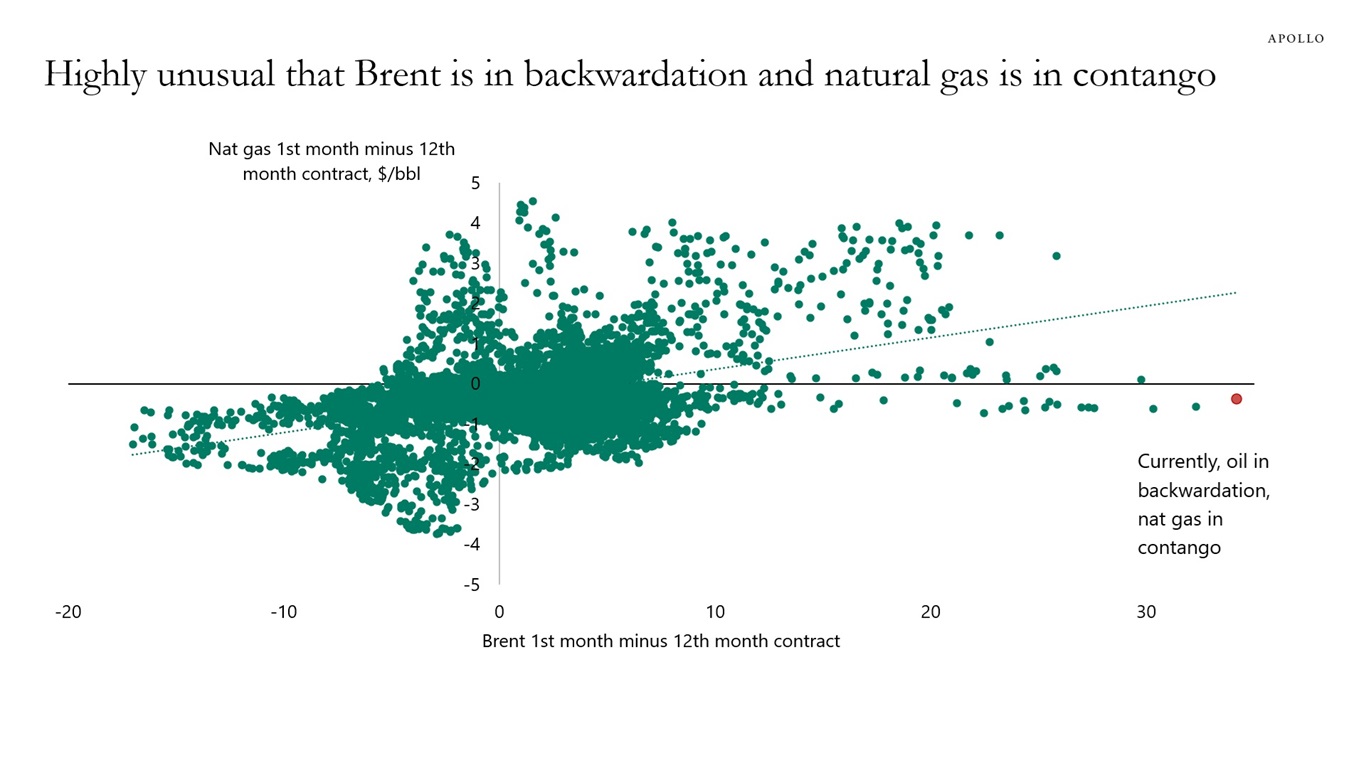
Brent in Backwardation, Natural Gas in Contango

Oil markets are signaling near-term stress while natural gas markets are signaling near-term oversupply, a combination that is almost never seen, see chart below.

Our chart book looking at energy demand and supply and the Strait of Hormuz is available here.

Highly unusual that Brent is in backwardation and natural gas is in contango
Sources: Bloomberg, Apollo Chief Economist

Download high-res chart book

Recent Posts

  • Understanding the Rise and Recent Fall in Gold Prices
  • Outlook for Public and Private Markets
  • $20 Bills Falling, $100 Bills Rising
  • 3% vs. 60%
  • Factors Driving Job Losses in Software

Recent Comments

No comments to show.

Archives

  • April 2026
  • March 2026
  • February 2026
  • January 2026
  • December 2025
  • November 2025
  • October 2025
  • September 2025
  • August 2025
  • July 2025
  • June 2025
  • May 2025
  • April 2025
  • March 2025
  • February 2025
  • January 2025
  • December 2024
  • November 2024
  • October 2024
  • September 2024
  • August 2024
  • July 2024
  • June 2024
  • May 2024
  • April 2024
  • March 2024
  • February 2024
  • January 2024
  • December 2023
  • November 2023
  • October 2023
  • September 2023
  • August 2023
  • July 2023
  • June 2023
  • May 2023
  • April 2023
  • March 2023
  • February 2023
  • January 2023
  • December 2022
  • November 2022
  • October 2022
  • September 2022
  • August 2022
  • July 2022
  • June 2022
  • May 2022
  • April 2022
  • March 2022
  • February 2022
  • January 2022
  • December 2021
  • November 2021

Categories

  • Apollo Answers
  • Course Introductions
  • Economic Intelligence
  • Hide from Wordpress Search
  • Investment Knowledge
  • Perspectives
  • Redirecting
  • The Daily Spark
  • The View from Apollo
  • The Weekly Brief
  • Uncategorized
  • White Papers

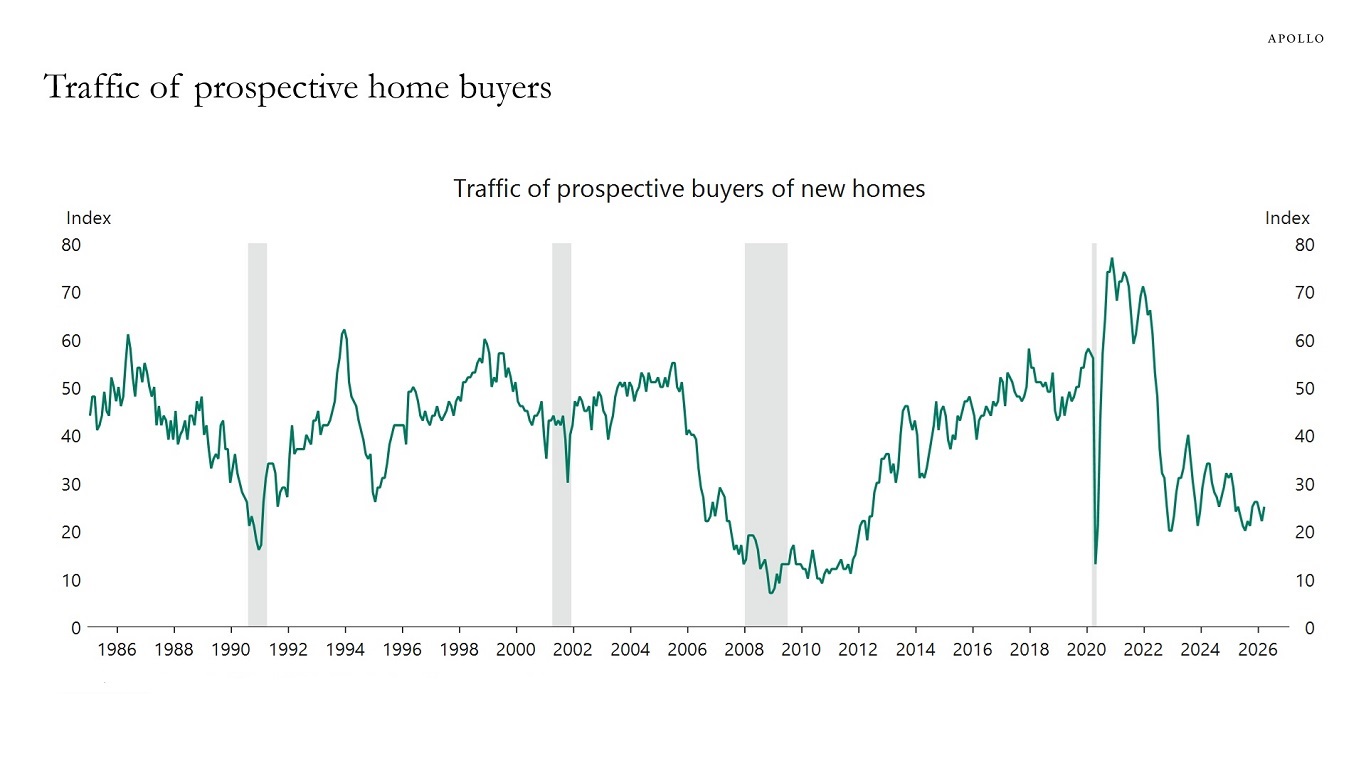
US Housing Outlook: Higher Mortgage Rates Not Helpful

In our latest US housing outlook, available here, we look at demand and supply in the housing market.

Traffic of prospective home buyers
Sources: National Association of Home Builders, Macrobond, Apollo Chief Economist

Download high-res chart book

Recent Posts

  • Understanding the Rise and Recent Fall in Gold Prices
  • Outlook for Public and Private Markets
  • $20 Bills Falling, $100 Bills Rising
  • 3% vs. 60%
  • Factors Driving Job Losses in Software

Recent Comments

No comments to show.

Archives

  • April 2026
  • March 2026
  • February 2026
  • January 2026
  • December 2025
  • November 2025
  • October 2025
  • September 2025
  • August 2025
  • July 2025
  • June 2025
  • May 2025
  • April 2025
  • March 2025
  • February 2025
  • January 2025
  • December 2024
  • November 2024
  • October 2024
  • September 2024
  • August 2024
  • July 2024
  • June 2024
  • May 2024
  • April 2024
  • March 2024
  • February 2024
  • January 2024
  • December 2023
  • November 2023
  • October 2023
  • September 2023
  • August 2023
  • July 2023
  • June 2023
  • May 2023
  • April 2023
  • March 2023
  • February 2023
  • January 2023
  • December 2022
  • November 2022
  • October 2022
  • September 2022
  • August 2022
  • July 2022
  • June 2022
  • May 2022
  • April 2022
  • March 2022
  • February 2022
  • January 2022
  • December 2021
  • November 2021

Categories

  • Apollo Answers
  • Course Introductions
  • Economic Intelligence
  • Hide from Wordpress Search
  • Investment Knowledge
  • Perspectives
  • Redirecting
  • The Daily Spark
  • The View from Apollo
  • The Weekly Brief
  • Uncategorized
  • White Papers

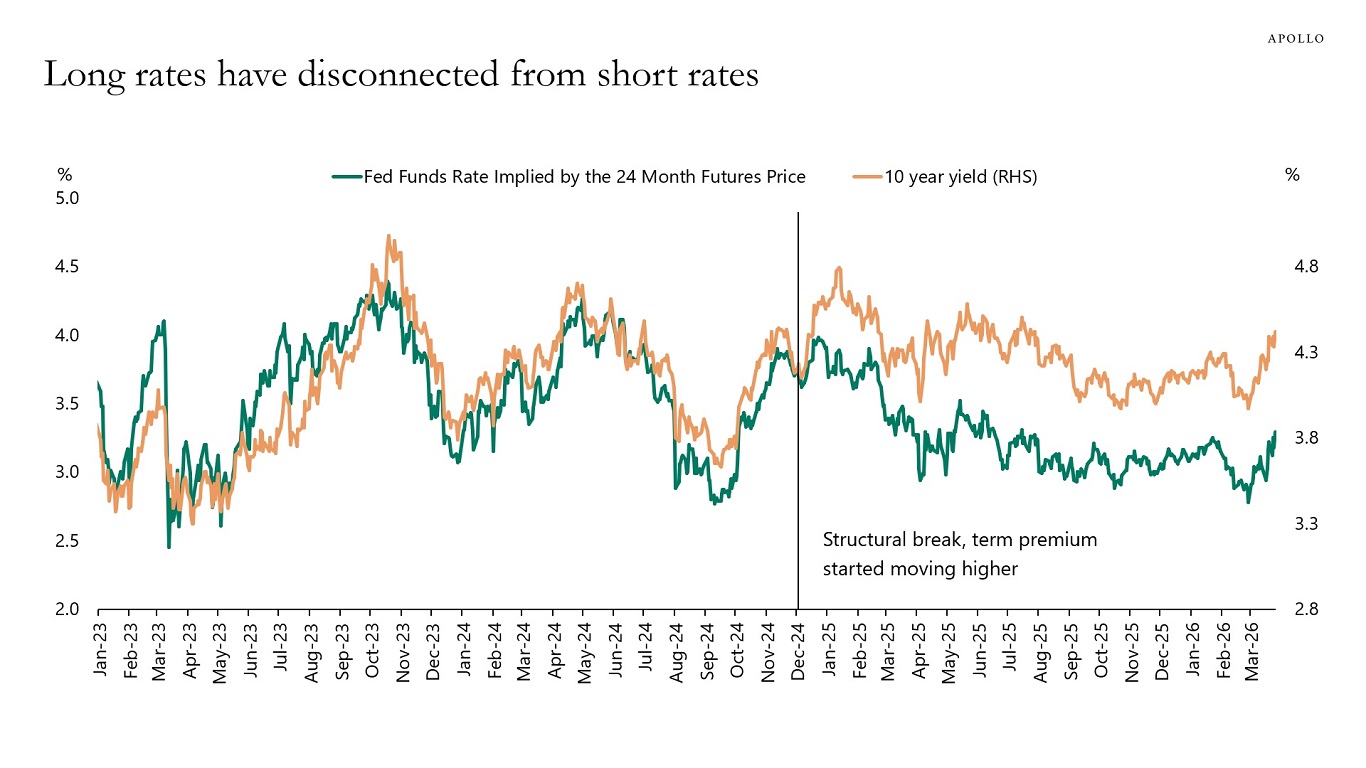
10-Year Yields Are Higher Than They Should Be

Long-term interest rates are normally driven by Fed expectations.

But a premium has emerged, and 10-year rates today should not be at 4.4%, but instead at 3.9%, see chart below.

The sources of the rise in the term premium could be fiscal worries, QT, lower foreign demand or concerns about Fed independence, including the possibility that the Fed could in the future raise the inflation target, leading to greater inflation variability.

The bottom line is that the 10-year yield is 55 bps higher than where it should be, and investors need to think about why.

For more discussion see also Fed papers here, here and here.

Long rates have disconnected from short rates
Sources: Haver Analytics, Apollo Chief Economist

Download high-res chart

Recent Posts

  • Understanding the Rise and Recent Fall in Gold Prices
  • Outlook for Public and Private Markets
  • $20 Bills Falling, $100 Bills Rising
  • 3% vs. 60%
  • Factors Driving Job Losses in Software

Recent Comments

No comments to show.

Archives

  • April 2026
  • March 2026
  • February 2026
  • January 2026
  • December 2025
  • November 2025
  • October 2025
  • September 2025
  • August 2025
  • July 2025
  • June 2025
  • May 2025
  • April 2025
  • March 2025
  • February 2025
  • January 2025
  • December 2024
  • November 2024
  • October 2024
  • September 2024
  • August 2024
  • July 2024
  • June 2024
  • May 2024
  • April 2024
  • March 2024
  • February 2024
  • January 2024
  • December 2023
  • November 2023
  • October 2023
  • September 2023
  • August 2023
  • July 2023
  • June 2023
  • May 2023
  • April 2023
  • March 2023
  • February 2023
  • January 2023
  • December 2022
  • November 2022
  • October 2022
  • September 2022
  • August 2022
  • July 2022
  • June 2022
  • May 2022
  • April 2022
  • March 2022
  • February 2022
  • January 2022
  • December 2021
  • November 2021

Categories

  • Apollo Answers
  • Course Introductions
  • Economic Intelligence
  • Hide from Wordpress Search
  • Investment Knowledge
  • Perspectives
  • Redirecting
  • The Daily Spark
  • The View from Apollo
  • The Weekly Brief
  • Uncategorized
  • White Papers

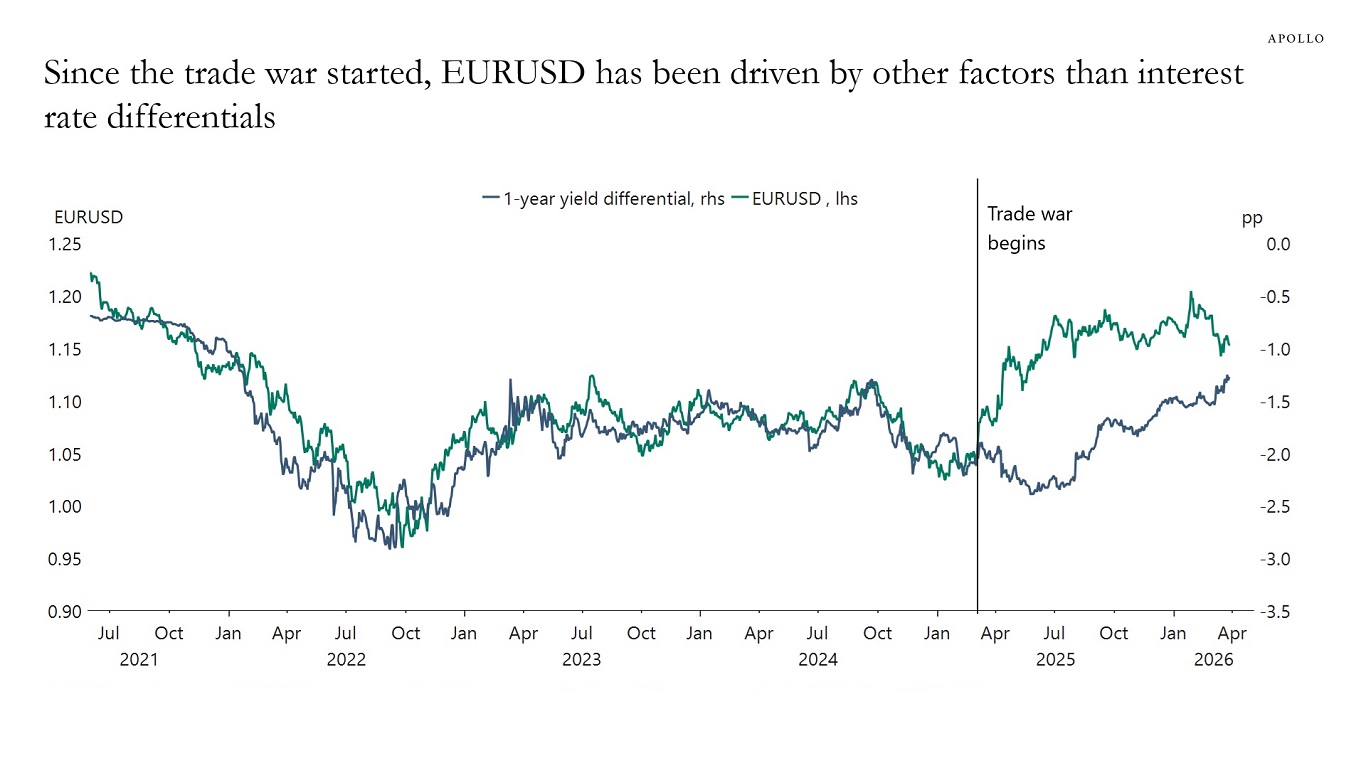
FX and Rates Converging Again

Since the trade war began, the dollar has traded weaker than interest-rate differentials would have predicted, see chart below. We expect to see convergence between FX and yield differentials as higher-for-longer rates in the US continue to attract investment from abroad and put upward pressure on the dollar.

Since the trade war started, EURUSD has been driven by other factors than interest rate differentials
Note: 1-year yield differential = 1-year German government bill minus 1-year US T-bill. pp = percentage points. Sources: Bloomberg, Macrobond, Apollo Chief Economist

Download high-res chart

Recent Posts

  • Understanding the Rise and Recent Fall in Gold Prices
  • Outlook for Public and Private Markets
  • $20 Bills Falling, $100 Bills Rising
  • 3% vs. 60%
  • Factors Driving Job Losses in Software

Recent Comments

No comments to show.

Archives

  • April 2026
  • March 2026
  • February 2026
  • January 2026
  • December 2025
  • November 2025
  • October 2025
  • September 2025
  • August 2025
  • July 2025
  • June 2025
  • May 2025
  • April 2025
  • March 2025
  • February 2025
  • January 2025
  • December 2024
  • November 2024
  • October 2024
  • September 2024
  • August 2024
  • July 2024
  • June 2024
  • May 2024
  • April 2024
  • March 2024
  • February 2024
  • January 2024
  • December 2023
  • November 2023
  • October 2023
  • September 2023
  • August 2023
  • July 2023
  • June 2023
  • May 2023
  • April 2023
  • March 2023
  • February 2023
  • January 2023
  • December 2022
  • November 2022
  • October 2022
  • September 2022
  • August 2022
  • July 2022
  • June 2022
  • May 2022
  • April 2022
  • March 2022
  • February 2022
  • January 2022
  • December 2021
  • November 2021

Categories

  • Apollo Answers
  • Course Introductions
  • Economic Intelligence
  • Hide from Wordpress Search
  • Investment Knowledge
  • Perspectives
  • Redirecting
  • The Daily Spark
  • The View from Apollo
  • The Weekly Brief
  • Uncategorized
  • White Papers

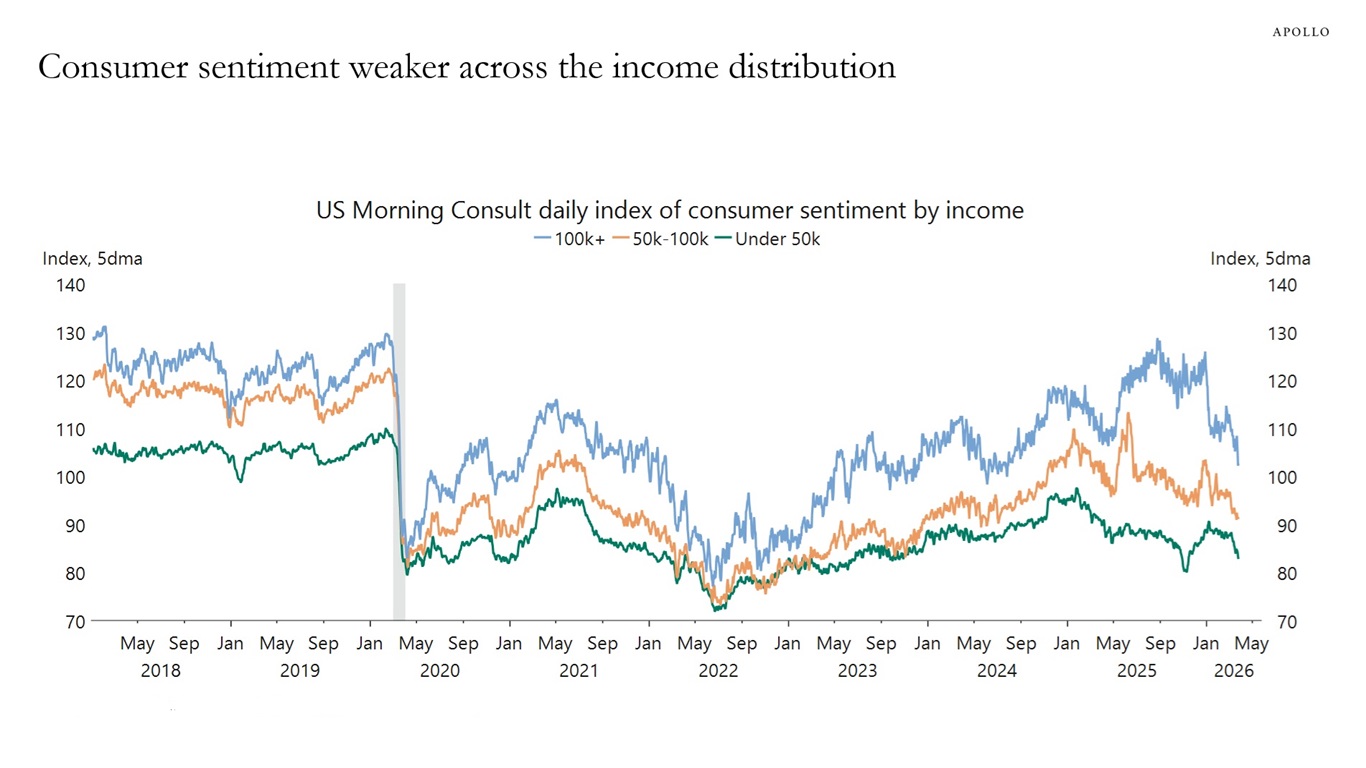
Sentiment Destruction, Not Demand Destruction

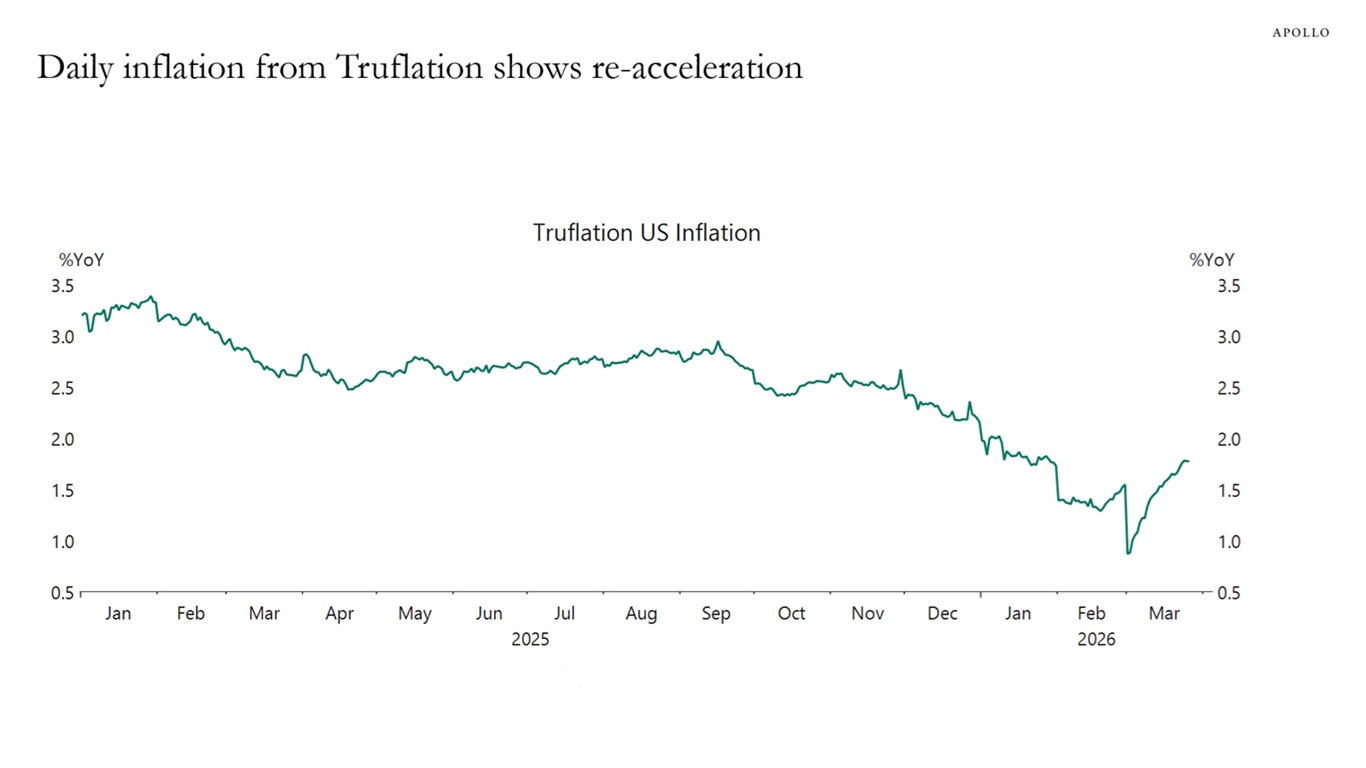
Daily data are starting to show a significant deterioration in inflation expectations and consumer sentiment across the income distribution, see the first two charts below.

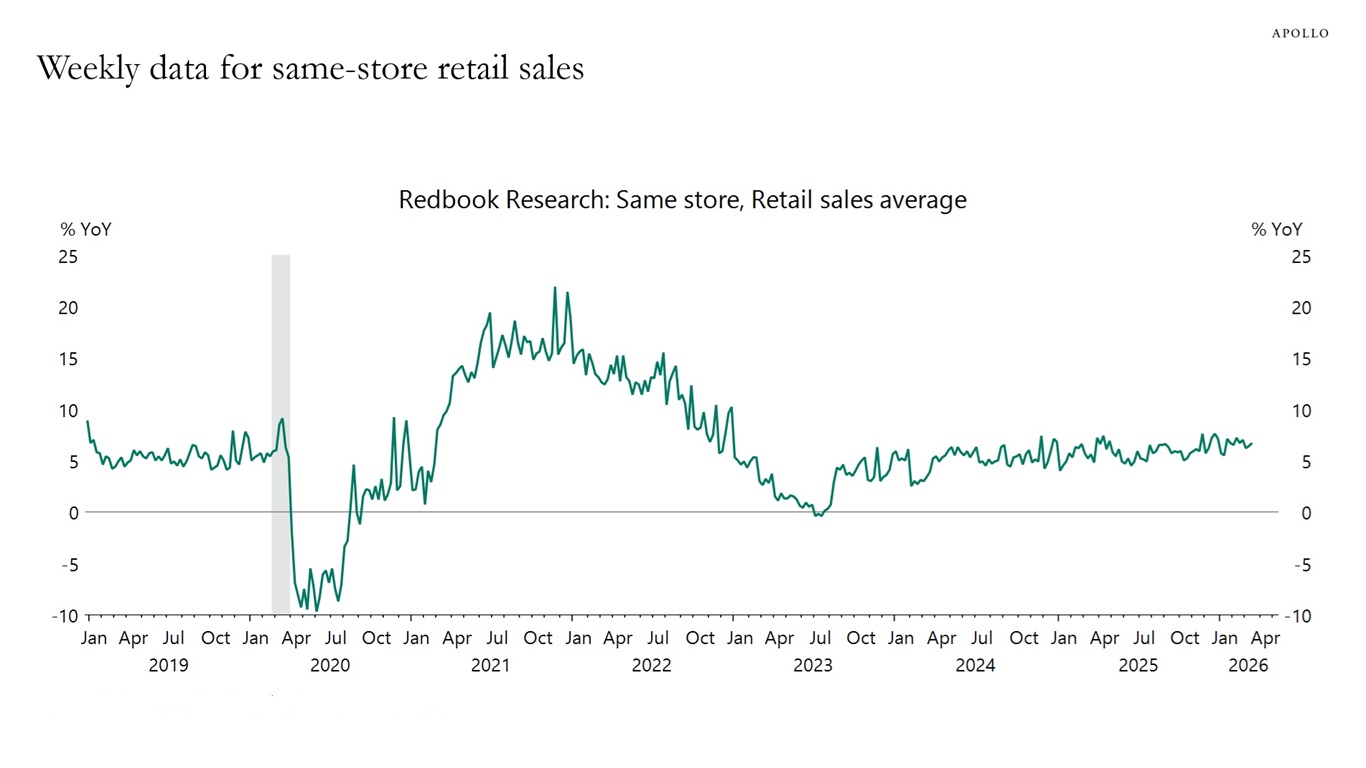
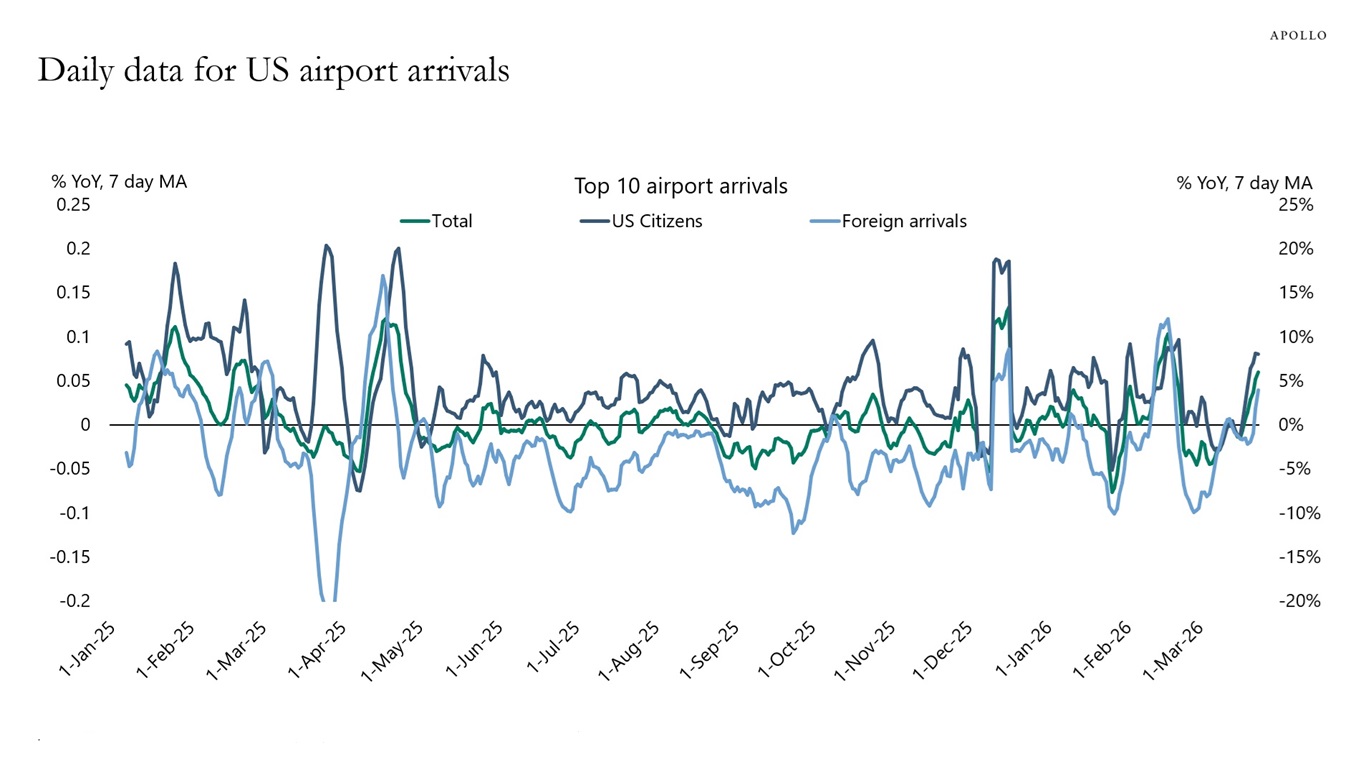
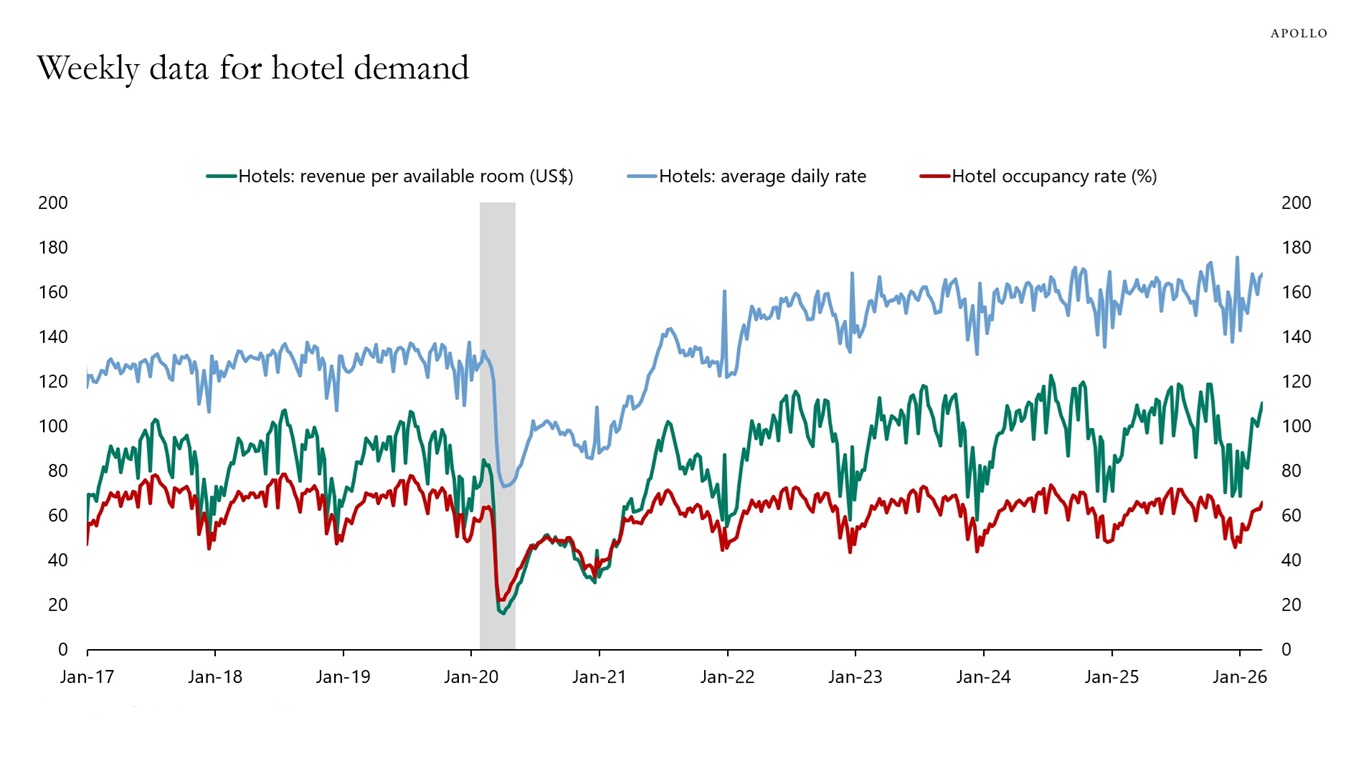
But there is a difference between what consumers are saying and what they are doing. The third, fourth and fifth charts below show that weekly data on consumer spending remain strong, daily data on airline travel remain strong and weekly data on hotel demand remain strong. A full review of all publicly available daily and weekly indicators shows no signs of demand destruction, see our chart book here.

Markets are overreacting to what will likely be a 4- to 6-week period of volatility, which will ultimately result in 50 years of stability in oil markets, supply chains and geopolitics. The Gulf region will become more stable and even more closely integrated with the global economy. For the Fed, the rise in inflation due to higher oil prices is temporary; once the conflict is over, Fed cuts will be priced in again, and long rates will decline.

The bottom line is that the Iran shock is not big enough to offset the strong tailwinds to the US economy from AI spending, the industrial renaissance and the One Big Beautiful Bill.

Consumer sentiment weaker across the income distribution
Sources: Morning Consult, Bloomberg, Macrobond, Apollo Chief Economist
Daily inflation from Truflation shows re-acceleration
Note: The Truflation US Inflation Index is a daily measure of US inflation based on data from over 30 sources, including major retailers like Amazon and Walmart, and real estate data from sources like Zillow. It tracks price changes from a consumer cost of living perspective across 12 spending categories and is differentiated from the traditional Consumer Price Index (CPI) by its daily updates, use of digital data and a methodology that leverages blockchain for immutability and decentralization. Sources: Truflation, Bloomberg, Macrobond, Apollo Chief Economist
Weekly data for same-store retail sales
Sources: Redbook Research Inc., Macrobond, Apollo Chief Economist
Daily data for US airport arrivals
Note: Airports included are ATL, LAX, DFW, MIA, ORD, DEN, IAD, SFO, MCO and JFK. Sources: CBP, Apollo Chief Economist
Weekly data for hotel demand
Sources: STR, Haver Analytics, Apollo Chief Economist

Download high-res chart book

Recent Posts

  • Understanding the Rise and Recent Fall in Gold Prices
  • Outlook for Public and Private Markets
  • $20 Bills Falling, $100 Bills Rising
  • 3% vs. 60%
  • Factors Driving Job Losses in Software

Recent Comments

No comments to show.

Archives

  • April 2026
  • March 2026
  • February 2026
  • January 2026
  • December 2025
  • November 2025
  • October 2025
  • September 2025
  • August 2025
  • July 2025
  • June 2025
  • May 2025
  • April 2025
  • March 2025
  • February 2025
  • January 2025
  • December 2024
  • November 2024
  • October 2024
  • September 2024
  • August 2024
  • July 2024
  • June 2024
  • May 2024
  • April 2024
  • March 2024
  • February 2024
  • January 2024
  • December 2023
  • November 2023
  • October 2023
  • September 2023
  • August 2023
  • July 2023
  • June 2023
  • May 2023
  • April 2023
  • March 2023
  • February 2023
  • January 2023
  • December 2022
  • November 2022
  • October 2022
  • September 2022
  • August 2022
  • July 2022
  • June 2022
  • May 2022
  • April 2022
  • March 2022
  • February 2022
  • January 2022
  • December 2021
  • November 2021

Categories

  • Apollo Answers
  • Course Introductions
  • Economic Intelligence
  • Hide from Wordpress Search
  • Investment Knowledge
  • Perspectives
  • Redirecting
  • The Daily Spark
  • The View from Apollo
  • The Weekly Brief
  • Uncategorized
  • White Papers

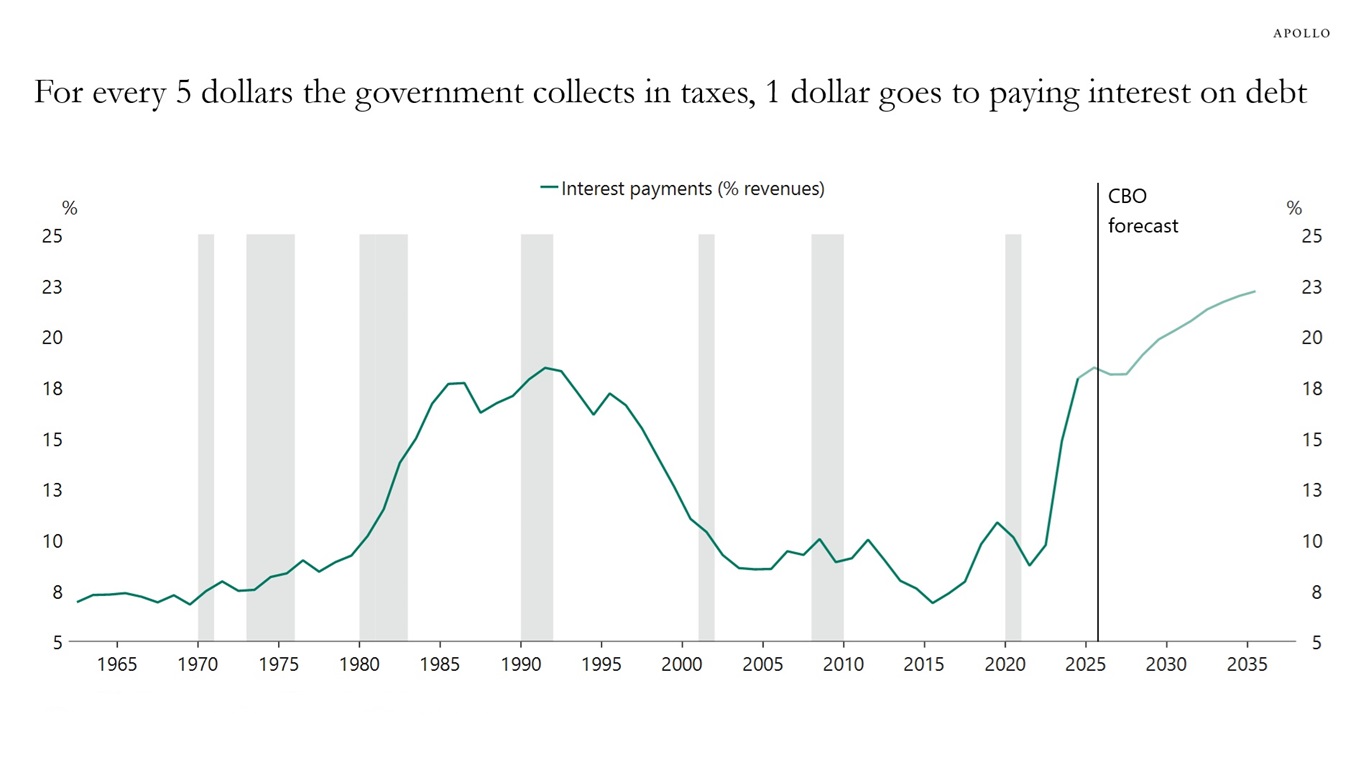
Debt Service Payments Rising

For every five dollars the government receives in tax revenue, one dollar is spent on servicing the national debt, see chart below.

For every 5 dollars the government collects in taxes, 1 dollar goes to paying interest on debt
Sources: US Congressional Budget Office (CBO), Macrobond, Apollo Chief Economist

Download high-res chart

Recent Posts

  • Understanding the Rise and Recent Fall in Gold Prices
  • Outlook for Public and Private Markets
  • $20 Bills Falling, $100 Bills Rising
  • 3% vs. 60%
  • Factors Driving Job Losses in Software

Recent Comments

No comments to show.

Archives

  • April 2026
  • March 2026
  • February 2026
  • January 2026
  • December 2025
  • November 2025
  • October 2025
  • September 2025
  • August 2025
  • July 2025
  • June 2025
  • May 2025
  • April 2025
  • March 2025
  • February 2025
  • January 2025
  • December 2024
  • November 2024
  • October 2024
  • September 2024
  • August 2024
  • July 2024
  • June 2024
  • May 2024
  • April 2024
  • March 2024
  • February 2024
  • January 2024
  • December 2023
  • November 2023
  • October 2023
  • September 2023
  • August 2023
  • July 2023
  • June 2023
  • May 2023
  • April 2023
  • March 2023
  • February 2023
  • January 2023
  • December 2022
  • November 2022
  • October 2022
  • September 2022
  • August 2022
  • July 2022
  • June 2022
  • May 2022
  • April 2022
  • March 2022
  • February 2022
  • January 2022
  • December 2021
  • November 2021

Categories

  • Apollo Answers
  • Course Introductions
  • Economic Intelligence
  • Hide from Wordpress Search
  • Investment Knowledge
  • Perspectives
  • Redirecting
  • The Daily Spark
  • The View from Apollo
  • The Weekly Brief
  • Uncategorized
  • White Papers

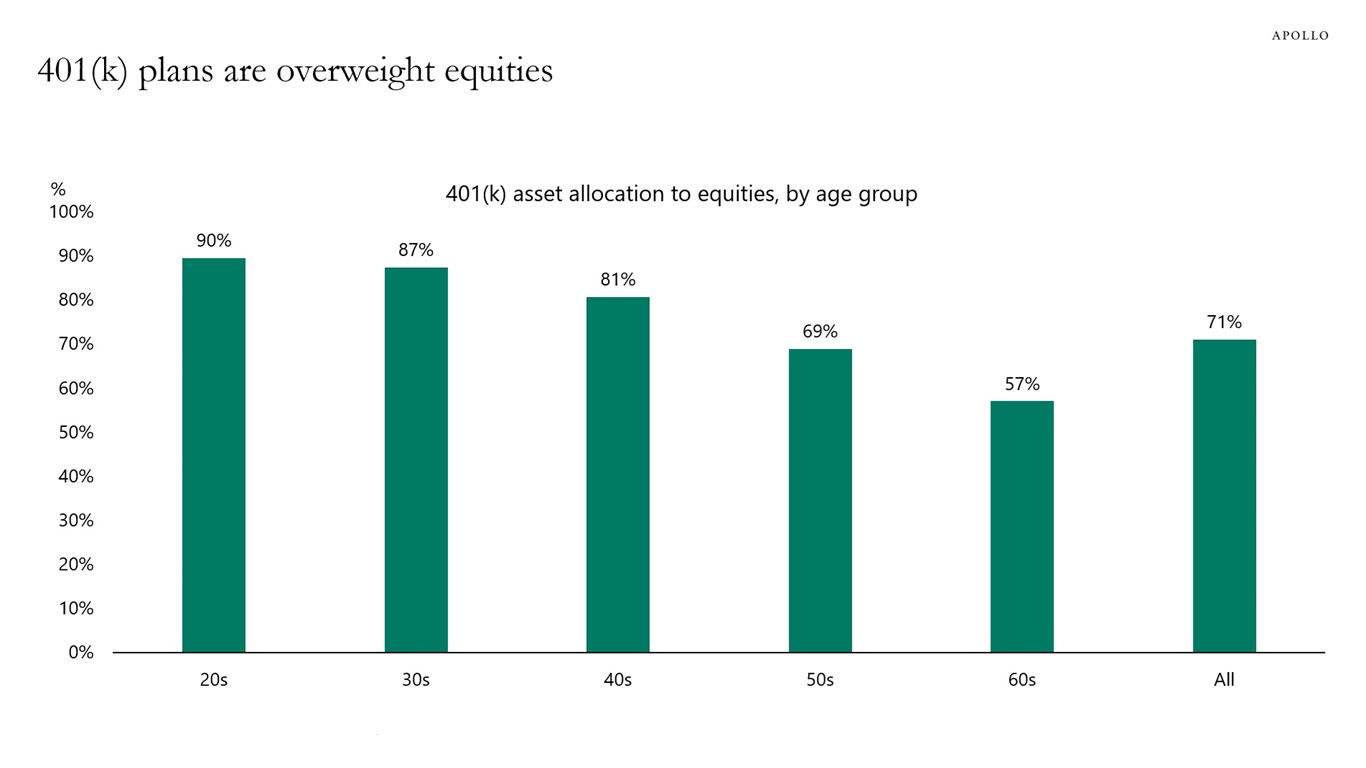
One Factor Driving All Returns

AI is driving returns in equity markets because of the growing size of tech in the S&P 500 index, and this is a problem for both institutional and individual investors, see chart below.

With hyperscalers issuing more debt, AI is increasingly also driving returns in bond markets.

And AI currently makes up 60% of investments in venture capital.

The bottom line is that there is one factor driving returns in portfolios, namely AI.

To avoid being overexposed to just one factor, asset allocation should deliberately increase exposure to sectors, regions and strategies whose fundamentals are less directly tied to AI.

401(k) plans are overweight equities
Note: Equities include equity funds, company stock and the equity portion of balanced funds. Sources: EBRI, ICI, Apollo Chief Economist

Download high-res chart

Recent Posts

  • Understanding the Rise and Recent Fall in Gold Prices
  • Outlook for Public and Private Markets
  • $20 Bills Falling, $100 Bills Rising
  • 3% vs. 60%
  • Factors Driving Job Losses in Software

Recent Comments

No comments to show.

Archives

  • April 2026
  • March 2026
  • February 2026
  • January 2026
  • December 2025
  • November 2025
  • October 2025
  • September 2025
  • August 2025
  • July 2025
  • June 2025
  • May 2025
  • April 2025
  • March 2025
  • February 2025
  • January 2025
  • December 2024
  • November 2024
  • October 2024
  • September 2024
  • August 2024
  • July 2024
  • June 2024
  • May 2024
  • April 2024
  • March 2024
  • February 2024
  • January 2024
  • December 2023
  • November 2023
  • October 2023
  • September 2023
  • August 2023
  • July 2023
  • June 2023
  • May 2023
  • April 2023
  • March 2023
  • February 2023
  • January 2023
  • December 2022
  • November 2022
  • October 2022
  • September 2022
  • August 2022
  • July 2022
  • June 2022
  • May 2022
  • April 2022
  • March 2022
  • February 2022
  • January 2022
  • December 2021
  • November 2021

Categories

  • Apollo Answers
  • Course Introductions
  • Economic Intelligence
  • Hide from Wordpress Search
  • Investment Knowledge
  • Perspectives
  • Redirecting
  • The Daily Spark
  • The View from Apollo
  • The Weekly Brief
  • Uncategorized
  • White Papers

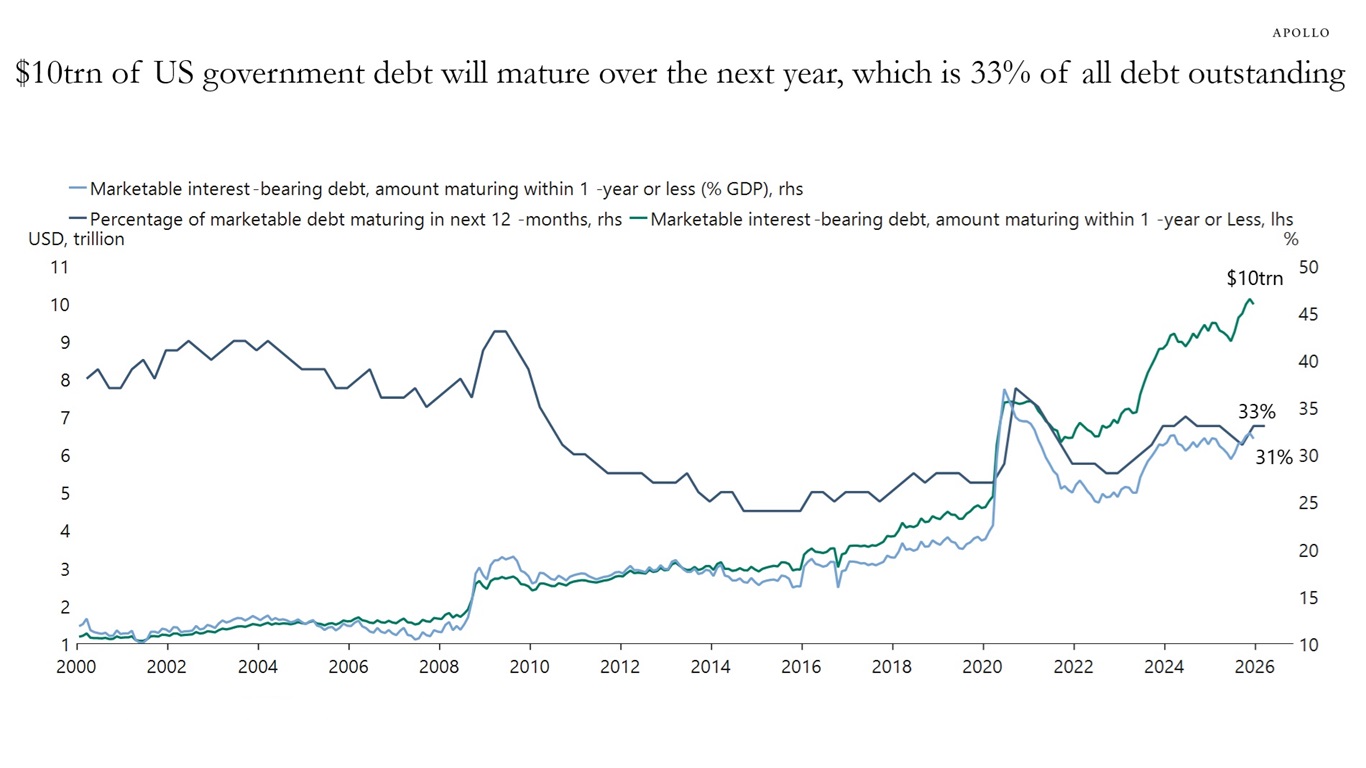
$14 Trillion in IG Supply Coming to the Market

Ten trillion dollars in existing US government debt will need to be refinanced over the coming 12 months, see chart below.

The budget deficit this year is about $2 trillion.

Total gross corporate bond issuance in 2026 is likely to be around $2 trillion because of increased supply from hyperscalers.

Adding it all up, the total amount of investment grade supply coming to the market this year is around $14 trillion.

The bottom line is that the growing supply of investment grade fixed income product is putting upward pressure on rates and credit spreads.

$10trn of US government debt will mature over the next year, which is 33% of all debt outstanding
Sources: US Department of Treasury, Macrobond, Apollo Chief Economist

Download high-res chart

Recent Posts

  • Understanding the Rise and Recent Fall in Gold Prices
  • Outlook for Public and Private Markets
  • $20 Bills Falling, $100 Bills Rising
  • 3% vs. 60%
  • Factors Driving Job Losses in Software

Recent Comments

No comments to show.

Archives

  • April 2026
  • March 2026
  • February 2026
  • January 2026
  • December 2025
  • November 2025
  • October 2025
  • September 2025
  • August 2025
  • July 2025
  • June 2025
  • May 2025
  • April 2025
  • March 2025
  • February 2025
  • January 2025
  • December 2024
  • November 2024
  • October 2024
  • September 2024
  • August 2024
  • July 2024
  • June 2024
  • May 2024
  • April 2024
  • March 2024
  • February 2024
  • January 2024
  • December 2023
  • November 2023
  • October 2023
  • September 2023
  • August 2023
  • July 2023
  • June 2023
  • May 2023
  • April 2023
  • March 2023
  • February 2023
  • January 2023
  • December 2022
  • November 2022
  • October 2022
  • September 2022
  • August 2022
  • July 2022
  • June 2022
  • May 2022
  • April 2022
  • March 2022
  • February 2022
  • January 2022
  • December 2021
  • November 2021

Categories

  • Apollo Answers
  • Course Introductions
  • Economic Intelligence
  • Hide from Wordpress Search
  • Investment Knowledge
  • Perspectives
  • Redirecting
  • The Daily Spark
  • The View from Apollo
  • The Weekly Brief
  • Uncategorized
  • White Papers

Posts navigation

Page 1 Page 2 … Page 4 Next page→
  • Privacy Notice
  • Terms of Use
  • Forward-Looking Statements
Apollo
© Apollo Global Management, Inc. All Rights Reserved.

The Apollo Academy is for informational and educational purposes only and nothing contained herein should be taken as investment advice or a recommendation to enter into any transaction. They are not an invitation by or on behalf of Apollo to any person to buy or sell any security or to adopt any investment strategy, and shall not form the basis of, nor may it accompany nor form part of, any right or contract to buy or sell any security or to adopt any investment strategy. There is no guarantee that the views and opinions expressed in this website will come to pass. For additional information, please see the disclaimers included in each piece of content or the legal page of our website here.